
Why Drugstore and Department Store Formulas Are Closer Than You Think
Price doesn't always predict performance in skincare. Here's what actually drives formulation quality — and where the gaps are real vs. perceived.
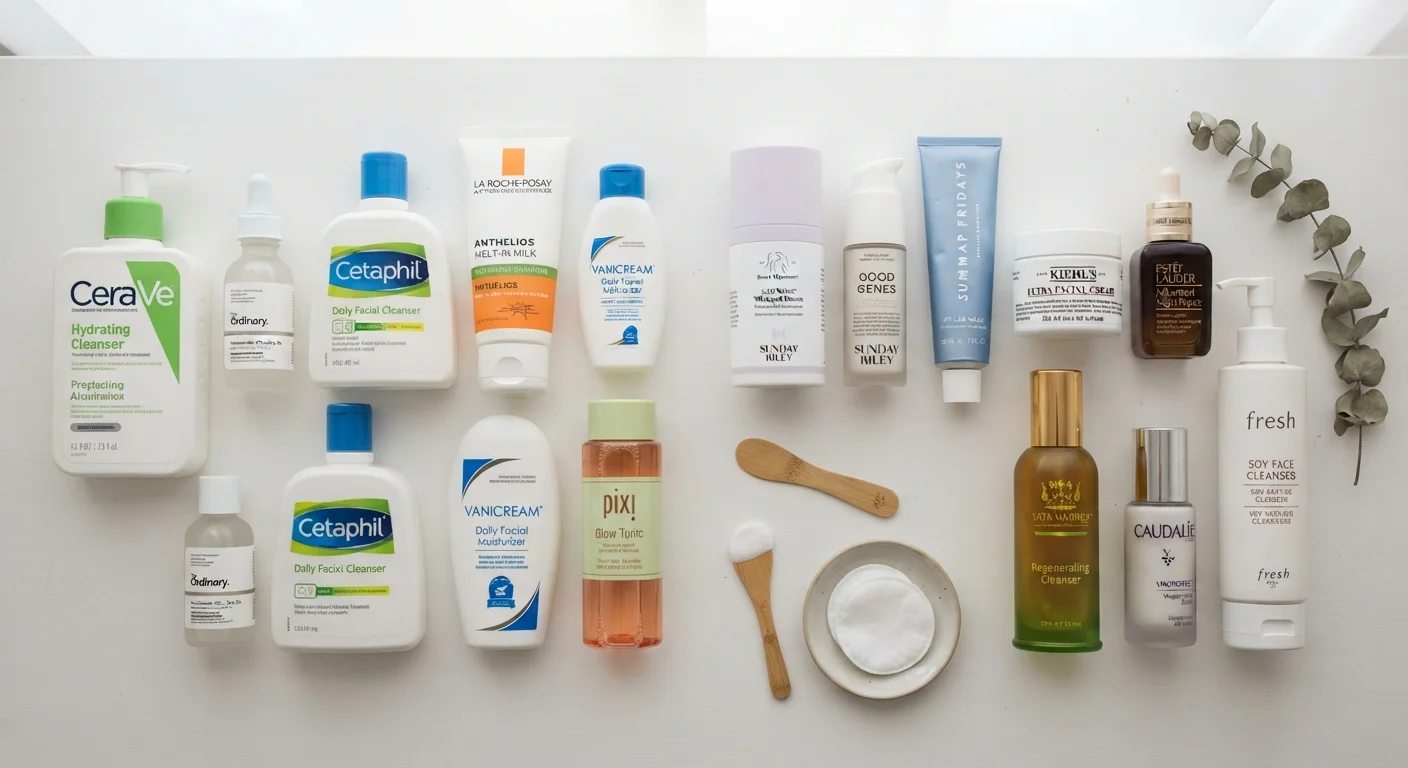
Photo: SaverSteals.com editorial
—— In This Article
Key Takeaways
- Many drugstore and department store formulas use identical active ingredients at comparable concentrations.
- Price differences often reflect packaging, marketing spend, and brand positioning — not formula complexity.
- A few real gaps exist: texture, fragrance profile, and certain proprietary delivery systems can differ meaningfully.
- Reading ingredient lists is a more reliable guide to efficacy than retail price or shelf placement.
- The most effective routine is one you'll actually use consistently, regardless of where you bought it.
What's Actually Inside the Bottle
Walk down any beauty aisle — physical or digital — and the price spread for a single moisturizer can run from $8 to $180. It's natural to assume that gap reflects what's in the formula. Often, it doesn't.
Most skincare products are built from the same catalog of cosmetic ingredients, regulated in the U.S. under FDA guidelines and required to list every component in descending order of concentration. That means a $12 drugstore serum and a $95 department store serum containing the same percentage of niacinamide are, chemically speaking, delivering the same active to your skin. The ingredient list is the most honest document on any beauty shelf — and learning to read it levels the playing field considerably.
The core workhorse ingredients — hyaluronic acid, glycerin, retinol, vitamin C derivatives, AHAs, BHAs, SPF filters — are widely available to formulators at every price tier. A cosmetic chemist working for a mass-market label sources from many of the same ingredient suppliers as a luxury house.
| Drugstore Formulas | Department Store Formulas | |
|---|---|---|
| Core active ingredients | Often identical (hyaluronic acid, retinol, niacinamide) | Often identical; may include proprietary variants |
| Delivery systems | Standard emulsions; straightforward absorption | May use encapsulation or time-release technology |
| Texture and sensory feel | Functional; occasionally less refined | Typically more refined; significant R&D investment |
| Fragrance complexity | Trending toward fragrance-free options | Often more complex scent profiles |
| Packaging | Practical; minimal | Premium materials; elaborate design |
| Price per ounce | Generally lower | Generally higher; reflects brand overhead |
| Clinical evidence of superiority | Comparable for standard actives | Limited independent evidence for premium claims |
Where the Price Gap Has Real Merit
That said, dismissing all price differences as pure marketing would be an overcorrection. A few areas genuinely do show variation between tiers.
Delivery Systems and Stability
Some higher-end formulas invest in encapsulated or time-release delivery systems designed to protect unstable ingredients — vitamin C (ascorbic acid) being a prime example — and improve penetration. Whether those systems translate into meaningfully better results on real skin is harder to prove, and independent comparative studies are limited.
Texture and Sensory Engineering
This is where luxury formulas often earn their premium most honestly. The way a product spreads, absorbs, and feels under makeup or throughout the day is a function of sophisticated emollients, silicones, and emulsifiers that require significant R&D investment. If you've ever preferred a department store moisturizer purely because it layered beautifully under foundation, that experience is real — even if the active ingredients are equivalent. For context on how finish matters in practice, see our guide to foundation finish types.
Fragrance and Allergen Profiles
Premium formulas sometimes use more complex fragrance compositions, which can be a draw or a drawback depending on your skin's sensitivity. Drugstore lines have increasingly moved toward fragrance-free options, which many dermatologists consider a plus for reactive skin types.
Don't Conflate 'Natural' With Safer or Better
Both drugstore and department store lines sometimes market 'clean' or 'natural' formulas as superior — but those terms aren't regulated by the FDA in cosmetics. A synthetic preservative can be safer and better-studied than a botanical alternative. Evaluate ingredients on their evidence profile, not their marketing positioning.
The Marketing Markup Is Very Real
Industry analysts have long noted that a significant portion of a prestige skincare product's retail price covers costs that have nothing to do with the formula: celebrity partnerships, print and digital advertising, elaborate packaging, counter real estate, and the aspirational positioning that makes a product feel premium. None of those factors affect what happens when the formula contacts your skin.
This dynamic isn't unique to beauty. Our broader look at store brands versus name brands shows the same pattern across consumer goods: private-label and mass-market products have closed the quality gap substantially, while brand premiums remain sticky.
~80%
Of skincare price attributed to non-formula costs
Cosmetic industry analysts and formulators commonly estimate that packaging, marketing, and retail placement account for the majority of a prestige product's retail price.
Top 5
Most common actives appear in both tiers
Ingredients like glycerin, hyaluronic acid, niacinamide, retinol, and SPF filters appear on ingredient lists across drugstore and department store products alike.
This doesn't mean prestige is a scam — it means the value is partly experiential and partly functional. Both are legitimate reasons to buy something. The problem arises when shoppers assume price signals efficacy and overlook equally effective options at lower price points.
Building a Routine That Actually Works
The most effective skincare routine is one you use consistently, with products that feel good on your skin, at a price point you can sustain. A $90 serum used sporadically will almost always underperform a $15 equivalent used every morning and evening.
A few practical principles help here. First, identify which steps in your routine involve active ingredients (retinol, vitamin C, exfoliating acids, SPF) — these are the categories where ingredient concentration matters most and where label-reading pays off. For a clear framework, our everyday skincare routine guide walks through which products do the heavy lifting and why order matters. Second, consider that actives don't work in isolation — layering matters too. The ingredient layering guide covers which combinations to embrace or avoid, regardless of which tier you're shopping.
There's also nothing wrong with mixing tiers. Many skincare enthusiasts use a drugstore cleanser and SPF alongside a mid-range or prestige treatment serum — prioritizing spend where they perceive the most difference for their individual skin. That's a perfectly rational approach, and it's worth noting that even online price comparisons can be deceptive when return policies and shipping costs aren't factored in.
Start With the Ingredient List
Before comparing prices, compare the first five to ten ingredients on the label — these represent the highest concentrations in the formula. If two products share the same key actives in similar positions on the list, they're likely to perform comparably. Paying more for a lower position on the shelf or a heavier jar is optional, not necessary.
This article is for general informational purposes only and is not a substitute for personalized skincare or medical advice. If you have a skin condition or concerns about ingredients, consult a board-certified dermatologist.

Style Editorial Team
Style Editorial Team is the collective byline for our editorial team and contributor network. Articles published under this byline or an editorial pen name are researched, written, and reviewed according to our editorial standards for clarity, consistency, and independence before publication.
View author profile