
Reading a Skincare Ingredient List Without a Chemistry Degree
INCI names, fragrance disclosures, and ingredient order — learn what a product label is actually telling you and what to look past.
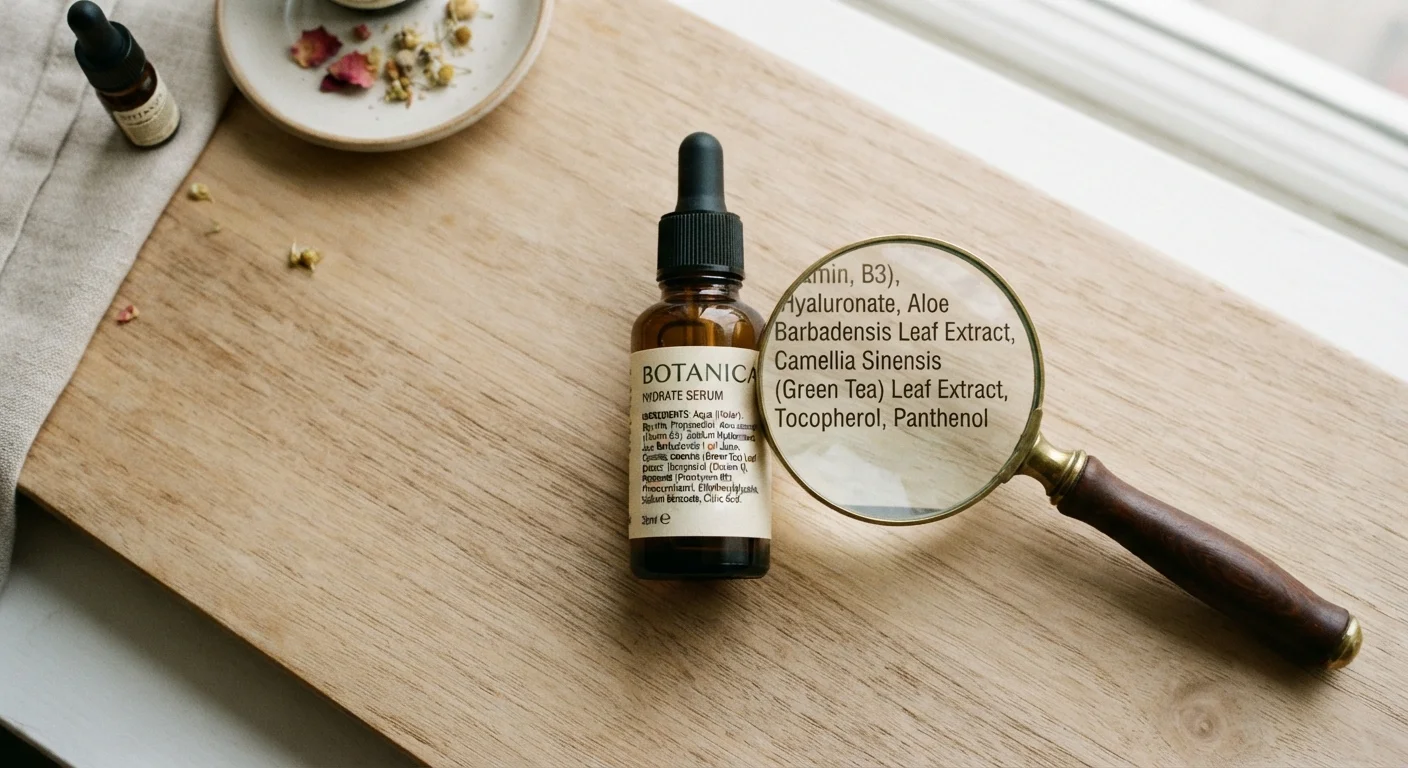
Photo: SaverSteals.com editorial
—— In This Article
Key Takeaways
- Ingredients are listed in descending order by concentration — the first few matter most.
- INCI names are standardized Latin or chemical terms used globally on all cosmetics labels.
- "Fragrance" or "parfum" is a legal catch-all that can cover many undisclosed compounds.
- Ingredients present at or below 1% concentration may be listed in any order.
- Marketing claims on the front of the package follow different — and looser — rules.
What You're Actually Looking At
Every skincare product sold in the U.S. must display its ingredients using INCI names — the International Nomenclature of Cosmetic Ingredients. These are standardized Latin or quasi-scientific terms adopted worldwide so that a moisturizer's label reads the same in Chicago as it does in Paris. That's why your gentle daily lotion lists Aloe barbadensis leaf juice instead of "aloe vera" and tocopherol instead of "vitamin E." The names look clinical, but they follow a consistent logic once you know the system.
The FDA requires cosmetics sold in the U.S. to follow this convention, and the ingredient list must appear in descending order of concentration. That single rule is the most useful thing you can bring to any label. Whatever appears first makes up the greatest share of what's in the jar.
If you've ever wondered whether the fancy active in a serum is doing real work or just earning its spot in the marketing copy, ingredient order is where you find your answer. For a broader look at how formulation quality actually breaks down across price points, see our piece on why drugstore and department store formulas are closer than you think.
What you will need
How to Read the List Step by Step
Follow these steps each time you pick up a new product. With a little practice, scanning a label takes under a minute.
Start at the Top — Identify the Base Ingredients
The first three to five ingredients typically make up the bulk of the formula — often 70–95% by weight. Common base ingredients include water (aqua), glycerin, or various oils. These set the texture and delivery system. If water is first and the rest are emollients and humectants, you're looking at a lotion or cream structure.
Locate the Active Ingredients
Scan the middle section of the list for ingredients you recognize as active — acids, antioxidants, peptides, or skin-identical compounds. These often appear after the base but before the preservatives. Their position relative to other ingredients gives you a rough sense of dose, though exact percentages are rarely disclosed on the label.
Find the 1% Threshold Marker
U.S. regulations allow ingredients present at or below 1% concentration to be listed in any order after those above 1%. Preservatives (like phenoxyethanol or sodium benzoate) and some fragrance components typically fall here. Spotting where preservatives begin can help you identify roughly where the sub-1% zone starts — everything after that point is present in very small amounts.
Check for Fragrance and Potential Sensitizers
Look for the word fragrance or parfum anywhere in the list. Also scan for known sensitizers such as essential oils (e.g., limonene, linalool, eugenol), which EU regulations require to be disclosed separately when above certain thresholds — though U.S. rules are less stringent. If you have sensitive skin, note their position; higher up means higher concentration.
Cross-Reference Unfamiliar Names
If a name stumps you, search it on a reputable cosmetic ingredient database. Many intimidating INCI names are simply the Latin names for everyday substances — Butyrospermum parkii is shea butter, Rosa canina fruit oil is rosehip oil. A quick lookup demystifies most entries within seconds. For food label decoding by comparison, see reading ingredient lists without getting confused by chemical-sounding names.
The Fine Print: Fragrance, Allergens, and Marketing Claims
Two areas of a label deserve extra attention beyond the ingredient list itself.
The Fragrance Loophole
"Fragrance" (or its international equivalent, parfum) is a protected trade-secret term in U.S. cosmetics regulation. A single entry can represent a proprietary blend of many individual compounds — some of which are common sensitizers. If you have reactive or sensitive skin, fragrance-free products — not just "unscented" ones — are worth seeking out. Unscented products may still contain masking fragrances.
"Fragrance-Free" vs. "Unscented" — Not the Same
"Fragrance-free" means no fragrance compounds were added. "Unscented" may still contain masking agents that neutralize odor without adding a perceptible scent — those agents are still fragrance compounds. If fragrance sensitivity is a concern, look specifically for "fragrance-free" on the label and confirm by checking the ingredient list for the absence of "fragrance" or "parfum."
Front-of-Package Claims
Words like "natural," "clean," "non-toxic," and "dermatologist-tested" are largely unregulated marketing terms in the U.S. cosmetics space. They reflect the brand's positioning, not a federally verified standard. The ingredient list on the back is the only part of the label that has regulatory teeth. For a parallel look at how this plays out on food packaging, the same principle applies — see what the nutrition facts label is actually telling you.
Use the Ingredient List, Not the Claims Panel
When evaluating a new product, flip it over before reading the front. The ingredient list is the only part of the label that carries regulatory weight in the U.S. Front-of-package claims like "clean," "natural," and "gentle" are unregulated marketing language — the ingredient list tells you what's actually inside.
If you're building a routine around specific actives — say, retinol — understanding label literacy helps you evaluate whether a product delivers a meaningful dose. Our guide on retinol: what it does, who it's for, and why patience is non-negotiable walks through what to look for. And once you understand your skincare ingredients, pairing them in the right order matters too — the everyday skincare routine: cleanser, moisturizer, SPF explains why sequence makes a real difference.
This article is for general informational and educational purposes only. It is not a substitute for professional dermatological or medical advice. If you have a skin condition, allergy, or sensitivity, consult a qualified healthcare provider before changing your skincare routine.

Style Editorial Team
Style Editorial Team is the collective byline for our editorial team and contributor network. Articles published under this byline or an editorial pen name are researched, written, and reviewed according to our editorial standards for clarity, consistency, and independence before publication.
View author profile