
The Household Supplies Worth Buying in Bulk—and the Ones That Aren't
Bulk buying saves money on the right items, but some products degrade, expire, or take up space without real benefit. Here's how to decide.
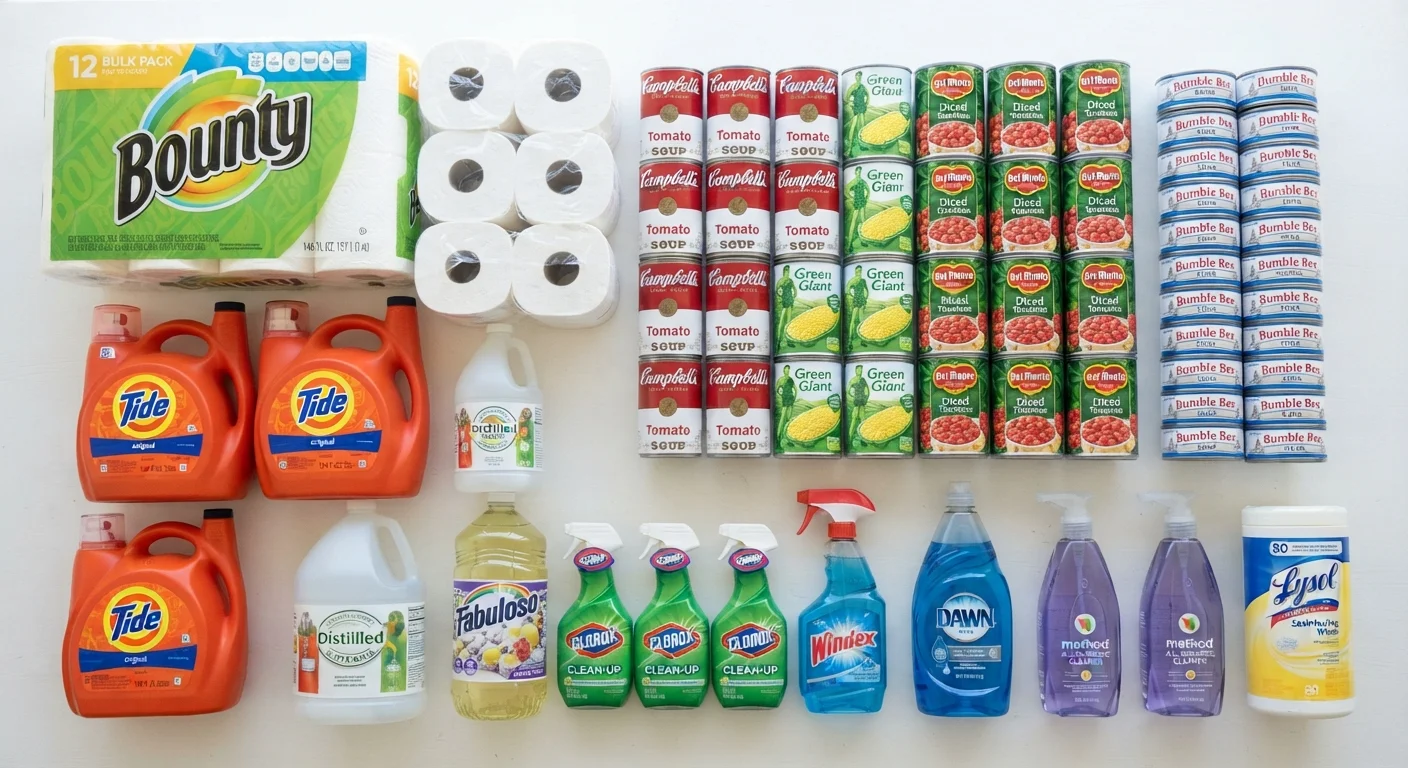
Photo: SaverSteals.com editorial
—— In This Article
Key Takeaways
- Non-perishable, high-use items like toilet paper and laundry detergent are reliably good bulk purchases.
- Products with short shelf lives, volatile formulas, or variable usage rates often cost more in bulk than they save.
- Storage space, household size, and usage rate should drive bulk-buying decisions as much as unit price.
- Some cleaning products degrade over time, making large quantities wasteful even if the price per unit looks attractive.
- Bulk buying only saves money when you actually use everything you buy before it expires or loses effectiveness.
Why Bulk Buying Isn't Automatically Smart
The math on bulk buying looks compelling at face value: pay less per unit, reduce shopping trips, never run out of essentials. Warehouse clubs and big-box retailers have built entire business models on this psychology. But the savings only materialize if you use what you buy before it degrades, expires, or takes over your closet.
For practical guidance on when the bulk mentality genuinely pays off across broader categories, see our pantry stocking guide. The principles there apply directly here: usage rate, shelf stability, and storage cost are the real variables — not the sticker price.
Household supplies fall into two honest camps: items that are chemically stable, consumed regularly, and storage-friendly; and items that degrade, go unused, or take up space disproportionate to any savings. Knowing which is which before loading the cart is the entire game.
Supplies That Genuinely Reward Bulk Purchasing
Certain products check every box: long shelf life, consistent usage across any household size, and no quality degradation over time. These are safe bulk buys for most households.
Toilet Paper and Paper Towels
These are arguably the clearest bulk-buy case in the household category. They don't expire, compress well for storage, and consumption is predictable. If you're weighing paper versus cloth alternatives, our paper towels vs. cloth towels comparison is worth reading first — but if paper towels are your standard choice, buying more at once rarely backfires.
Laundry Detergent (Liquid or Pod)
Powder detergent is among the most shelf-stable cleaning products available, making it an easy bulk purchase. Liquid detergent and pods are also stable for at least 12–18 months when stored properly. Given that laundry happens in virtually every household on a regular cadence, bulk quantities are usually consumed well within that window.
Dish Soap and Hand Soap
Both are used daily and have shelf lives of two or more years. Refill-format bulk purchases — large containers used to refill smaller pump bottles — are especially efficient on space.
Trash Bags, Aluminum Foil, and Plastic Wrap
These consumables have indefinite shelf lives and compact packaging. Usage is steady and predictable. Buying in volume here is almost always a straightforward win.
| Buy in Bulk | Buy in Standard Quantities | |
|---|---|---|
| Shelf life | Long (2+ years, stable) | Short or variable (under 12 months) |
| Usage frequency | Daily or weekly | Occasional or seasonal |
| Storage footprint | Compact or well-managed | Large, awkward, or hazardous |
| Formula stability | Chemically stable over time | Degrades, loses potency, or changes |
| Scented or specialty | Unscented, standard formulas | Scented, seasonal, or specialty |
| Example products | Toilet paper, laundry detergent, trash bags | Disinfectant spray, scented candles, drain cleaner |
Supplies That Don't Reward Bulk Buying
The case against bulk buying is less obvious but just as real. These categories look like savings opportunities but frequently disappoint.
Cleaning Sprays and Disinfectants
Many multi-surface sprays and disinfectants have active ingredients — such as hydrogen peroxide or quaternary ammonium compounds — that lose potency within 12 to 24 months of manufacture, sometimes sooner once opened. Buying a two-year supply only makes sense if you'll actually use it in time. Our household cleaning myths article covers related misconceptions about how cleaning products actually work. And before storing large quantities of cleaners together, review which combinations to avoid — our guide on cleaning products you should never mix covers the safety essentials.
Specialty or Seasonal Cleaners
Oven cleaner, drain openers, and similar specialty products are used infrequently by most households. Buying in bulk means storing a product for months or years, often in a form that can degrade or become a safety hazard. Standard single-use quantities are more appropriate here.
Scented Products (Candles, Air Fresheners, Fabric Softener)
Fragrance degrades. Scented candles lose throw, liquid air fresheners lose potency, and scented fabric softener can smell off after 12–18 months. Buying large quantities of any scented product is a common source of quiet waste — especially if preferences change.
Medications and Health Products
Over-the-counter medications, vitamins, and supplements all carry expiration dates for a reason: active ingredient concentrations decline over time. Buying in bulk risks having products become less effective — or having to discard large quantities. Consult a healthcare professional about any supplement or medication decisions; this article provides general shopping guidance only.
Bulk Storage Can Create Safety Hazards
Large quantities of cleaning products stored together — especially in a garage, basement, or under-sink cabinet — increase the risk of accidental mixing, spills, or exposure. Make sure products are sealed, clearly labeled, and stored away from heat sources and out of reach of children. Never stockpile more than you have space to store safely.
How to Evaluate Any Item Before Buying in Bulk
Rather than memorizing a fixed list, use these four questions to evaluate any household supply before committing to a large quantity:
- What is the realistic shelf life? Check the manufacturer's guidance, not just your intuition. A product with an 18-month shelf life only makes sense in bulk if your household will consume it within that window.
- How consistently do you use it? If you only use something occasionally, a bulk purchase can sit for years. If you reach for it daily or weekly, bulk quantities make mathematical sense.
- Where will you store it? Storage isn't free. If a bulk purchase occupies a significant amount of space for a minor per-unit saving, the math is often closer than it appears. Convenience packaging costs cut the other way, but space costs are real too.
- Are you buying it because you need it, or because it's on offer? Structured shopping — knowing what you actually need before you shop — consistently outperforms impulse volume buying. Our look at shopping with a list versus by feel breaks down why this matters in practice.
Track What You Actually Use
Before committing to a bulk purchase, spend one month noting how quickly you go through a product. A rough usage rate — even just 'one bottle per month' — is far more reliable than guessing. It also reveals whether a bulk format will realistically be used up before any expiration or degradation window closes.
For general budget and savings strategy, the principles discussed in our saving and debt hub apply directly to household purchasing decisions.

Shopping Editorial Team
Shopping Editorial Team is the collective byline for our editorial team and contributor network. Articles published under this byline or an editorial pen name are researched, written, and reviewed according to our editorial standards for clarity, consistency, and independence before publication.
View author profile