
Flying With Medications: Rules, Packing, and What to Declare
General guidance on TSA rules for prescription and over-the-counter medications, documentation, and what to know at security checkpoints.
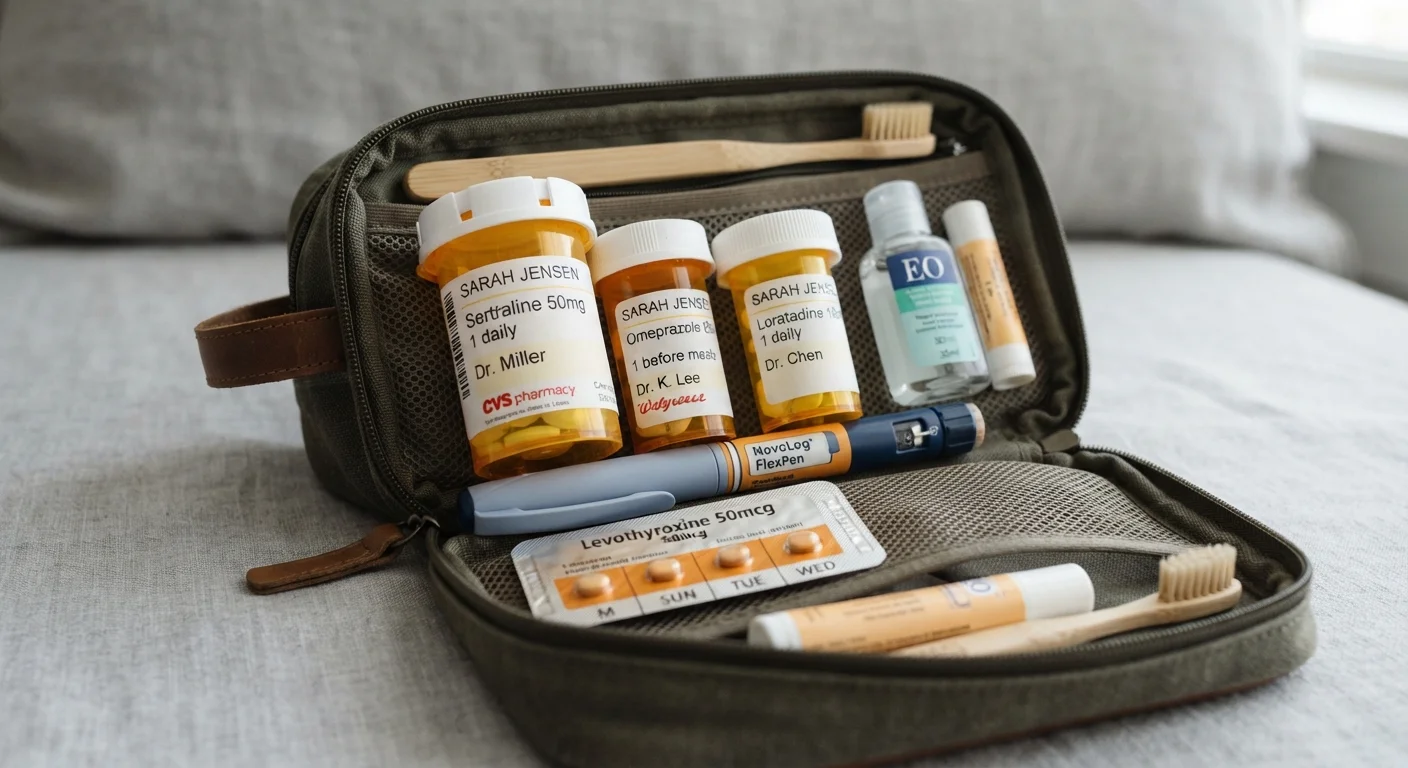
Photo: SaverSteals.com editorial
—— In This Article
Key Takeaways
- TSA allows both prescription and over-the-counter medications in carry-on and checked bags.
- Liquid medications are exempt from the 3-1-1 rule but must be declared separately at screening.
- Keeping medications in original labeled containers helps avoid delays at security.
- International travelers should verify destination-country rules before packing controlled substances.
- Always carry enough medication for your full trip plus a buffer in case of delays.
What TSA Actually Allows
The Transportation Security Administration (TSA) permits passengers to bring both prescription and over-the-counter medications in carry-on and checked bags — with no strict quantity limit for solid forms like pills and tablets. There is no federal requirement to carry a prescription label at domestic checkpoints, though having one makes the process smoother.
Liquid medications — including cough syrup, eye drops, and insulin — are exempt from the standard 3-1-1 liquids rule that limits containers to 3.4 ounces. However, you must declare them to a TSA officer at the checkpoint and present them separately for inspection. TSA may ask you to open containers, so keep lids accessible.
For more on what else counts as a liquid under TSA rules, see our breakdown of common airport myths.
Needles, Syringes, and Medical Devices
TSA permits syringes, lancets, and auto-injectors in carry-on bags when accompanied by the medication they're used to administer. Sharps containers are also allowed. Notify the TSA officer before screening begins if you're carrying any of these items. Medical devices such as CPAP machines or portable nebulizers are generally permitted as carry-on items and typically do not count against your carry-on bag limit, though airline policies vary — confirm with your carrier before you fly.
Packing Practices That Reduce Checkpoint Friction
How you pack medications matters as much as what you bring. A few habits that prevent unnecessary delays:
Keep medications in their original pharmacy-labeled containers whenever possible.
Original containers display the medication name, your name, prescribing provider, and dosage — information that quickly resolves screener questions. Pill organizers are permitted but may trigger additional screening.
Pack all essential medications in your carry-on bag, not your checked luggage.
Checked bags can be delayed, lost, or misrouted. If your medication is critical to your health — especially for chronic conditions — losing access to it mid-trip poses a serious risk.
Bring a written medication list with generic and brand names, doses, and your provider's contact information.
If a medication is lost or damaged during travel, a local pharmacy or urgent care provider needs to know exactly what you take. Generic names are particularly useful internationally, where brand names differ.
Pack a buffer supply beyond your expected trip length.
Flight delays, extended stays, or return travel disruptions can stretch a trip beyond its planned dates. Running out of a critical medication while traveling is avoidable with simple forward planning.
Store temperature-sensitive medications properly and declare any cooling accessories at screening.
Medications like insulin or certain biologics can degrade if exposed to heat or freezing temperatures. Insulated pouches with gel ice packs are permitted by TSA, though ice packs must be fully frozen when screened.
If you're still sorting out what goes in your carry-on versus your checked bag overall, our carry-on vs. checked bag guide covers the full decision framework.
Documentation, Declarations, and International Travel
For domestic US flights, formal documentation isn't legally required, but carrying a copy of your prescription or a letter from your prescribing provider is strongly advisable for controlled substances (such as opioids, benzodiazepines, or stimulants). A provider letter that includes your diagnosis, medication name, dosage, and prescriber contact can prevent significant delays if a screener has questions.
International travel adds an additional layer of complexity. Some countries classify medications that are legal in the US as controlled or even prohibited substances. Before flying internationally with any controlled medication, verify the destination country's import rules through that nation's embassy or official government health authority — rules vary widely and can change. The US Department of State's country information pages are a useful starting point, but always confirm directly with the destination country.
“Travelers carrying medications — especially controlled substances — should research destination-country requirements well in advance. What is legally prescribed at home may be classified differently abroad, and customs rules are enforced independently of US law.”
— US Department of State, Federal agency providing international travel guidance for US citizens
For a complete pre-trip checklist that includes medication refills and documentation, see our domestic travel preparation checklist.
Quick Actions Before Your Next Flight
Whether you're flying next week or next month, a handful of simple steps now can prevent real problems at the airport.
If you have TSA PreCheck, your medication screening experience may be slightly faster — though you'll still need to declare liquid medications. Learn more about how TSA PreCheck and Global Entry work if you travel frequently.
This article provides general travel information only and is not medical or legal advice. Rules and regulations are subject to change; verify current requirements with the TSA, your airline, and relevant government authorities before you travel.

Travel Editorial Team
Travel Editorial Team is the collective byline for our editorial team and contributor network. Articles published under this byline or an editorial pen name are researched, written, and reviewed according to our editorial standards for clarity, consistency, and independence before publication.
View author profile