
Accessories as a Style Tool: What They Add (and When They Clutter)
Accessories can pull an outfit together or overwhelm it. A balanced look at how accessories function, what they contribute, and when to hold back.
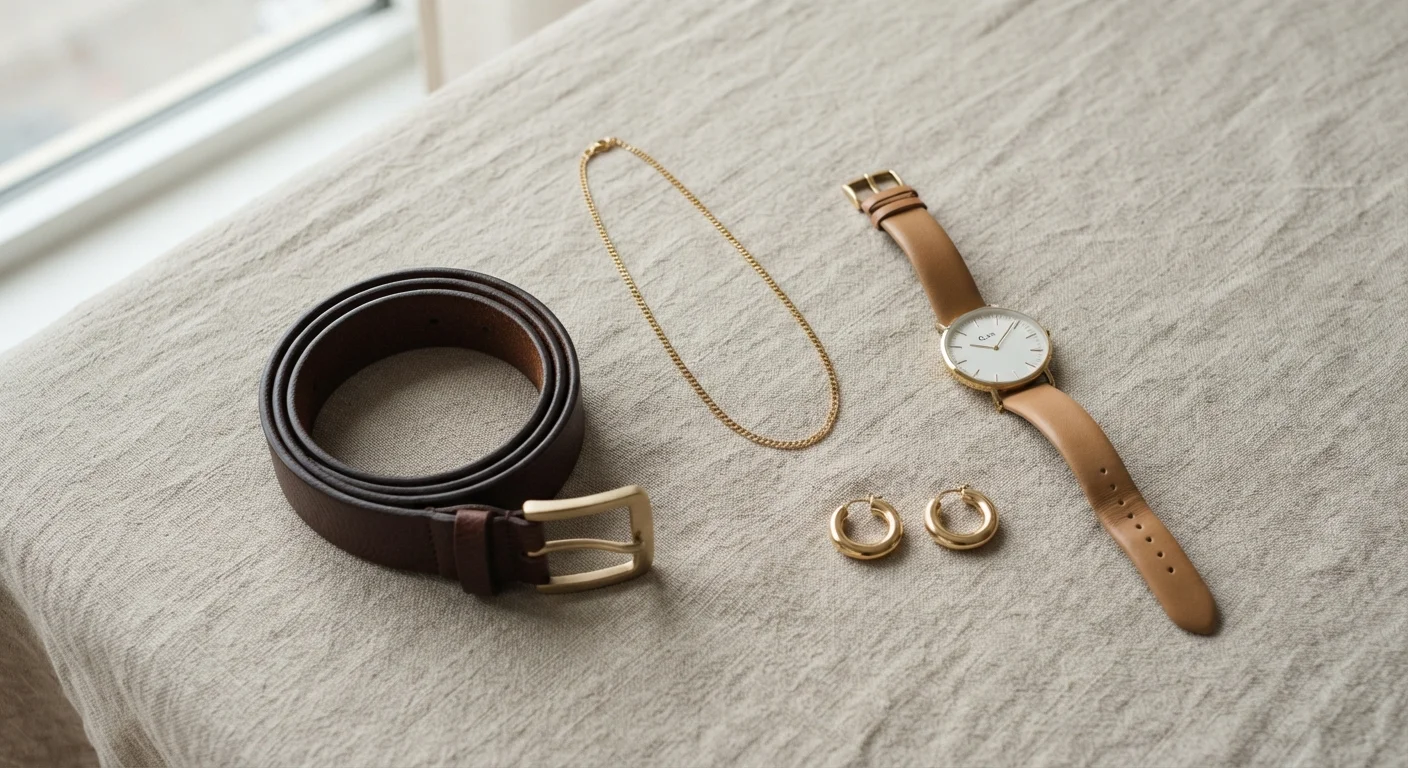
Photo: SaverSteals.com editorial
—— In This Article
Key Takeaways
- Accessories can transform a basic outfit into something that feels intentional and complete.
- Wearing too many at once often creates visual noise rather than impact.
- Choosing accessories based on outfit proportion and occasion context matters more than trend.
- A single statement piece generally works better than several competing ones.
- Editing down — removing one thing before you leave — is a widely used stylist technique.
Shifts an outfit's tone without changing clothes
A single accessory swap — switching a casual belt for a structured one, or flat shoes for heeled boots — can move an outfit between contexts like casual, professional, or evening without requiring a full change of clothing.
Adds visual interest to simple or neutral outfits
Monochromatic or minimalist outfits benefit significantly from one well-placed accessory that introduces texture, color, or detail — without overwhelming the clean foundation.
Defines and reshapes perceived silhouette
Belts, structured bags, and certain jewelry styles direct the eye and create proportion — a technique that works regardless of body shape or outfit construction.
Extends the versatility of existing wardrobe pieces
Accessories allow a single clothing item to serve multiple functions — the same blazer reads differently with a silk scarf versus a chunky chain, effectively multiplying outfit options without adding garments.
More budget-accessible than buying new clothing
A well-chosen accessory often costs significantly less than a new garment but delivers a comparable style update, making it a cost-effective lever for refreshing a wardrobe.
Too many pieces create visual noise, not impact
When multiple bold accessories compete simultaneously, each one loses its ability to draw the eye — the overall effect becomes busy rather than intentional, which tends to undermine the outfit.
Wrong scale clashes with outfit complexity
Heavily detailed or patterned clothing paired with statement accessories creates a visual conflict; the pieces fight rather than support each other, making the total look harder to read.
Occasion mismatch creates awkwardness
Accessories carry strong contextual signals — heavy jewelry at a casual outdoor event or minimal accessories at a formal occasion can both feel off, undermining an otherwise well-assembled outfit.
Can accumulate into clutter and decision fatigue
A large, disorganized accessories collection can make getting dressed slower and more stressful rather than easier — more options don't always translate to better outcomes. Our article on wardrobe habits that complicate daily dressing covers this broader pattern.
What Accessories Actually Do for an Outfit
An accessory isn't decoration layered on top of an outfit — it's a functional styling element that changes proportion, draws the eye, and communicates tone. A wide belt cinched at the waist redefines silhouette. A delicate necklace at a specific neckline adds refinement without weight. A structured bag in a contrasting color becomes a visual anchor for an otherwise neutral look.
Accessories also signal context. The same dark jeans and white shirt reads as casual with sneakers and a canvas tote, business-adjacent with loafers and a structured shoulder bag, and evening-ready with heeled mules and statement earrings. The clothing hasn't changed — the accessories are doing the communicating.
This is why stylists often treat accessories as the final layer of an outfit rather than an afterthought. They're calibrating, not decorating. If you want to explore how outfit-building works more broadly, our guide to building outfits from what you already own walks through the full process.
Shifts an outfit's tone without changing clothes
A single accessory swap — switching a casual belt for a structured one, or flat shoes for heeled boots — can move an outfit between contexts like casual, professional, or evening without requiring a full change of clothing.
Adds visual interest to simple or neutral outfits
Monochromatic or minimalist outfits benefit significantly from one well-placed accessory that introduces texture, color, or detail — without overwhelming the clean foundation.
Defines and reshapes perceived silhouette
Belts, structured bags, and certain jewelry styles direct the eye and create proportion — a technique that works regardless of body shape or outfit construction.
Extends the versatility of existing wardrobe pieces
Accessories allow a single clothing item to serve multiple functions — the same blazer reads differently with a silk scarf versus a chunky chain, effectively multiplying outfit options without adding garments.
More budget-accessible than buying new clothing
A well-chosen accessory often costs significantly less than a new garment but delivers a comparable style update, making it a cost-effective lever for refreshing a wardrobe.
When Accessories Start Working Against You
The tipping point between polished and cluttered is easier to cross than most people expect. It usually happens when multiple accessories compete for the same visual real estate — chunky rings and a bold bracelet and a statement necklace and a printed scarf all in one look. Each piece may be great on its own. Together, they cancel each other out.
Occasion mismatch is another common issue. Heavy accessories in relaxed settings can feel effortful in a way that reads as awkward rather than stylish. Conversely, very minimal accessories in a formal context can leave an outfit looking unfinished. Reading the room — or the event — matters as much as the pieces themselves.
Volume and scale clash with outfit complexity too. A dress with intricate pattern-work or elaborate seaming already has a lot going on visually. Pairing it with bold accessories adds competing elements rather than reinforcing them. This connects to the same logic behind pattern mixing: contrast works when it's controlled, not when everything is loud at once.
Too many pieces create visual noise, not impact
When multiple bold accessories compete simultaneously, each one loses its ability to draw the eye — the overall effect becomes busy rather than intentional, which tends to undermine the outfit.
Wrong scale clashes with outfit complexity
Heavily detailed or patterned clothing paired with statement accessories creates a visual conflict; the pieces fight rather than support each other, making the total look harder to read.
Occasion mismatch creates awkwardness
Accessories carry strong contextual signals — heavy jewelry at a casual outdoor event or minimal accessories at a formal occasion can both feel off, undermining an otherwise well-assembled outfit.
Can accumulate into clutter and decision fatigue
A large, disorganized accessories collection can make getting dressed slower and more stressful rather than easier — more options don't always translate to better outcomes. Our article on wardrobe habits that complicate daily dressing covers this broader pattern.
A Practical Framework for Editing Your Accessories
One approach that many stylists describe: dress completely, then assess each accessory individually. Ask what each piece is contributing — contrast, proportion, polish, color — and whether it's doing that job or simply adding more. If an accessory isn't actively improving the look, that's useful information.
The "One Thing" Edit in Practice
Before leaving the house, take a full-length look and identify the dominant accessory — the piece doing the most visual work. Then evaluate everything else against it. If a second piece is reinforcing the first (matching metal tones, echoing a color), it's likely earning its place. If it's just adding more, removing it will usually sharpen the overall look. This isn't a rule — it's a quick gut-check that takes about thirty seconds.
The classic "remove one thing" rule, often attributed broadly to French styling conventions, isn't about minimalism for its own sake. It's about ensuring that what remains is intentional. Sometimes that means removing a necklace; sometimes it means swapping three thin bracelets for one with more presence.
Proportion is the most reliable guide. Large-scale clothing — wide-leg trousers, oversized blazers, voluminous skirts — tends to support bolder or more substantial accessories. Fitted, streamlined silhouettes often pair better with smaller, cleaner pieces. This principle complements the broader guidance in our body-shape dressing article, which also addresses how proportion affects overall appearance.
1 statement piece
Typical stylist recommendation per look
Fashion educators and professional stylists widely advise anchoring an outfit around a single focal accessory rather than distributing attention across several, though personal style varies.
~65%
Shoppers who say accessories refresh outfits affordably
Consumer surveys on fashion spending consistently find that accessories rank among the most cost-effective methods for updating an existing wardrobe without purchasing new garments.

Style Editorial Team
Style Editorial Team is the collective byline for our editorial team and contributor network. Articles published under this byline or an editorial pen name are researched, written, and reviewed according to our editorial standards for clarity, consistency, and independence before publication.
View author profile