
Unit Price Math: The Shelf Tag Number Most Shoppers Ignore
Unit prices reveal the true cost of any product. Learn how to read them, calculate your own, and use them to stretch every grocery dollar further.
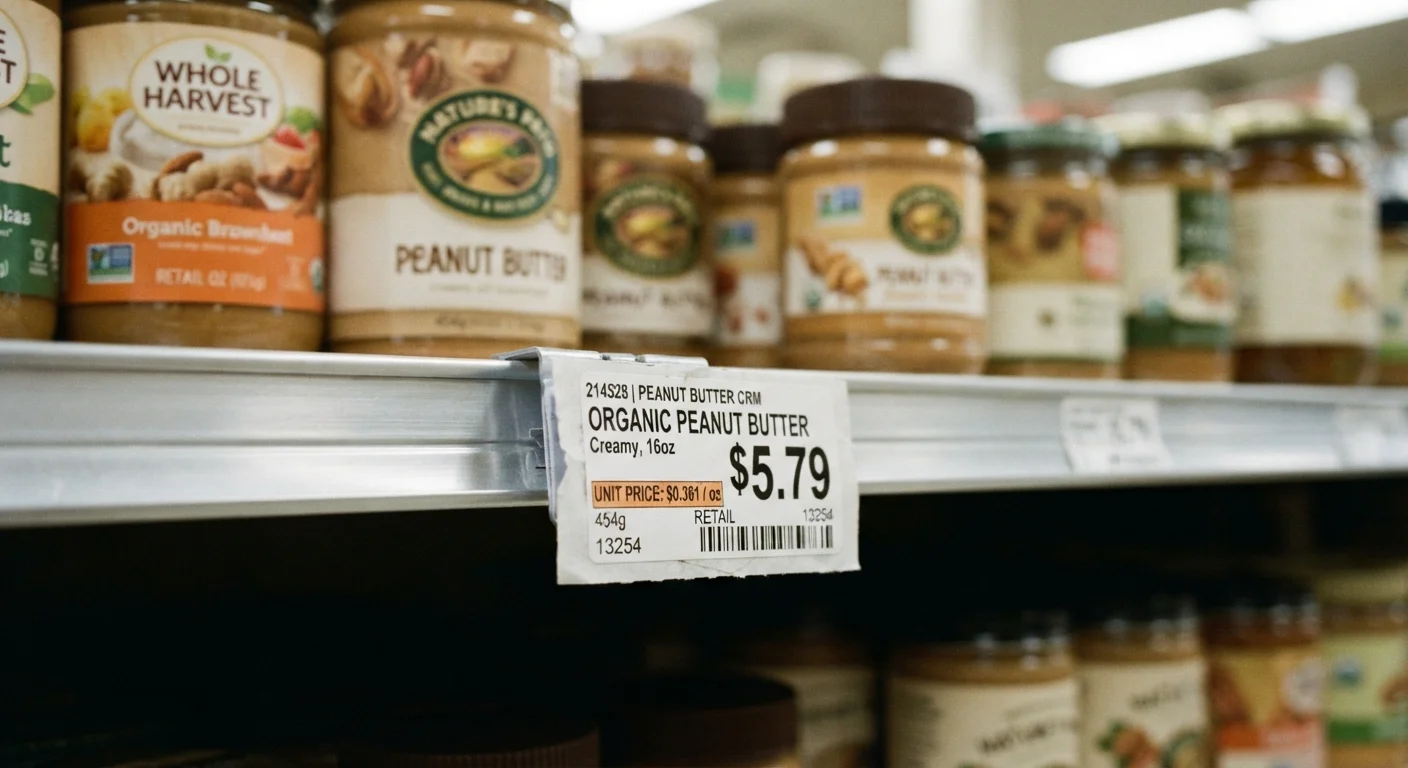
Photo: SaverSteals.com editorial
—— In This Article
Key Takeaways
- Unit price reveals the true cost per measurement, not just the sticker price of a package.
- Bigger packages are not always cheaper per unit — size assumptions can cost you money.
- You can calculate unit price yourself by dividing total price by the quantity or weight.
- Sale prices don't automatically beat everyday unit prices of a competing product.
- Comparing unit prices only works when the unit of measure is the same across products.
The Number Hiding in Plain Sight
The large price printed on a shelf tag answers one question: what does this specific package cost? The small number — the unit price — answers a more useful one: what am I actually paying per ounce, per sheet, or per serving?
Most shoppers focus on the big number. That's understandable; it's designed to be seen. But comparing total prices across different package sizes is like comparing apples and oranges. A 16-oz jar at $3.49 and a 24-oz jar at $4.99 can't be sensibly compared without reducing both to the same denominator. Unit pricing does exactly that.
The math is straightforward: divide the total price by the quantity. In the example above, the 16-oz jar costs roughly $0.218 per ounce. The 24-oz jar costs about $0.208 per ounce. The larger jar wins — but only by a cent per ounce. If you don't need 24 ounces before the product expires, that 'savings' disappears into the trash.
Keep a Calculator Handy at the Store
Your phone's default calculator is all you need. When shelf tags lack unit prices or use inconsistent units, divide total price by package size on the spot. Building this habit takes about 30 seconds per product comparison and pays off quickly on frequently purchased items.
Why Assumptions About Size and Price Are Often Wrong
The instinct that bigger always means cheaper-per-unit is not reliably true. Retailers adjust pricing by package size for a range of reasons: shelf space economics, demand patterns, promotional cycles, and packaging costs. A store-brand mid-size can often undercuts both the small and the club-size version of a name brand on a per-unit basis.
Sale pricing introduces another wrinkle. A 20%-off promotion on a small package might still leave it more expensive per unit than the regular price on a larger one. Sale prices don't automatically signal savings — unit price is the check that cuts through promotional noise.
~33%
Shoppers who regularly check unit prices
Consumer research consistently finds that a minority of grocery shoppers consult unit prices when making purchase decisions, despite their widespread availability on shelf tags.
Up to 2x
Unit price premium for small vs. large sizes
Packaging cost analyses have found that the smallest available package size of a product can cost double or more per unit compared to mid-range or bulk equivalents.
This matters most in high-frequency categories: laundry detergent, cooking oils, canned goods, paper products, and pantry staples where you're buying the same item repeatedly. A difference of five cents per ounce across 50 purchases adds up to real money.
How to Calculate Unit Price Yourself
If a shelf tag doesn't display a unit price — or if you're shopping online — the calculation takes about ten seconds with a phone calculator.
- Find the total price and the package size (weight, count, or volume).
- Divide price by size. A $7.49 bottle of dish soap with 32 fl oz = $0.234 per fl oz.
- Repeat for the competing product using the same unit. A $5.29 bottle at 19 fl oz = $0.278 per fl oz. The larger bottle wins.
The only requirement: both products must share the same unit of measure. Comparing price-per-ounce to price-per-pound without converting first gives you garbage output. One pound equals 16 ounces — if one product is listed per pound, multiply that unit price by 16 to convert to per-ounce before comparing.
For products sold by count — trash bags, batteries, coffee pods — divide by the number of items. A 45-count pack at $12.99 costs $0.289 per unit. A 72-count pack at $19.99 costs $0.278 per unit. Barely different, but now you're deciding based on fact rather than feel.
The same logic extends beyond the grocery aisle. Convenience packaging often doubles your cost per serving precisely because the per-unit price is never front and center.
When Unit Price Isn't the Whole Story
Unit price is a powerful tool, but it doesn't capture everything. A few real-world factors can make the lower unit price the wrong choice:
- Perishability: If you can't use a 5-lb bag of produce before it spoils, a smaller, more expensive-per-pound option may waste less money overall.
- Storage: Bulk quantities require space. If you lack it, the savings don't materialize.
- Quality differences: Two products priced at the same unit cost are not necessarily equivalent in quality, concentration, or yield. A more concentrated cleaning product may require less per use, making its real unit cost lower than it appears.
These considerations explain why bulk buying requires more than just a unit price check. Unit price tells you the cost of what's on the shelf — your household situation determines whether that cost actually translates to savings.
For a broader look at what total cost of a purchase actually includes — especially when buying online — there are additional variables worth examining before clicking checkout.
Unit Pricing Rules Vary by State
Not every state mandates unit pricing on shelf tags, and even where it is required, enforcement and format vary. If you shop at stores that don't consistently display unit prices, calculating your own using price and package weight is the most reliable fallback. Online retailers are particularly inconsistent — unit prices are sometimes buried or absent entirely.
Frequently Asked Questions

Shopping Editorial Team
Shopping Editorial Team is the collective byline for our editorial team and contributor network. Articles published under this byline or an editorial pen name are researched, written, and reviewed according to our editorial standards for clarity, consistency, and independence before publication.
View author profile