
The Real Cost of Minimum Payments Over Time
Paying just the minimum feels manageable, but the math tells a different story. Here's how interest compounds and what it means for your payoff timeline.
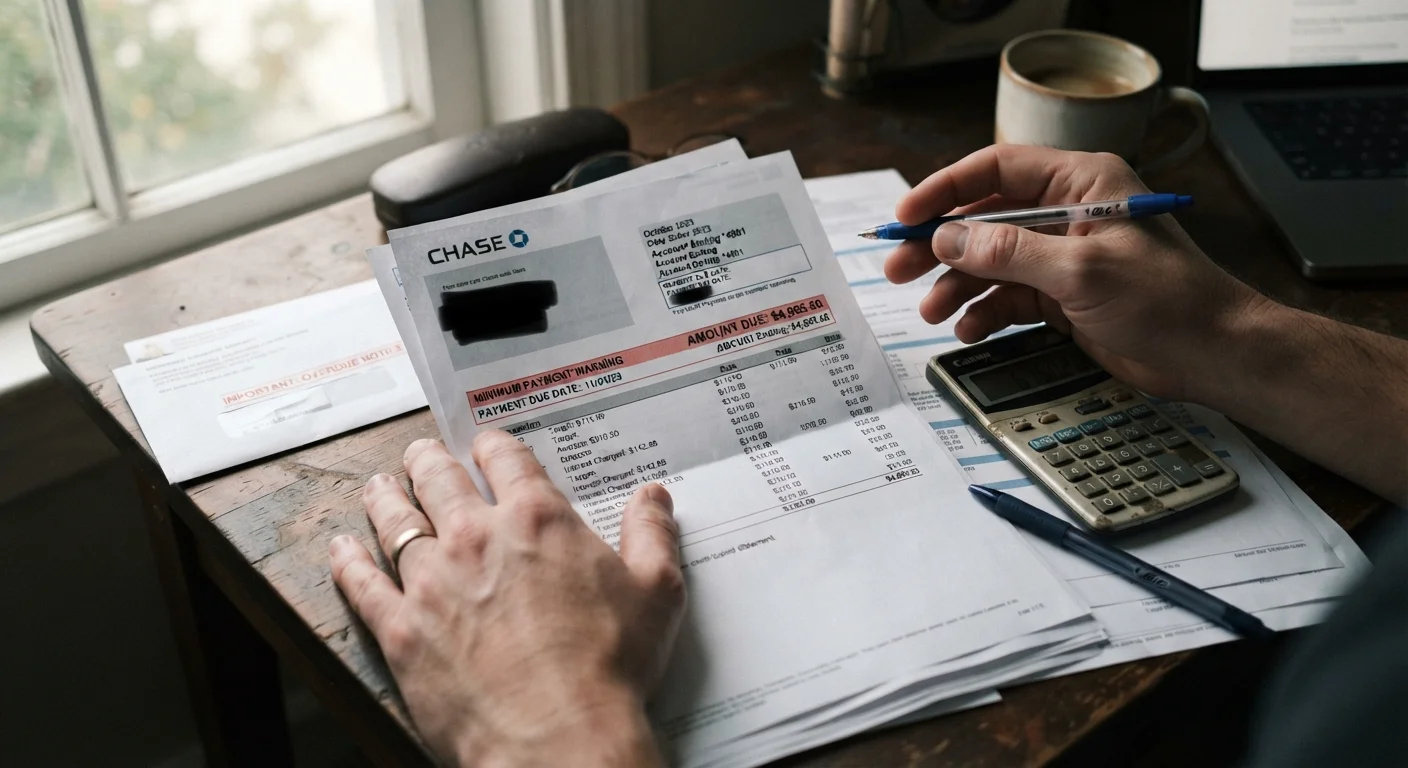
Photo: SaverSteals.com editorial
—— In This Article
Key Takeaways
- Minimum payments are designed to keep you in debt longer, not to help you get out of it quickly.
- High APRs mean most of your minimum payment covers interest, barely reducing principal.
- Compound interest causes balances to grow faster than small payments can shrink them.
- Paying even a modest amount above the minimum can dramatically cut your payoff timeline.
- Understanding the true cost of revolving debt is foundational to any debt payoff strategy.
Why Minimum Payments Feel Manageable — But Aren't
Credit card issuers set minimum payments low for a reason: a small, affordable-looking number feels easy to meet. For a $3,000 balance at a 22% annual percentage rate (APR), a typical minimum might be around $60–$75 per month. That seems painless compared to the full balance — but appearances deceive.
At that payment level, the majority of each dollar sent goes toward interest charges, not toward reducing what you actually owe. The principal — the original amount borrowed — barely moves. This is by design: issuers earn more revenue the longer a balance stays outstanding.
To understand why, it helps to revisit how interest compounds. Every month, interest is calculated on your remaining balance. If you're only paying down a sliver of that balance, the next month's interest charge is nearly as large as the one before. Compound interest is a powerful force — and on high-rate debt, it works squarely against you.
The Math Behind a Minimum-Only Payoff
Let's look at a concrete illustration. Assume a $3,000 credit card balance at 22% APR, with a minimum payment set at 2% of the balance (floored at $25). In the early months, roughly $55 of a $60 minimum payment goes to interest — leaving less than $10 applied to principal.
20+ years
Estimated payoff time on minimum-only payments
A $3,000 balance at 22% APR paid only at the minimum can take over two decades to retire, according to standard amortization modeling.
~$55
Interest portion of a typical early minimum payment
On a $3,000 balance at 22% APR with a 2% minimum, the first month's payment of roughly $60 directs approximately $55 to interest and less than $10 to principal.
2 years
Approximate payoff with fixed $150/month payment
Replacing a declining minimum payment with a fixed $150 monthly payment on the same $3,000 balance at 22% APR reduces the repayment period dramatically.
As the balance shrinks slightly, the minimum payment also drops — which means payoff progress slows further. Under this structure, paying only the minimum on a $3,000 balance could take over 20 years to fully repay, with total interest paid potentially exceeding the original balance itself.
This is not a hypothetical edge case. The Credit CARD Act of 2009 requires issuers to disclose this on every statement — the payoff timeline and interest total for minimum-only payments — precisely because the numbers are so striking when made visible.
Required Disclosures on Your Statement
Thanks to the Credit CARD Act of 2009, every credit card statement must show two figures in a prominent box: the number of months it will take to pay off your balance if you make only minimum payments, and the total interest you'll pay doing so. If you've been ignoring that box, it's worth a closer look — the numbers are often sobering and can serve as a useful motivator.
What Paying More Does to the Timeline
The payoff math shifts quickly when you increase your monthly payment. On the same $3,000 balance at 22% APR, moving from a ~$60 minimum to a fixed $150 monthly payment can cut the repayment period from decades to roughly two years — and reduce total interest paid by thousands of dollars.
The key principle: fixed payments outperform percentage-based minimums. When you pay a set amount each month rather than letting the minimum shrink with the balance, more money reaches the principal sooner, and interest has less to compound on. Even committing to pay twice your stated minimum is a meaningful step.
Set a Fixed Payment, Not a Minimum-Based One
Rather than letting your payment shrink as your balance falls, set a fixed monthly auto-pay amount — ideally what the minimum was when you started. This keeps more money hitting principal each month, shortening your timeline without requiring you to think about it every cycle. Even an extra $20–$30 above the minimum accelerates payoff meaningfully over 12 months.
If you're weighing how to allocate extra cash between savings and debt repayment, that trade-off deserves careful thought. See our piece on balancing savings and debt payoff for a framework that fits different financial situations.
Strategies to Break the Minimum Payment Cycle
Awareness is the starting point, but a structured approach gets results. Two widely used methods — the debt avalanche and the debt snowball — offer different psychological and mathematical trade-offs for tackling multiple balances. Our explainer on debt avalanche and debt snowball strategies walks through both in detail.
A few principles apply regardless of which approach you choose:
- Stop treating the minimum as the target. The minimum is a floor, not a plan.
- Identify your highest-rate balances first. Knowing what qualifies as high-interest debt helps you prioritize where extra payments do the most good.
- Automate above-minimum payments. Set a fixed monthly amount higher than the minimum so payoff progress is consistent and doesn't require active decision-making each cycle.
- Track your principal balance, not just statements. Watching principal decline month over month reinforces that your payments are working.
This article is for general informational purposes only and does not constitute personalized financial or legal advice. Consult a licensed financial professional for guidance specific to your situation.
Frequently Asked Questions

Finance Editorial Team
Finance Editorial Team is the collective byline for our editorial team and contributor network. Articles published under this byline or an editorial pen name are researched, written, and reviewed according to our editorial standards for clarity, consistency, and independence before publication.
View author profile