
Compound Interest: The Principle That Works For You When Saving and Against You When Borrowing
The same mathematical force that grows a savings account also deepens debt. Understanding how it works on both sides changes how you prioritize.
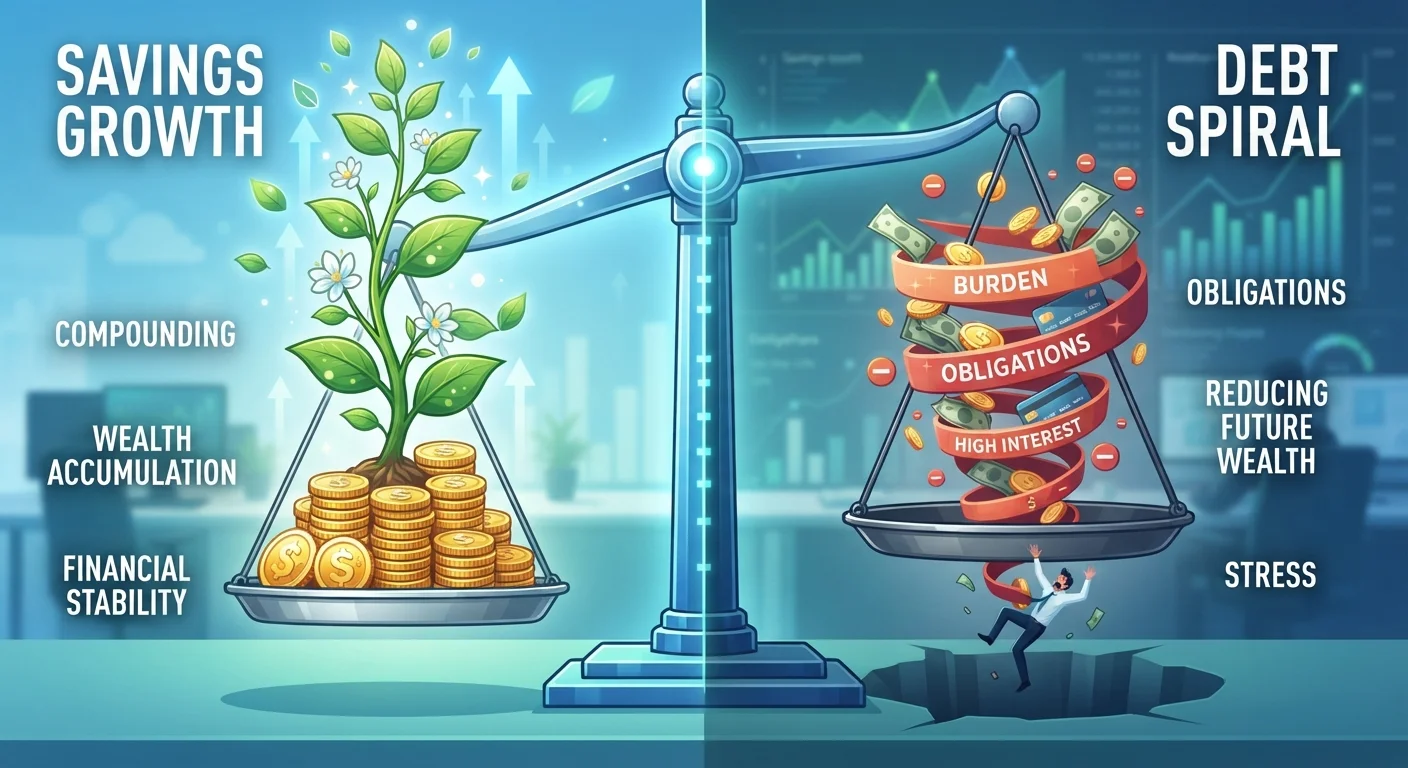
Photo: SaverSteals.com editorial
—— In This Article
Key Takeaways
- Compound interest accelerates growth in savings accounts and accelerates debt accumulation on loans.
- The interest rate and compounding frequency both determine how quickly balances change.
- High-interest debt, such as credit card balances, compounds rapidly and can outpace most savings returns.
- Time is the most powerful variable — the longer money grows or debt sits unpaid, the larger the compounding effect.
- Understanding both sides of compound interest helps you prioritize where your next dollar should go.
The Core Mechanic: Interest on Interest
Most people understand that money in a savings account earns interest, and that borrowing money costs interest. What's less intuitive is how that interest compounds — meaning it feeds back into the balance and then earns (or costs) interest itself.
Here's a straightforward illustration. If you deposit $1,000 at a 5% annual interest rate, you earn $50 in year one. In year two, you're not earning 5% on $1,000 — you're earning it on $1,050. That extra $2.50 might seem trivial, but over 20 or 30 years, this snowball effect becomes the dominant factor in your balance.
The same logic applies to debt. A $5,000 credit card balance at 20% APR doesn't just cost $1,000 per year — it costs more each month you carry it, because unpaid interest is added to your principal and then charged interest itself.
“Compound interest is the eighth wonder of the world. He who understands it, earns it; he who doesn't, pays it.”
— Widely attributed to Albert Einstein, This quote, frequently cited in financial literature, captures the dual nature of compounding — though its precise origin is debated among historians.
For a foundational understanding of how saving and debt relate more broadly, see our introduction to personal finance.
When Compound Interest Works For You: Saving and Investing
In the context of savings accounts, certificates of deposit (CDs), or investment accounts, compound interest is a long-term ally. The key variables are:
- Principal: The initial amount you deposit or invest.
- Interest rate (APY): The annual percentage yield, which reflects compounding.
- Time: How long the money stays invested or saved.
- Contributions: Regular deposits amplify compounding significantly.
Time is the most underestimated factor. A person who begins saving in their mid-20s can accumulate substantially more than someone who starts in their mid-30s, even if the later saver contributes more money in total. This is purely the result of compounding having more cycles to operate.
~10x
Potential growth over 30 years at 8% annual compounding
A widely cited illustration in financial education shows that $10,000 compounded at 8% annually grows to roughly $100,000 over 30 years, without any additional contributions.
20%+
Average credit card APR in the U.S.
According to Federal Reserve consumer credit data, average credit card interest rates have been above 20% in recent years, making credit card debt one of the most costly forms of compound interest consumers encounter.
Understanding this can shift behavior. Delaying contributions — even by a few years — represents a real cost, not just a postponement. This is worth weighing when deciding how to allocate limited dollars between saving and debt repayment.
When Compound Interest Works Against You: Carrying Debt
On the borrowing side, compounding is the reason minimum payments on credit cards can feel like running on a treadmill. When you pay only the minimum, you're often covering little more than that month's interest charge — leaving the principal largely intact to generate new interest the following month.
Consider what this means practically: a $3,000 credit card balance at 22% APR, paid at a minimum rate, can take well over a decade to clear and cost more in total interest than the original balance. The definition of high-interest debt matters here — not all debt compounds at the same rate, and the rate determines how urgently payoff should be prioritized.
Reduce Principal, Reduce the Compounding Base
Any extra payment you make toward a debt balance directly reduces the principal — the number on which future interest is calculated. Even modest additional payments early in a loan's life can meaningfully reduce total interest paid over its term. Before using savings to pay down debt, review our checklist on what to consider first.
It's also worth noting that different debts compound at different frequencies. Mortgages typically compound monthly; most credit cards compound daily. The more frequent the compounding, the faster balances build — for good or ill.
Comparing Both Sides: The Rate Gap That Guides Decisions
One of the most practical insights from understanding compound interest is the concept of comparing rates. If your savings account earns 4.5% APY and your credit card charges 22% APR, you are losing ground every month you prioritize saving over debt repayment — at least mathematically.
That said, financial decisions involve more than math. Maintaining even a small emergency fund may be worth accepting a temporary rate disadvantage, because without it, any unexpected expense forces you back into high-interest borrowing. Our article on saving vs. paying down debt explores this trade-off in detail.
If you're managing both debt and savings goals simultaneously, a structured approach can help you make progress on both fronts. See our guide on managing debt and savings at the same time for a practical framework.
This article is for general informational and educational purposes only and does not constitute personalized financial advice. Consult a qualified financial professional for guidance specific to your situation.
Frequently Asked Questions

Finance Editorial Team
Finance Editorial Team is the collective byline for our editorial team and contributor network. Articles published under this byline or an editorial pen name are researched, written, and reviewed according to our editorial standards for clarity, consistency, and independence before publication.
View author profile