
The Debt Avalanche and Debt Snowball, Explained
Two popular payoff strategies, one clear explanation. Learn how the avalanche and snowball methods work and what each one actually costs you.
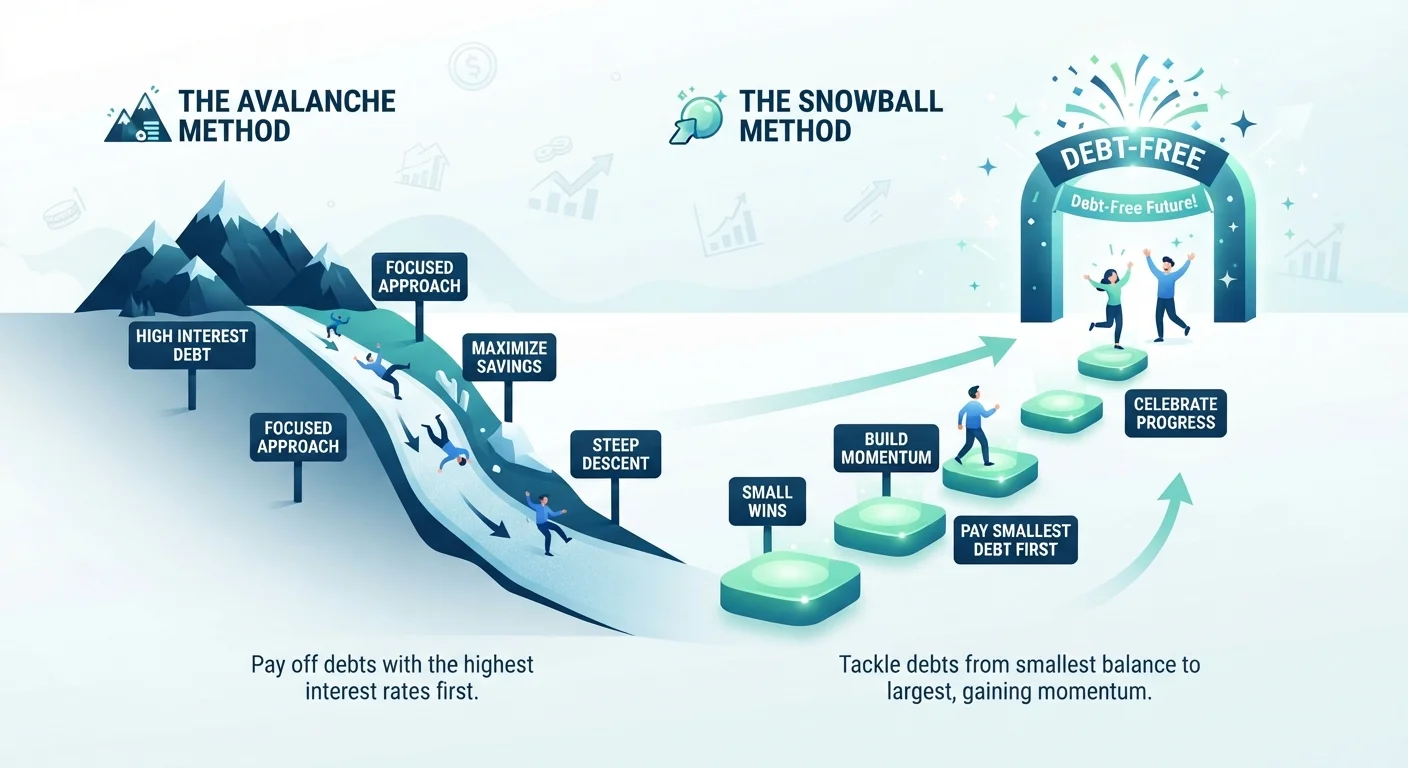
Photo: SaverSteals.com editorial
—— In This Article
Key Takeaways
- The avalanche method saves more money in interest over the life of your debts.
- The snowball method eliminates individual debts faster, which can build momentum.
- Both methods require consistent minimum payments on all debts while focusing extra funds on one.
- The best method is the one you can stick with long enough to finish.
- Neither method requires opening new accounts or restructuring your existing debt.
How the Debt Avalanche Works
The avalanche method organizes your debts by annual percentage rate (APR) — the yearly cost of borrowing expressed as a percentage. You make minimum payments on every account, then direct all remaining available funds toward the debt with the highest APR. Once that balance reaches zero, the freed-up payment rolls into the next highest-rate debt, and so on.
Because interest compounds continuously on unpaid balances, targeting the highest rate first stops the most expensive debt from growing. Over months and years, this reduces the total dollars you spend on interest — sometimes by hundreds or even thousands compared to paying debts in random order.
The tradeoff: your highest-rate debt may also carry a large balance, which means it could take many months before you eliminate a single account. That can feel discouraging if early progress seems invisible. For a refresher on terms like APR and amortization, see this plain-language debt glossary.
~$6,500
Average U.S. credit card balance per cardholder
According to Federal Reserve consumer credit data, the average revolving credit card balance among those who carry a balance has remained in the mid-thousands, underscoring why interest rate order matters in payoff planning.
20%+
Average credit card APR in recent years
The Federal Reserve's consumer credit report has tracked average credit card interest rates above 20% in recent periods, making high-rate debt among the most costly forms of consumer borrowing.
65%
U.S. adults who carry credit card debt month to month
Survey data from the American Bankers Association and similar sources consistently show that a majority of cardholders carry a revolving balance, rather than paying in full each cycle.
How the Debt Snowball Works
The snowball method organizes debts by outstanding balance, smallest to largest, regardless of interest rate. As with the avalanche, you make minimum payments everywhere and throw extra money at the priority debt — but here, the priority is the account closest to zero.
Paying off a small balance in weeks or months rather than years delivers a concrete win. Research in behavioral finance suggests these early victories reinforce the habit of prioritizing debt repayment, making people more likely to continue. Personal finance educator Dave Ramsey popularized the snowball approach partly for this reason: eliminating accounts one by one creates visible momentum.
The trade-off is mathematical: if your smallest balance carries a low interest rate while a larger balance sits at 24% APR, you're letting expensive debt grow while chasing a cheaper payoff. Over a long timeline, that can cost meaningfully more in total interest.
“Personal finance is more personal than it is finance. The best debt payoff strategy is ultimately the one that fits your psychology well enough that you actually follow through with it.”
— Carl Richards, Certified Financial Planner and author of 'The Behavior Gap'
Comparing the Two Methods Side by Side
Neither method is universally superior. The right choice depends on your debt profile, your cash flow, and — critically — your ability to stay consistent.
| Factor | Avalanche | Snowball |
|---|---|---|
| Priority order | Highest APR first | Smallest balance first |
| Total interest paid | Lower (typically) | Higher (typically) |
| Speed of first payoff | Slower (if high APR = large balance) | Faster |
| Psychological reward | Delayed | Early and frequent |
| Best suited for | Disciplined planners focused on minimizing cost | Those who need motivation to stay on track |
If your high-interest debt also happens to carry a small balance, the two methods may actually produce the same starting point — a useful scenario in which the avalanche delivers fast wins and saves money.
Try a Hybrid Approach
If neither method feels like a perfect fit, consider a hybrid: use the snowball to eliminate one or two small balances quickly, then switch to the avalanche for the remainder. You get an early motivational boost without abandoning the long-term interest savings. Just document your plan clearly so you don't lose track of where your extra payments are going.
Putting Either Strategy Into Practice
Before you pick a method, list every debt you owe with its current balance, minimum payment, and interest rate. This snapshot is the foundation of both strategies. Then decide how much extra money you can reliably direct toward debt each month — even a modest amount compounds into meaningful acceleration over time.
A few principles apply regardless of which method you choose:
- Never miss a minimum payment on any account. Late fees and penalty rates can erase the gains from your extra payments.
- Automate minimums where possible so the baseline is covered before you decide where the surplus goes.
- Reassess periodically. A raise, a new expense, or a balance transfer can change the optimal payoff order.
If your plan stalls — which is common — the issue is often structural rather than motivational. Learn why debt payoff plans derail and how to course-correct. And if you're trying to pay down debt while also building savings, a balanced approach is possible with the right structure.
This article is for general informational purposes only and does not constitute personalized financial, legal, or tax advice. Consult a licensed financial professional for guidance specific to your situation.
Frequently Asked Questions

Finance Editorial Team
Finance Editorial Team is the collective byline for our editorial team and contributor network. Articles published under this byline or an editorial pen name are researched, written, and reviewed according to our editorial standards for clarity, consistency, and independence before publication.
View author profile