Assessed Value, Appraised Value, and Market Value: What Each One Means
Three different numbers can describe one home's worth. Here's what each value means and when it actually matters.
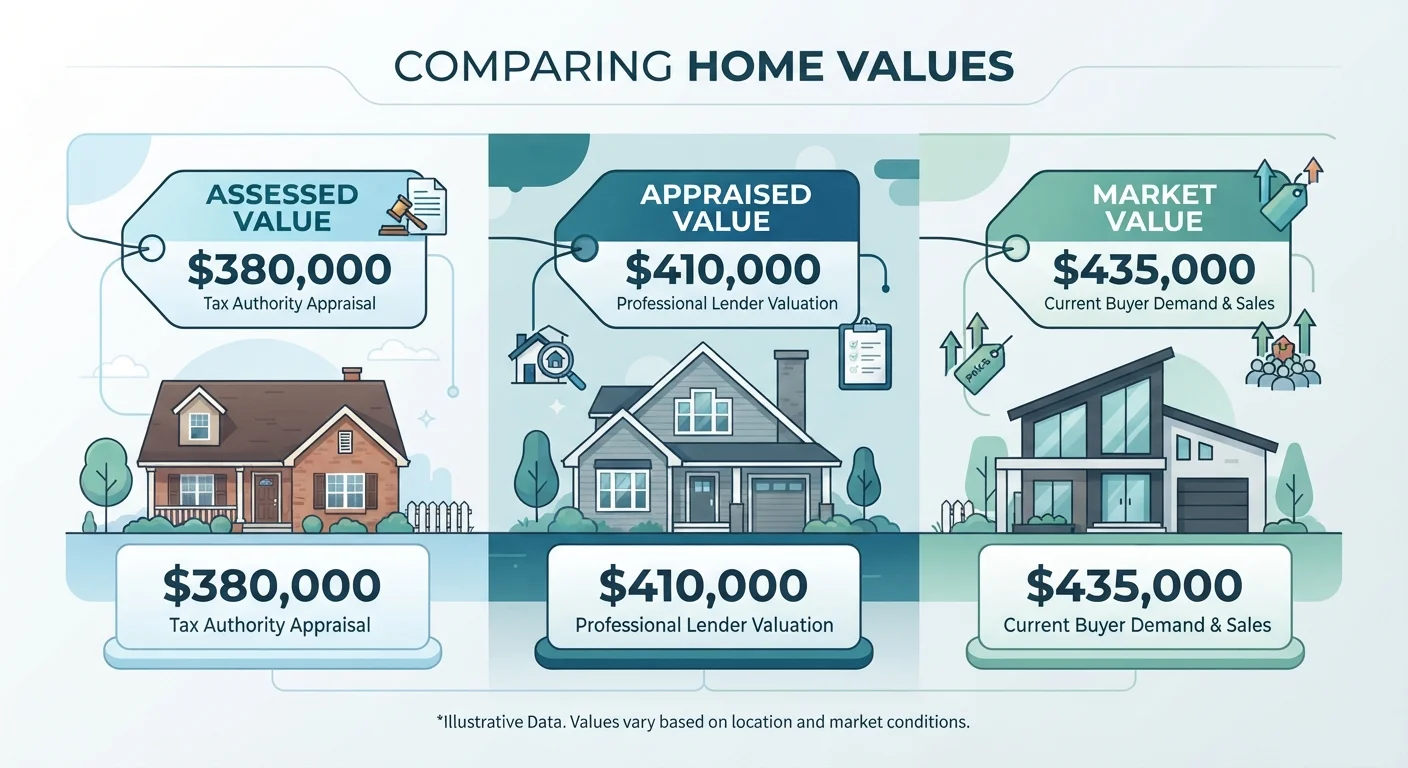
Photo: SaverSteals.com editorial
—— In This Article
Three Numbers, One Property
If you've ever bought, sold, or received a property tax bill, you've probably encountered three different figures describing what your home is worth — and they rarely match. That's not an error. Each figure — assessed value, appraised value, and market value — is calculated for a specific purpose by a specific party. Confusing them can lead to real misunderstandings, whether you're disputing a tax bill, applying for a mortgage, or negotiating a sale price.
| Who sets assessed value | Local government tax assessor |
| Who sets appraised value | Licensed or certified real estate appraiser |
| Who sets market value | Buyers and sellers in open-market transactions |
| Primary use of assessed value | Calculating property taxes |
| Primary use of appraised value | Mortgage lending and underwriting |
| Primary use of market value | Pricing and negotiating a home sale |
This reference explains what each value measures, who determines it, and when it actually matters to you as a homeowner or buyer.
Assessed Value: The Tax Authority's Figure
Assessed value is the dollar figure your local government assigns to your property for the purpose of calculating property taxes. It is set by a government assessor — not a private appraiser — and is typically updated on a periodic schedule that varies by jurisdiction.
Assessed value is almost never equal to what a home would sell for on the open market. Many counties apply an assessment ratio — a percentage of the estimated market value — to arrive at the assessed figure. For example, a jurisdiction with an 80% assessment ratio would assign an assessed value of $320,000 to a home estimated at $400,000.
Homeowners who believe their assessed value is inaccurate generally have the right to appeal through a formal review process. Learn how assessed value connects to your tax bill and what options exist if you disagree with the number.
Assessed Value
The value assigned to a property by a local government assessor, used solely to calculate property taxes. It is often a percentage of estimated market value and is updated on a set schedule.
Appraised Value
A licensed appraiser's professional opinion of a property's value at a specific point in time, typically required by mortgage lenders before approving a home loan.
Market Value
The price a ready, willing, and informed buyer would pay a ready, willing seller in a fair, open-market transaction. It reflects current supply, demand, and comparable sales.
Assessment Ratio
The percentage of a property's estimated market value that a local jurisdiction uses to calculate its assessed value for tax purposes. Ratios vary widely by location.
Comparable Sales (Comps)
Recent sales of similar, nearby properties used by appraisers and real estate agents to estimate a home's value. Comps are central to both the appraisal process and market pricing.
Arm's-Length Transaction
A real estate sale in which buyer and seller act independently and in their own self-interest, with neither party under pressure or undue influence — the standard condition assumed in market value definitions.
Appraised Value: The Lender's Reference Point
Appraised value is an opinion of value produced by a licensed or certified real estate appraiser following a structured inspection and analysis process. It is most commonly required by mortgage lenders, who need an independent confirmation that a property is worth at least as much as the loan amount before financing is approved.
Appraisers examine the physical condition of the home, its features and square footage, and recent sales of comparable nearby properties — often called comps. They apply recognized methodologies, such as the sales comparison approach or the cost approach, to reach a defensible, documented value conclusion. See how the full appraisal process unfolds, from the initial inspection to the final report.
Appraised value is a point-in-time professional judgment. It can differ from market value — sometimes significantly — because it reflects specific methodologies and data constraints rather than live buyer sentiment. Understand where appraised and market value diverge and why both figures matter in a transaction.
Market Value: What Buyers Will Actually Pay
Market value is what a willing, informed buyer would pay a willing, informed seller in an arm's-length transaction — with neither party under pressure to act. It is not set by any single authority; it emerges from actual market conditions, buyer competition, seasonal demand, interest rate environments, and comparable recent sales in the area.
Market value is the number most relevant when you're listing or purchasing a home. A seller's asking price is an opinion; the final sale price — after negotiation — is the closest real-world expression of market value at that moment. Online valuation tools attempt to estimate market value algorithmically, but they carry meaningful limitations. Explore why online estimates and professional appraisals often disagree.
Market value is also the most dynamic of the three figures — it can shift week to week based on inventory levels, buyer demand, and broader economic conditions. Discover why two similar homes on the same street can carry very different market values.
Market Value Moves — Other Figures May Not
Market value can shift rapidly in response to interest rate changes, local inventory levels, or broader economic shifts. Assessed values, by contrast, are updated on government schedules that may lag real market conditions by a year or more. Appraised values are also snapshots in time — valid as of the inspection date, not necessarily months later. Always consider when each figure was last updated before relying on it.
How to Use Each Value
Knowing which figure applies in a given situation prevents costly confusion:
- Assessed value is relevant when reviewing your property tax bill or filing an appeal with your local assessor's office.
- Appraised value matters most during mortgage underwriting — if a home appraises below the agreed sale price, lenders will typically limit financing to the appraised figure.
- Market value is the primary consideration when pricing a home to sell or evaluating whether a listing price is reasonable before making an offer.
For a broader view of how all valuation methods fit together, explore a complete overview of home valuation from start to finish.
This article is for general informational purposes only and does not constitute financial, legal, or tax advice. Consult a licensed real estate professional, appraiser, or tax adviser for guidance specific to your situation.

Real Estate Editorial Team
Real Estate Editorial Team is the collective byline for our editorial team and contributor network. Articles published under this byline or an editorial pen name are researched, written, and reviewed according to our editorial standards for clarity, consistency, and independence before publication.
View author profile