Why Your Home's Value and Your Neighbor's Look Nothing Alike
Similar houses on the same street can carry very different values. Here's what separates them beyond just square footage.
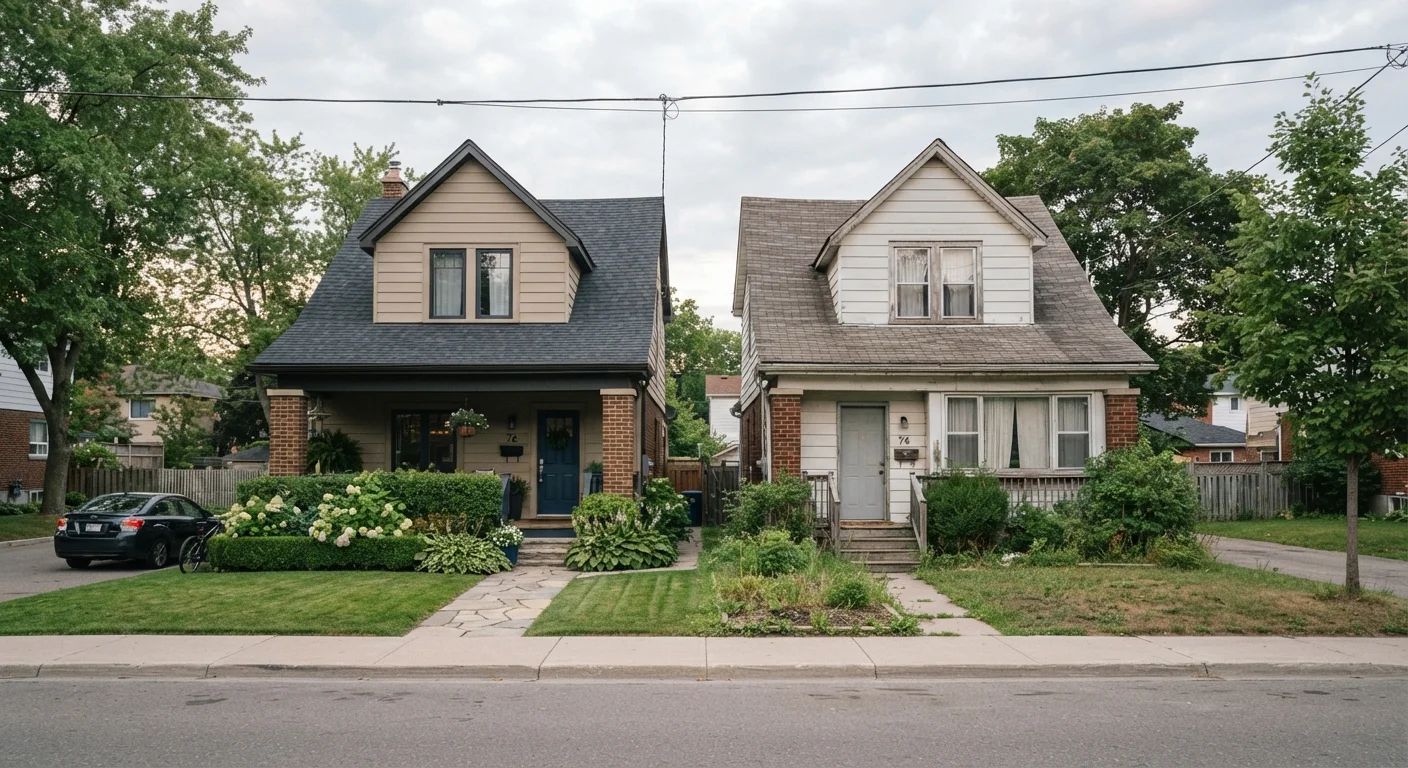
Photo: SaverSteals.com editorial
—— In This Article
Key Takeaways
- Square footage is just one of many factors that determine a home's market value.
- Lot position, interior layout, condition, and updates all create value differences between neighboring homes.
- Assessed value and market value are not the same number and serve different purposes.
- Appraisers use a structured comparison process — not a simple formula — to arrive at value.
- Homeowners frequently overestimate how much renovations add to appraised value.
Why Two Nearly Identical Homes Can Have Very Different Values
Walk down almost any residential street and you'll find homes that look like twins from the outside — same era, same general size, same neighborhood. Yet when those homes sell, the prices can diverge by tens of thousands of dollars. For homeowners trying to understand where their property stands, that gap is often puzzling and sometimes frustrating.
The answer lies in how home value is actually determined. It's not a single formula applied uniformly. It's a layered assessment that weighs dozens of variables, many of which are invisible at first glance. Understanding those variables — and correcting some widespread myths about them — gives homeowners a much clearer picture of what their home is really worth and why.
Myth
If my neighbor's house sold for $400,000, mine should be worth the same — we have the same floor plan.
Fact
Identical floor plans do not produce identical values. Lot position, condition, finishes, and updates all create meaningful price differences.
Appraisers use comparable sales — often called "comps" — as a starting point, but they then make dollar adjustments for every meaningful difference between properties. A home on a corner lot may appraise differently than one mid-block. A kitchen remodeled five years ago competes differently than one that is original to a 1995 build. Even something as subtle as a functional layout versus an awkward one can shift value by thousands of dollars. The same square footage, in other words, does not mean the same home.
Myth
My tax assessment reflects what my home is actually worth on the open market.
Fact
Assessed value is a local government figure used to calculate property taxes — it often lags well behind current market conditions.
Municipalities reassess properties on varying schedules, and many use a percentage of estimated market value rather than full value. The result is a number that can be significantly lower — or occasionally higher — than what a buyer would pay today. For a clear breakdown of how these figures relate, see Assessed Value, Appraised Value, and Market Value: What Each One Means. Using your tax assessment to price a home for sale is one of the more common and costly mistakes sellers make.
Myth
A full kitchen remodel will add at least as much value as it costs.
Fact
Most renovation projects return less than their cost in appraised value, especially high-end upgrades in mid-range neighborhoods.
Appraisers consider what the market will bear in a given neighborhood — a concept sometimes called the principle of conformity. A $90,000 luxury kitchen in a block of $300,000 homes is unlikely to push that home's value to $390,000, because buyers in that price range typically look elsewhere. Some renovation projects return far less than homeowners expect, and the gap between cost and added value is often wider than sellers anticipate.
Myth
Appraised value and market value are essentially the same number.
Fact
Appraised value is a licensed professional's opinion for a specific purpose (often lending); market value is what a willing buyer actually pays.
These two figures can differ, sometimes by a meaningful margin. An appraisal is ordered for a defined purpose — typically mortgage underwriting — and follows a regulated methodology. Market value is determined by negotiation between buyer and seller and reflects real-time demand. In a fast-moving market, homes frequently sell above their appraised value, which can create complications for financing. Understanding how appraised value and market value differ is essential for anyone navigating a purchase or sale.
Myth
Location only matters in terms of the city or school district — the specific spot on the street doesn't matter.
Fact
Micro-location within a neighborhood — including street position, proximity to traffic, and views — can produce real, measurable value differences.
A home backing to a busy arterial road, situated under a flight path, or adjacent to a commercial property will typically appraise lower than an otherwise identical home two blocks away. Appraisers are trained to identify and adjust for these factors. Conversely, a corner lot with extra green space, a cul-de-sac location, or a water view can command a meaningful premium. The full range of factors that drive a home's value extends well beyond the macro-level location most homeowners consider.
What Appraisers Actually Look At
When a licensed appraiser evaluates a property, they are building a case — not running a calculation. They begin with recent comparable sales in the area, then make systematic adjustments for every meaningful difference between those sales and the subject property. Condition, functional layout, updates, lot characteristics, and even the direction a home faces can all factor into those adjustments.
This is why two neighbors with the same square footage and the same zip code can receive different appraisals. One may have a finished basement the other lacks. One may sit on a larger lot. One may have had the HVAC system replaced recently while the other has aging systems that a buyer would need to address. Each difference, in a properly conducted appraisal, translates to a dollar adjustment.
Don't Rely Solely on Online Estimates
Automated valuation tools (such as online home value estimators) pull from public records and sales data, but they cannot account for interior condition, recent upgrades, or hyper-local nuances. Treat these figures as a rough starting point only. For financing, listing, or purchase decisions, a licensed appraisal or a comparative market analysis from a local agent is far more reliable.
For a broader look at how these individual factors stack up, explore the key drivers behind property prices — from structural condition to local market forces.
~5%
Typical appraiser adjustment for a major kitchen remodel
Industry appraisal guidance suggests kitchen upgrades commonly add a fraction of their cost in value, varying widely by market and neighborhood price point.
1 in 3
Homeowners who believe their assessed value equals market value
Consumer surveys on real estate literacy consistently find widespread confusion between tax-assessed value and what a home would sell for on the open market.
Correcting the Most Costly Misconceptions
Many homeowners anchor their expectations to flawed assumptions — a neighbor's sale price, a tax bill, or an online estimate. Each of those figures tells a partial story at best. Several common beliefs lead homeowners to significantly misjudge their property's worth, and the consequences can range from a poorly timed listing to a failed refinance.
The most reliable path to understanding your home's value is combining awareness of these distinctions with guidance from a licensed professional — whether that's a certified appraiser, a local real estate agent with current market data, or both. No online tool, tax bill, or neighbor's sale can substitute for that grounded, site-specific analysis.
Valuation Is Not an Exact Science
Home values are professional estimates grounded in market data, not precise calculations. Two licensed appraisers can legally arrive at different values for the same property. Understanding this range helps homeowners set realistic expectations when buying, selling, or refinancing.
This article is for general informational and educational purposes only. It does not constitute financial, legal, or real estate advice. Readers should consult a licensed appraiser or real estate professional for guidance specific to their property and circumstances.

Real Estate Editorial Team
Real Estate Editorial Team is the collective byline for our editorial team and contributor network. Articles published under this byline or an editorial pen name are researched, written, and reviewed according to our editorial standards for clarity, consistency, and independence before publication.
View author profile