
Envelope Budgeting vs. Digital Tracking Apps
Cash envelopes and budgeting apps both keep spending in check, but they work very differently. See which approach fits your habits and lifestyle.
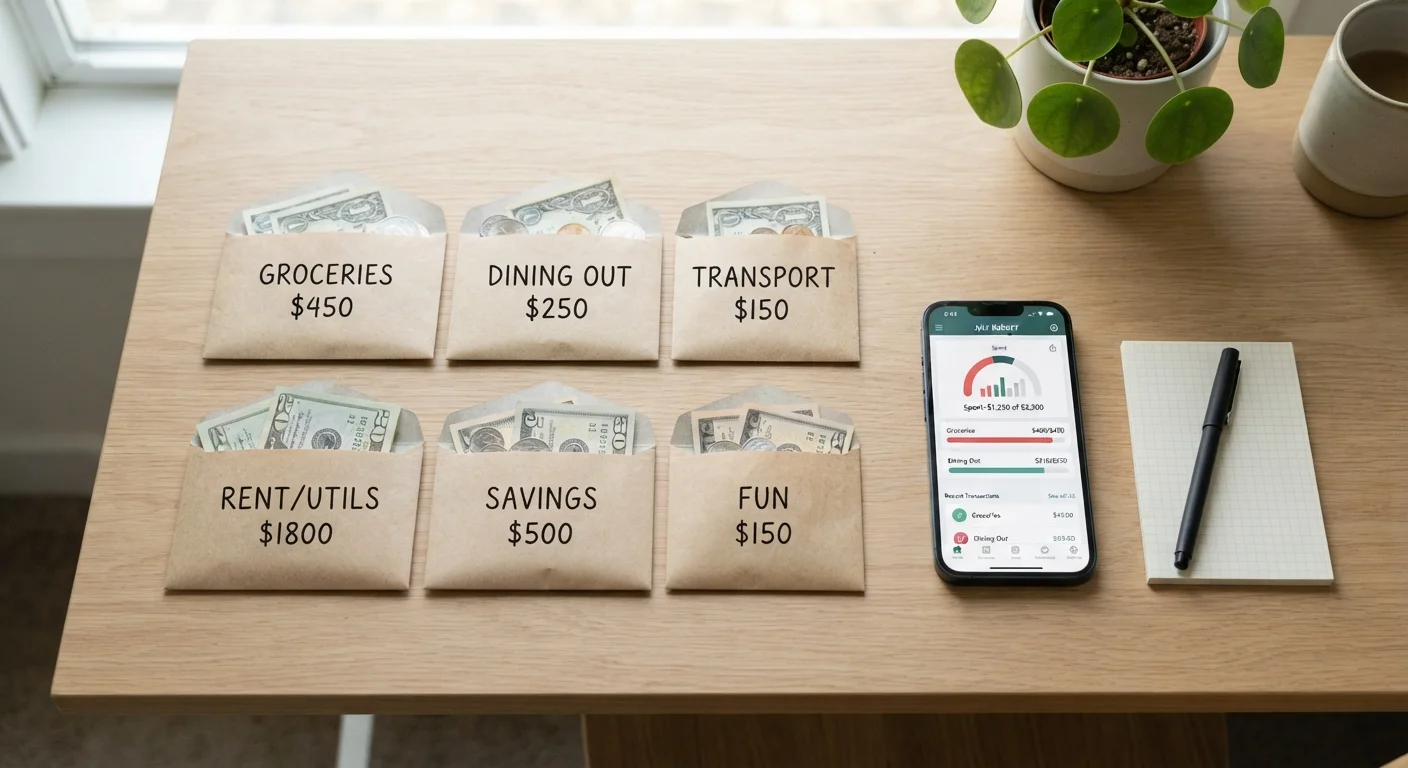
Photo: SaverSteals.com editorial
—— In This Article
Key Takeaways
- Envelope budgeting uses physical cash divided into labeled categories to enforce hard spending limits.
- Digital tracking apps sync with bank and card accounts to automate transaction categorization and reporting.
- The envelope method creates strong psychological accountability; apps offer convenience and historical data.
- Neither method is universally superior — the right choice depends on your spending habits and lifestyle.
- Both approaches work best when paired with clearly defined spending categories and a monthly review habit.
How Each Method Works
Envelope budgeting is straightforward by design. At the start of each pay period, you withdraw cash and distribute it into labeled envelopes — one for groceries, one for gas, one for dining out, and so on. When an envelope is empty, spending in that category stops until the next funding cycle. The physical boundary is the entire point.
Digital tracking apps take the opposite approach: rather than restricting cash in advance, they record what you've already spent. Most apps connect directly to your bank accounts and credit cards, automatically categorizing each transaction. You set category limits, and the app alerts you when you're approaching or exceeding them. See which spending categories to track for a practical framework that works with either method.
The core difference is proactive restriction versus reactive awareness. Envelopes enforce limits before you spend; apps inform you after. Both are legitimate strategies — the question is which friction point motivates you most.
| Criterion | Envelope Budgeting | Digital Tracking Apps |
|---|---|---|
| Spending mechanism | Physical cash only | Cards, accounts, digital payments |
| Limit enforcement | Hard stop when envelope is empty | Alerts and notifications |
| Setup effort | Manual cash withdrawal and sorting | Account linking and category setup |
| Automation | None — fully manual | Automatic transaction syncing |
| Psychological impact | High — cash feels tangible | Lower — digital transactions feel abstract |
| Historical reporting | Limited unless tracked manually | Detailed trends and analytics |
| Privacy risk | None — no third-party access | Requires sharing account access |
| Best for | Cash spenders, impulse-control goals | Digital-first, data-driven budgeters |
The Real-World Trade-Offs
Envelope budgeting's biggest strength is also its biggest limitation: it only works with cash. In an era of online subscriptions, tap-to-pay, and automatic bill drafts, physically managing every dollar becomes logistically complicated. You'll need a separate system for fixed expenses like rent and utilities, which creates a hybrid approach that some people find hard to maintain consistently.
Digital apps eliminate that friction but introduce a different challenge: the psychological distance between swiping a card and seeing a number change on a screen is far smaller than watching a cash envelope empty out. Research in consumer behavior consistently suggests that paying with cash tends to feel more "painful" — which is actually a feature, not a bug, for people working to curb impulsive spending.
A Note on App Security and Privacy
Most budgeting apps use bank-level encryption and read-only account access, meaning they can view transactions but cannot move money. However, security practices vary by provider, and no third-party connection is entirely without risk. Before linking accounts, review the app's privacy policy and check whether it is regulated or audited under financial data standards applicable in your state.
Apps also carry privacy and security considerations. Connecting financial accounts to third-party software means sharing login credentials or bank-level access tokens with an external platform. Reviewing a service's data practices and understanding how your information is protected is a reasonable step before linking accounts. If this concern weighs heavily on you, envelope budgeting — or a manual spreadsheet — keeps your financial data entirely private.
For a balanced look at the psychological and practical costs of tightly controlled budgeting in either format, the article on the upsides and downsides of strict budgeting covers the territory well.
Choosing the Right Fit — or Combining Both
The most useful question isn't "which method is better?" — it's "where does my spending go off track?" If you routinely exceed your grocery or restaurant budget and most of those transactions are in-person, cash envelopes may close the gap in ways an app notification never will. If your problem is losing track of subscriptions and online purchases, a digital tool with automatic syncing addresses the actual problem more directly.
Many people find that a hybrid approach works well: use cash envelopes for two or three high-temptation categories (dining, clothing, entertainment) while tracking fixed and digital expenses in an app or spreadsheet. This lets you apply the psychological weight of physical cash where it matters most without abandoning the convenience of digital tools for everything else.
If you're still building foundational budgeting skills, start with personal budgeting from the ground up before committing to either format. And regardless of which method you choose, a regular review habit — such as the one outlined in your monthly budget health check — is what turns a budgeting system into lasting financial progress.
~30%
More spent when paying by card vs. cash
Multiple consumer behavior studies suggest people tend to spend meaningfully more when using cards rather than cash, due to reduced psychological friction at the point of purchase.
1 in 3
Americans with no written or tracked budget
Surveys by the National Financial Educators Council and similar organizations consistently find that a significant share of U.S. adults manage money without any formal budgeting system.
This article is for general informational and educational purposes only and does not constitute personalized financial advice. Consult a qualified financial professional for guidance tailored to your individual circumstances.

Finance Editorial Team
Finance Editorial Team is the collective byline for our editorial team and contributor network. Articles published under this byline or an editorial pen name are researched, written, and reviewed according to our editorial standards for clarity, consistency, and independence before publication.
View author profile