
OLED, QLED, and LED: Sorting Out the Display Panel Alphabet
OLED, QLED, and LED screens look similar in a store but differ in real ways. Here's what separates them and when those differences matter.
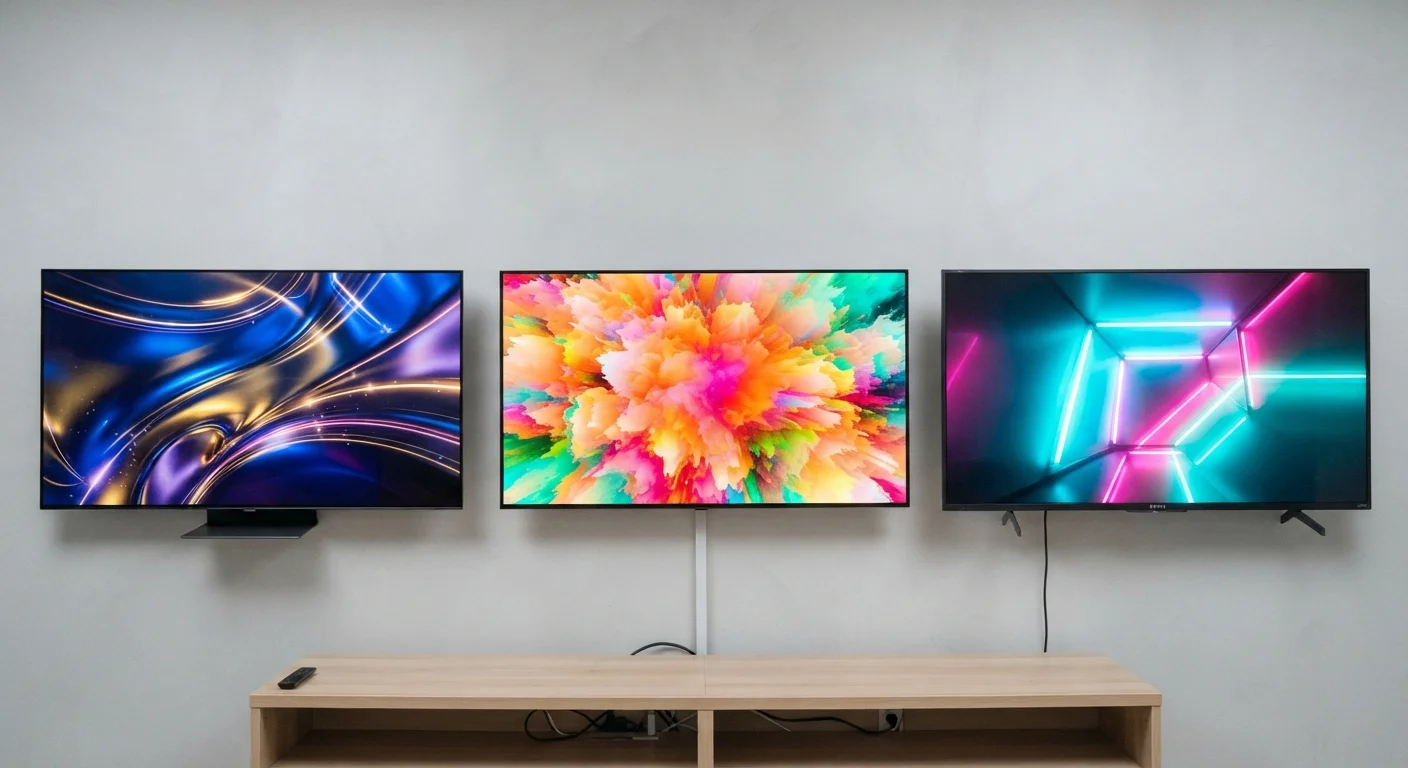
Photo: SaverSteals.com editorial
—— In This Article
Key Takeaways
- LED is the baseline technology; QLED and OLED are distinct improvements built on different principles.
- OLED panels produce true blacks by turning off individual pixels, giving superior contrast in dark rooms.
- QLED uses a quantum-dot filter to push LED brightness higher, making it strong in well-lit environments.
- Burn-in is a real but manageable risk with OLED; standard LED and QLED panels are not susceptible.
- Price differences between panel types reflect real performance trade-offs, not just marketing.
Why the Naming Conventions Are Confusing
Walk through any electronics department and you will see OLED, QLED, and LED stacked side by side — sometimes with barely visible price differences, sometimes with dramatic ones. The names look like a logical progression, but they do not describe the same underlying technology. Understanding the distinction saves you from paying for capabilities you do not need, or skimping on ones that actually matter for how you watch.
Standard LED (Light-Emitting Diode) is the foundation. Nearly every flat-panel TV sold today uses LED backlighting behind an LCD (Liquid Crystal Display) layer that controls which light passes through. QLED adds a quantum-dot enhancement layer to that same LED-LCD structure to improve color and brightness. OLED (Organic Light-Emitting Diode) is a fundamentally different approach: each pixel generates its own light independently, with no backlight at all. That distinction drives nearly every performance difference between them.
For a deeper look at how these panels interact with specs like refresh rate and resolution, see our guide to TV specs.
How Each Technology Works
Standard LED/LCD panels use a grid of LEDs behind the screen. Better sets use "local dimming," which dims specific zones of the backlight to deepen blacks — but because a zone covers many pixels, some light bleeds into dark areas, a visible effect called blooming.
QLED panels place a thin film of quantum dots — semiconductor nanocrystals — between the LED backlight and the LCD layer. When blue LEDs hit these dots, they emit highly precise red and green wavelengths, expanding the color gamut and boosting peak brightness. The structure is still a backlight behind an LCD, so blooming remains a possibility, though high-end implementations minimize it with many local dimming zones.
OLED panels eliminate the backlight entirely. Each organic compound pixel emits its own light when electricity passes through it — and switches completely off to display black. That pixel-level control produces contrast ratios that backlit screens cannot match. The trade-off is that organic materials degrade over time, raising concerns about both long-term brightness and burn-in (permanent image retention from static content displayed for extended periods).
| Standard LED | QLED | OLED | |
|---|---|---|---|
| Black levels / Contrast | Moderate (zone dimming) | Moderate to good | Excellent (pixel off = true black) |
| Peak Brightness | Good | Very high | Moderate to good |
| Color Gamut | Standard wide color | Very wide, high saturation | Accurate, wide color |
| Response Time | Good | Good | Excellent |
| Burn-in Risk | None | None | Low to moderate (with heavy static content) |
| Typical Price Range | Lower | Mid to high | High |
| Best Room Lighting | Any | Bright rooms | Dark or dim rooms |
Where Each Panel Excels — and Where It Doesn't
Contrast and black levels: OLED's self-emissive pixels win decisively here. In a dark room watching a film with starfields or nighttime scenes, the difference is visible to nearly any viewer. LED and QLED panels, regardless of local dimming quality, produce some degree of glow in what should be pure black areas.
Brightness: QLED holds the advantage, particularly for HDR (High Dynamic Range) content, which benefits from high peak brightness. OLED panels have improved but generally cannot sustain the same peak brightness levels for long periods, especially across large bright areas of the screen.
Color volume: QLED covers a wide color gamut with strong saturation at high brightness, which matters for sports and nature content. OLED delivers excellent color accuracy at lower brightness levels and tends to score well in professional calibration tests.
Response time and motion: OLED's pixel-level switching is nearly instantaneous, making it a strong option for gaming and fast-motion content. Standard LED and QLED panels have improved response times, but OLED still holds a measurable edge at the high end.
Burn-in risk: OLED panels can develop permanent image retention if a static element — a news ticker, a game HUD, a channel logo — sits in the same position for many hours repeatedly. Panel manufacturers have introduced mitigations, but the risk is real. LED and QLED panels are not susceptible.
OLED Burn-In Is Real, Not Just a Myth
Burn-in occurs when a static image element is displayed in the same screen position for extended periods, causing the organic pixels to degrade unevenly. It is most likely to affect viewers who use an OLED as a dedicated PC monitor, watch one channel for many hours daily, or leave game HUDs on-screen for long gaming sessions. Casual TV viewers are generally at lower risk. If your usage pattern involves heavy static content, this is worth factoring into your decision.
Practical Factors to Weigh Before Deciding
Room lighting matters more than most buyers expect. OLED's contrast advantage is most visible in dim or controlled-light environments. In a bright living room with windows, a high-brightness QLED panel may actually deliver a more satisfying image because it overpowers ambient glare more effectively.
Screen size also plays a role. OLED manufacturing at very large sizes has historically been more expensive and less widely available, though that has shifted over time. Standard LED panels remain broadly available in the widest range of sizes and price points.
Viewing content type is worth honest self-assessment. If your primary use is gaming in a dark room or watching prestige cinema, the contrast performance of OLED is relevant. If you primarily watch sports, news, or streaming in a bright space, QLED's brightness ceiling and color volume may serve you better. For a mixed household with varied viewing habits and a tighter budget, a well-implemented LED panel with local dimming can cover most needs without the premium.
When comparing options in-store, use the same source content on each panel and adjust the room lighting to match your home environment. Factory-set demo modes are typically calibrated for showroom brightness and do not represent typical home performance. Our guide to screen size and viewing distance covers how to match display size to your actual setup.
Test Panels With Realistic Content
In-store demo modes are engineered to impress, not to represent everyday viewing. When evaluating panels, ask store staff to switch to a standard or filmmaker mode and test with content that reflects how you actually watch — mixed lighting, regular TV programming, or gameplay footage. A realistic side-by-side comparison will reveal more than any spec sheet.

Shopping Editorial Team
Shopping Editorial Team is the collective byline for our editorial team and contributor network. Articles published under this byline or an editorial pen name are researched, written, and reviewed according to our editorial standards for clarity, consistency, and independence before publication.
View author profile