
Renting vs. Buying a Home: How to Think Through the Decision
Neither option is universally better. Explore the financial, lifestyle, and risk factors that shape the rent-or-buy calculation.
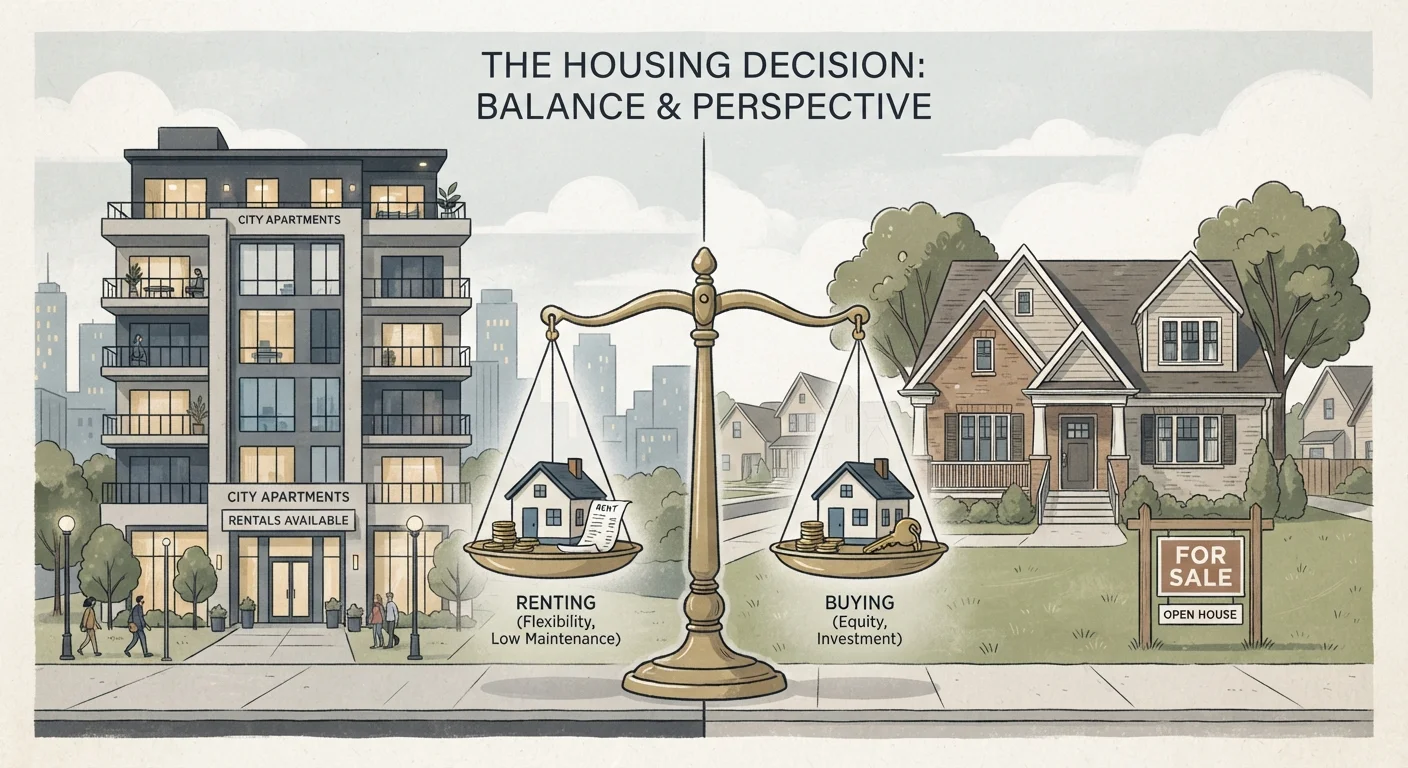
Photo: SaverSteals.com editorial
—— In This Article
Key Takeaways
- Neither renting nor buying is universally superior — the right choice depends on your financial situation and goals.
- Buying builds equity over time but requires significant upfront capital and ongoing maintenance costs.
- Renting offers flexibility and predictable short-term costs but provides no ownership stake.
- Local market conditions, job stability, and how long you plan to stay heavily influence the calculation.
- Consult a licensed financial adviser or HUD-approved housing counselor before making a major housing decision.
Builds equity with each mortgage payment
Unlike rent, a portion of every mortgage payment reduces what you owe, gradually increasing your ownership stake in the property.
Protection from rent increases
A fixed-rate mortgage locks in your principal and interest payment for the loan term, shielding you from the rent volatility that renters face at lease renewal.
Freedom to modify the property
Owners can renovate, repaint, landscape, or otherwise customize their home without landlord approval, which is often meaningful for long-term residents.
Potential long-term appreciation
Historically, residential real estate in many US markets has appreciated over long periods, though past performance does not guarantee future results and values can decline.
No equity or ownership stake accumulates
Monthly rent payments do not build an asset. Over years, the total rent paid represents housing costs rather than a retained financial position.
Subject to landlord decisions and market rents
Landlords may raise rents at renewal, sell the property, or decline to renew a lease, all of which can force an unwanted move with limited notice.
Limited ability to personalize the space
Most leases restrict painting, structural changes, and permanent fixtures, limiting how much renters can adapt a unit to their preferences.
No benefit from property appreciation
If local property values rise significantly, renters see none of that upside, while their housing costs may increase as a direct result.
Why There Is No Universal Answer
The rent-or-buy debate is one of the most common financial questions Americans face, yet it resists a simple answer. Real estate markets vary dramatically by city and neighborhood — a home that is affordable to purchase in one region may require a mortgage payment far exceeding local rents in another.
Before running any numbers, it helps to be honest about two non-financial factors: how long you plan to stay in your current location and how much financial uncertainty you are comfortable carrying. A longer time horizon generally favors buying; high job or life uncertainty generally favors renting. The financial math follows from those realities rather than preceding them.
Price-to-Rent Ratio: A Quick Gauge
The price-to-rent ratio compares the cost of buying to the cost of renting similar housing in a given market. It is calculated by dividing median home price by annual median rent. Ratios vary widely across US cities — a high ratio suggests renting may be more economical, while a low ratio may indicate buying offers better value. This metric is a starting point for comparison, not a complete decision-making tool.
The Financial Case for Buying
Homeownership is often framed as wealth-building, and for many households over long periods, that framing holds. When you make mortgage payments, a portion reduces your principal balance — a process called building equity. Over a decade or more, equity can represent a significant asset, especially in markets where property values have risen.
Builds equity with each mortgage payment
Unlike rent, a portion of every mortgage payment reduces what you owe, gradually increasing your ownership stake in the property.
Protection from rent increases
A fixed-rate mortgage locks in your principal and interest payment for the loan term, shielding you from the rent volatility that renters face at lease renewal.
Freedom to modify the property
Owners can renovate, repaint, landscape, or otherwise customize their home without landlord approval, which is often meaningful for long-term residents.
Potential long-term appreciation
Historically, residential real estate in many US markets has appreciated over long periods, though past performance does not guarantee future results and values can decline.
Beyond equity, owners in some circumstances benefit from mortgage interest deductions and property tax deductions on federal returns, though the 2017 tax law changes reduced this advantage for many middle-income buyers. It is worth verifying current tax treatment with a qualified accountant.
For a deeper look at real estate as an investment category, the Property Investment hub covers fundamentals worth understanding before committing.
The Financial Case for Renting
Renting is frequently described as "throwing money away," but that framing is misleading. Rent purchases something real: housing, flexibility, and freedom from large unexpected repair bills. When the full cost of ownership is calculated — mortgage interest, property taxes, homeowner's insurance, HOA fees, maintenance, and the opportunity cost of the down payment — renting can be cheaper on a monthly basis, particularly in expensive metro areas.
No equity or ownership stake accumulates
Monthly rent payments do not build an asset. Over years, the total rent paid represents housing costs rather than a retained financial position.
Subject to landlord decisions and market rents
Landlords may raise rents at renewal, sell the property, or decline to renew a lease, all of which can force an unwanted move with limited notice.
Limited ability to personalize the space
Most leases restrict painting, structural changes, and permanent fixtures, limiting how much renters can adapt a unit to their preferences.
No benefit from property appreciation
If local property values rise significantly, renters see none of that upside, while their housing costs may increase as a direct result.
The full financial picture of renting goes beyond the base rent figure and includes items like application fees, renters insurance, and utilities — all of which affect the true cost comparison.
~43%
Share of US households that rent
According to US Census Bureau data, roughly 43% of occupied housing units are renter-occupied, reflecting the widespread role renting plays in American housing.
5–7 years
Minimum stay often cited to justify buying
Many housing economists and financial planners use a five-to-seven-year horizon as a general threshold for homeownership to overcome upfront transaction costs.
Lifestyle and Risk Factors That Shift the Calculation
Financial models only capture part of the picture. Lifestyle considerations often determine which option is livable rather than merely affordable.
Flexibility: Renters can typically relocate with 30 to 60 days' notice. Homeowners face months-long sale timelines, closing costs of roughly 6–10% of the sale price, and potential losses if they must sell quickly in a down market.
Maintenance responsibility: Homeowners absorb all repair costs. A single roof replacement or HVAC failure can cost thousands of dollars. Renters transfer that risk to a landlord, though they accept less control over the property.
Stability: Owned homes cannot be subjected to sudden rent increases or non-renewal notices. Long-term renters face the risk that a landlord may sell the property or raise rent substantially at lease renewal.
If you are exploring renting for the first time, this guide to renting your first apartment covers leases, landlord expectations, and budgeting in practical detail.
A Framework for Making the Decision
A structured approach helps cut through the noise. Consider these questions in order:
- Can you afford to buy without financial strain? A conventional mortgage typically requires a 20% down payment to avoid private mortgage insurance (PMI), plus closing costs of 2–5% of the loan amount. If meeting this threshold would deplete your emergency fund, buying may carry more risk than it resolves.
- How long will you stay? Most financial analysts suggest a minimum of five years in a purchased home to offset transaction costs and allow appreciation to work. Shorter stays often favor renting.
- What does the price-to-rent ratio say about your market? Divide the median home price by the annual median rent for comparable properties. A ratio above 20 generally signals that renting is more cost-effective; below 15 tends to favor buying. This is a rough benchmark, not a definitive rule.
- What is your income stability? A mortgage is a long-term obligation. Job or income uncertainty raises the stakes of ownership significantly.
The rent-versus-own logic applies beyond housing too — the buy-versus-lease dynamic for vehicles follows a structurally similar decision framework.
This article is for general informational purposes only and does not constitute financial, legal, or real estate advice. Individual circumstances vary significantly. Consult a licensed financial adviser or a HUD-approved housing counselor before making major housing decisions.

Real Estate Editorial Team
Real Estate Editorial Team is the collective byline for our editorial team and contributor network. Articles published under this byline or an editorial pen name are researched, written, and reviewed according to our editorial standards for clarity, consistency, and independence before publication.
View author profile