
How Tool Rental Compares to Buying on Sale for One-Off Jobs
A discounted purchase is not always the cheapest option for a single project. This comparison breaks down when renting makes more financial sense.
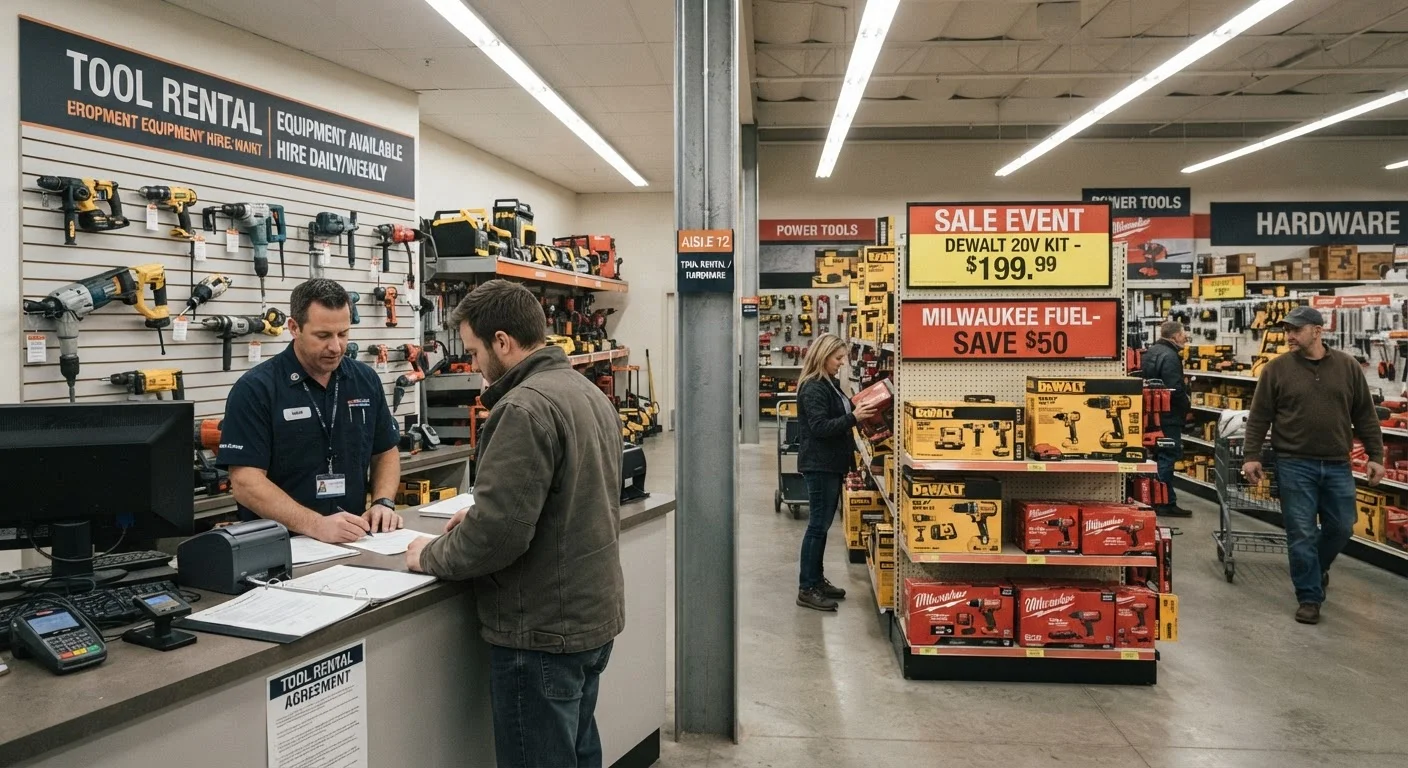
Photo: SaverSteals.com | Explore More. Shop Smarter. editorial
—— In This Article
Key Takeaways
- Renting often costs less than buying when a tool will only be used once or twice.
- Sale prices on tools can mislead — storage, maintenance, and resale loss add hidden costs.
- The break-even point between renting and buying depends heavily on the tool type and job frequency.
- Timing a purchase around hardware store sale cycles makes buying more defensible for repeat-use tools.
- Neither option is universally better — the right choice depends on your specific project scope.
The Real Cost of a 'Good Deal' on a Tool You'll Use Once
A 30% markdown at a hardware store looks compelling in the moment. But for a one-off job — say, a tile saw for a bathroom renovation or a drain snake for a single clog — the purchase price is only the beginning. Add in storage space, any required maintenance, and the reality that many tools bought for singular projects never get used again, and that sale price looks less impressive.
The true cost of ownership includes depreciation (tools lose value quickly), the opportunity cost of cash tied up in something sitting in your garage, and potential resale friction if you later try to recoup money. For tools that are large, specialized, or battery-platform-specific, resale can be slow and returns are often poor.
If you're disciplined about timing purchases — see when hardware stores actually cut prices — buying can make sense for tools you'll genuinely reuse. But for the one-and-done scenario, that logic collapses fast.
How Rental Pricing Actually Works
Tool rental is priced in tiers: typically a half-day rate, a full-day rate, a weekly rate, and sometimes a four-week rate. For most one-off home projects, the full-day or weekend rate is the relevant comparison point. Rental rates vary significantly by region and tool type, but for reference, a mid-grade tile saw might rent for $50–$80 per day, while purchasing a comparable new unit could run $300–$600 or more even on sale.
Rental also bundles in something that purchase doesn't: maintained equipment. Rental centers are required to keep tools in working order, calibrate blades, and replace worn parts. You're not inheriting someone else's problem — or your own future maintenance bill.
| Tool Rental | Buying on Sale | |
|---|---|---|
| Upfront cost | Low (daily/weekly rate) | Higher, offset by discount |
| Long-term cost (infrequent use) | Lower overall | Higher once ownership costs added |
| Long-term cost (frequent use) | Accumulates quickly | Lower per-use over time |
| Maintenance responsibility | Rental center's responsibility | Owner's responsibility |
| Storage required | None | Yes — can be significant for large tools |
| Equipment condition | Maintained, standardized | Varies; clearance items may lack warranty |
| Availability | Depends on local rental centers | Widely available; sale timing varies |
| Best for | One-off or rare projects | Repeated use across multiple projects |
One underappreciated advantage is liability management. If a rented tool malfunctions due to a pre-existing defect, the rental center bears responsibility. A discounted purchase — especially a closeout or clearance item — may come with a limited or voided warranty.
Where Buying on Sale Wins
Rental makes less sense when you already know a tool will see repeated use. If you're a homeowner who does annual deck maintenance, owns rental properties, or regularly takes on DIY projects, buying during a genuine sale cycle is a sound strategy. The key word is genuine — not every sale represents a real markdown. A year-round approach to tool spending helps you distinguish real price drops from inflated reference prices.
For hand tools — wrenches, chisels, levels, clamps — the math almost always favors buying, even at full price. These items are durable, compact, and used across many different jobs. Renting a set of clamps for an afternoon rarely makes financial or logistical sense. For more guidance on which categories hold up well secondhand, the hand tools vs. power tools used-market comparison covers the durability and risk tradeoffs in detail.
Do a Realistic Frequency Audit First
Before committing to a purchase, write down every time in the past two years you would have used the tool. If you can count those instances on one hand, rental is probably the smarter financial move. Honest self-assessment here saves more money than any sale discount.
Running the Numbers: A Simple Break-Even Framework
Before deciding, run a quick break-even calculation. Estimate the total rental cost for the number of times you'd realistically use the tool over the next two years. Then compare that to the discounted purchase price, minus a conservative resale value estimate. If the rental total is lower, rent. If buying comes out ahead — and you're honest about future use — then a sale purchase is defensible.
For example: a power washer renting at $60/day used three times per year costs $360 over two years. A sale-priced unit at $250 with a realistic resale value of $100 after two years nets $150 in actual cost. In that scenario, buying wins — but only because the frequency of use is genuinely high. Change the usage to once, and rental is clearly cheaper.
If used equipment interests you as a middle path, see online auctions vs. local resale for used tools for how to evaluate secondhand options without overpaying. And if you work with contractors or are exploring trade accounts, contractor accounts vs. standard retail explains where those savings actually apply.

Tools Editorial Team
Tools Editorial Team is the collective byline for our editorial team and contributor network. Articles published under this byline or an editorial pen name are researched, written, and reviewed according to our editorial standards for clarity, consistency, and independence before publication.
View author profile