
Online Auctions vs. Local Resale: Choosing the Right Channel for Used Tools
Weigh the trade-offs between bidding online and shopping locally so you find the right used tools without overpaying or guessing.
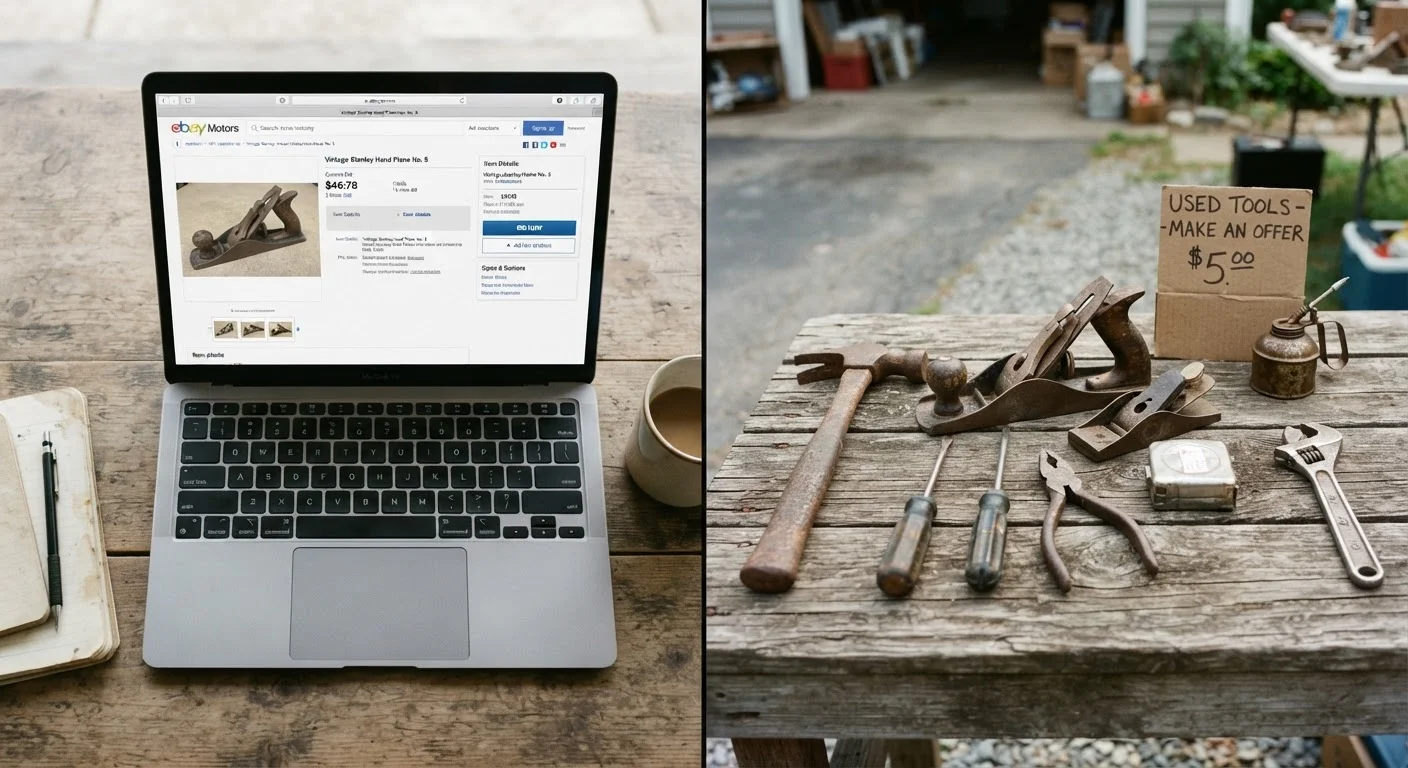
Photo: SaverSteals.com | Explore More. Shop Smarter. editorial
—— In This Article
Key Takeaways
- Online auctions offer wider inventory but require careful listing analysis and add shipping costs.
- Local resale lets you inspect tools in person, reducing the risk of hidden damage.
- Auction final prices can exceed private-sale equivalents once buyer's premiums and shipping are factored in.
- Local deals on large, heavy equipment are almost always more cost-effective than shipping alternatives.
- Neither channel is universally superior — the right choice depends on the specific tool and your inspection confidence.
How Each Channel Actually Works
Online auction platforms aggregate used tools from sellers across the country — sometimes from commercial liquidations, contractor estates, or individual resellers. You bid against other buyers, and the final price is determined by competition, not a fixed ask. Buyer's premiums (typically 10–20% added at checkout on commercial auction sites) and shipping costs are layered on top. For a thorough look at what you gain and give up when bidding, see Buying Used Tools at Auction: The Full Picture.
Local resale covers garage sales, estate sales, flea markets, and peer-to-peer listings on community-based platforms. Prices are usually posted, and negotiation is common. You drive to the seller, inspect the tool, and walk away with it the same day — or you don't buy it at all. The pool of available tools is limited to your geographic area, but so is the friction.
| Criterion | Online Auctions | Local Resale |
|---|---|---|
| Inventory breadth | National; wide selection | Local area only |
| Pre-purchase inspection | Photos and descriptions only | Full hands-on access |
| Price transparency | Final price varies by competition | Asking price upfront; negotiable |
| Additional fees | Buyer's premium + shipping | Typically none beyond asking price |
| Heavy equipment suitability | Poor; shipping cost and risk high | Strong; local pickup avoids freight |
| Rare or specialty tools | Strong; national reach helps | Limited by local supply |
| Transaction speed | Days to weeks including shipping | Same-day pickup possible |
Inspection Access: The Single Biggest Difference
The ability — or inability — to physically test a tool before purchase is where these channels diverge most sharply. Locally, you can plug in a circular saw, listen to the motor, check the blade guard, and look for hairline cracks in the housing. That kind of verification is impossible remotely.
Online, you're working from photos and seller descriptions. Listing language matters enormously: vague terms like "works when last used" or "sold as-is" are not interchangeable with a verified condition report. Knowing how to interpret those signals is a skill — and Reading a Tool Auction Listing Without Being Misled walks through the specific phrases and photo omissions that should raise flags before you bid.
This inspection gap is especially consequential for power tools where internal components — brushes, bearings, armatures — can fail invisibly. Hand tools are generally lower risk because wear is easier to spot visually.
"As-Is" Means No Recourse
Both online auctions and local resale transactions are frequently conducted on an as-is basis, meaning the seller makes no warranty about function or condition. Unlike new-tool retail purchases, there is generally no return window. Factor this in before assuming a low price compensates for unknown condition — repair costs on power tools can be significant.
Price Reality: What You'll Actually Pay
Sticker price and final cost are rarely the same thing in either channel. Online auctions on commercial platforms add buyer's premiums; shipping on anything heavier than a hand tool adds $30–$80 or more depending on size and distance. A drill press that appears to sell for $120 at auction can land at your door costing $200 or higher once all fees are included.
Local resale pricing is more transparent upfront, but common tools in high-demand areas — cordless drills, levels, circular saws — often carry asking prices that reflect the seller's inflated sense of value. Negotiation is standard; arriving informed about typical used-market values for a specific tool category helps.
10–20%
Typical buyer's premium on commercial auction sites
Commercial tool auction platforms commonly add a buyer's premium on top of the hammer price, increasing effective cost beyond the winning bid.
$30–$80+
Estimated freight cost for a mid-size power tool
Shipping costs for heavier tools vary significantly by carrier and distance, and can substantially close the gap between online and local pricing.
For context on how purchase cost stacks up against other options, How Tool Rental Compares to Buying on Sale for One-Off Jobs provides a useful framework if a tool is only needed once.
Matching Channel to Tool Type
The smarter approach is not picking a single channel for all purchases, but matching channel to tool type. Heavy stationary equipment — table saws, band saws, drill presses, air compressors — almost always makes more sense to source locally. The shipping logistics alone create cost and damage risk that undermine any apparent online savings.
Specialty or uncommon tools — particular router profiles, vintage hand planes, industrial-grade torque wrenches — are better suited to online auction search where national reach brings far more inventory into view. Common cordless tools fall in between: local is convenient, but online competition can produce lower final prices if you're patient and disciplined about setting a ceiling bid.
The same calculus applies in adjacent categories. Online Listings vs. In-Person Markets: Where Used Furniture Deals Actually Hold Up examines very similar trade-offs in the furniture resale space and reinforces why item size and freight risk are recurring factors in the channel decision.
For a broader look at how these channel dynamics play out across product types, Tool Deals is a useful reference point for staying grounded on market-rate pricing before you bid or negotiate.

Tools Editorial Team
Tools Editorial Team is the collective byline for our editorial team and contributor network. Articles published under this byline or an editorial pen name are researched, written, and reviewed according to our editorial standards for clarity, consistency, and independence before publication.
View author profile