

Key Takeaways
Why Cyber Monday Is a Paradise for Fake Discounts
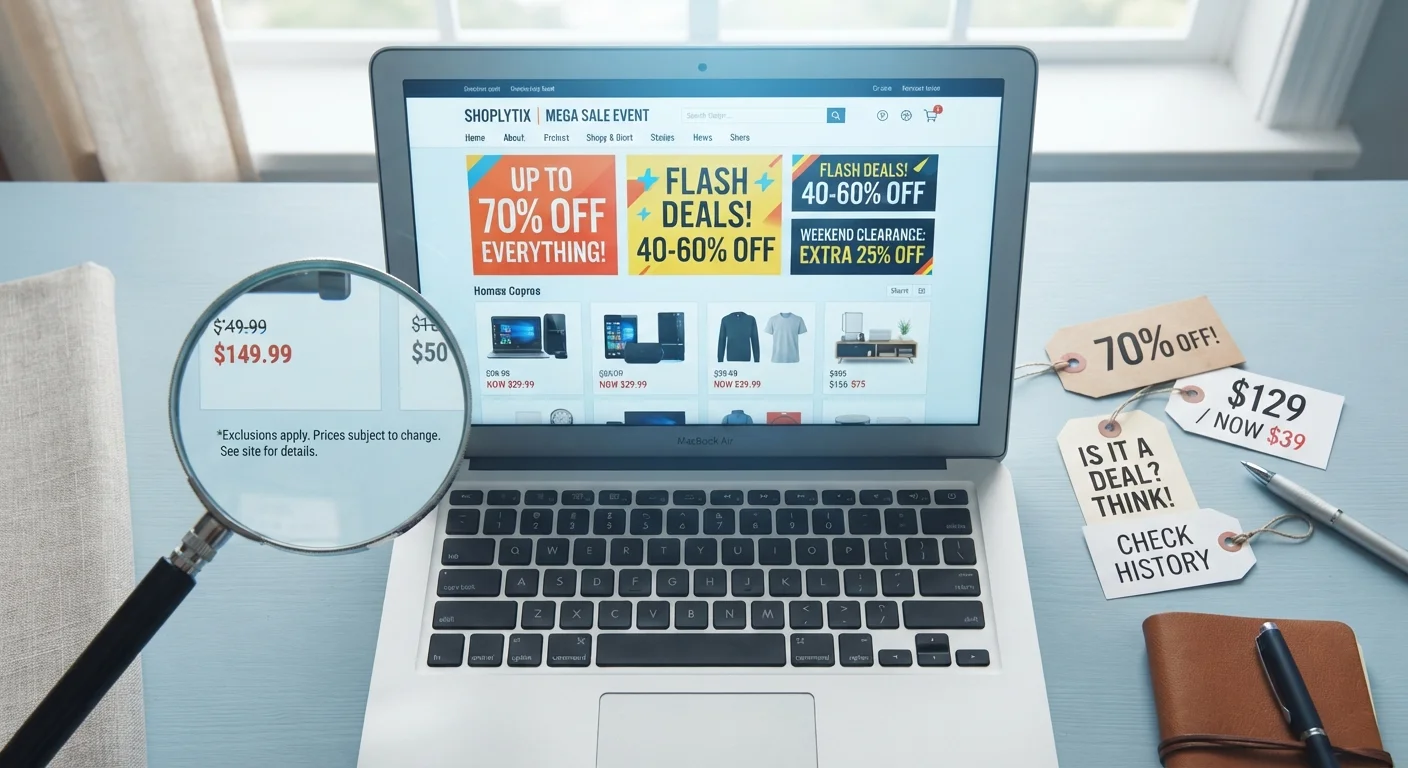
Cyber Monday generated over $12 billion in U.S. online spending in a single day in 2023, according to Adobe Analytics. That number tells you everything about why retailers invest heavily in looking like they're giving money away, even when margins barely move. The sheer volume of traffic, the social pressure to buy before time runs out, and the assumption that everything is on sale creates ideal conditions for inflated discounts to go unquestioned.
The mechanics are straightforward: a retailer raises the listed 'regular' price weeks before Cyber Monday, then marks it down to what was actually the normal selling price - or only slightly below - and calls it 40% off. Shoppers see a big red badge and skip the math. This practice, sometimes called reference price manipulation, is legal in most U.S. states as long as the inflated price was technically listed at some point, even briefly.
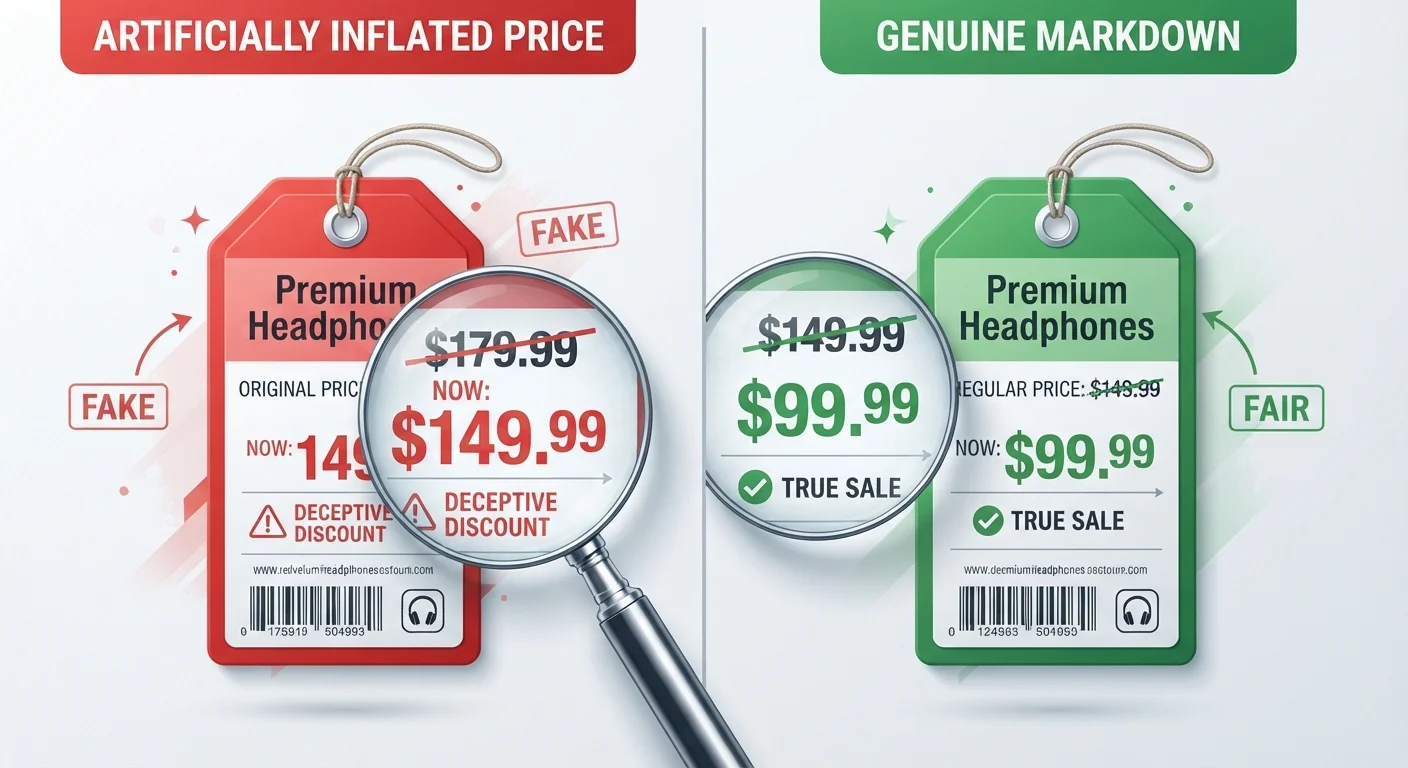
Understanding how fake deals are constructed is the fastest path to identifying real ones. The sections below dismantle the most persistent myths about Cyber Monday pricing, then give you the specific tools and signals to spot genuine markdowns before you click buy.
For a broader look at how Cyber Monday compares to other sale windows, see why Cyber Monday deals hit different than Black Friday.
The Myths - Busted One by One
These are the beliefs that cost shoppers real money every Cyber Monday. Each one is rooted in a half-truth that retailers are happy to leave uncorrected.
Myth
The 'original price' shown next to a Cyber Monday discount is what you would have paid before the sale.
Fact
Retailers frequently raise reference prices weeks before Cyber Monday specifically to create the appearance of a larger discount on sale day.
The Federal Trade Commission requires that a 'former price' must have been offered in good faith for a reasonably substantial period. In practice, enforcement is inconsistent, and many retailers list inflated reference prices briefly - sometimes only online - to meet the technical threshold. The result is that a $200 item marked 'Was $350, Now $210' may have sold at $200 for most of the prior year.
The fix is simple: never use the retailer's stated 'original price' as your benchmark. Use the 90-day price average from a tracker like CamelCamelCamel or Honey. If the Cyber Monday price is at or above that average, the deal is not real. The same price inflation tactics apply on Black Friday - the mechanics are identical across both events.
Myth
Cyber Monday deals are only available for 24 hours, so you need to act immediately.
Fact
Most major Cyber Monday 'deals' extend for several days, and many identical prices persist into the following week or reappear during December sales.
The 'limited time' framing is one of the most effective psychological pressure tools in retail. Countdown timers create urgency, but the underlying prices often don't move when those timers expire. Retailers routinely extend sales, reset timers, and re-run identical promotions under new event names ('Cyber Week,' 'Extended Cyber Savings') within days of the original event.
Before responding to any countdown timer, check whether the same retailer ran an identical or near-identical promotion in the weeks prior. Deal aggregator sites like Slickdeals archive historical promotions, making this a 30-second check. If the 'limited time' deal has appeared three times in the last two months, the urgency is manufactured.
That said, genuine lightning deals and doorbusters with hard inventory caps do exist - primarily on specific high-demand electronics. The difference is that real scarcity shows up in actual stock-out data, not just in a timer graphic.
Myth
Bigger discount percentages always mean bigger real savings.
Fact
A 60% badge on a low-quality item with an inflated reference price can represent less real value than a 15% discount on a competitively priced product with a verified price history.
Percentage-off figures are calculated against whatever reference price the retailer chooses to display. A private-label product with a $100 MSRP that realistically sells for $45 year-round can be listed as '55% off' at $45 without any meaningful change to the actual market price. The badge number is arithmetic - it tells you nothing about whether the absolute price is competitive.
The productive frame is: what is this item worth, and am I paying less than that? For commoditized products with standardized specs (USB cables, generic accessories, basic appliances), comparison shopping across five retailers in two minutes tells you more than any discount badge. For brand-name products with stable price histories, the 90-day tracker does the same work. Holiday sale myths around discount percentages cost shoppers money every year - the percentage figure is among the most abused metrics in retail marketing.
Myth
If a deal is featured on a deal aggregator site like Slickdeals, it's verified as genuinely good.
Fact
Aggregator sites surface user-submitted deals without systematic price history verification; community voting helps but does not guarantee accuracy.
Deal aggregator communities are genuinely useful - the collective knowledge of deal hunters catches a lot of fake discounts, and the comment sections often surface price history data quickly. But the model relies on crowd wisdom, which has blind spots. Newer retailers, less-trafficked product categories, and sponsored deal placements all pass through aggregators with less scrutiny than flagship electronics deals.
Use aggregators as a discovery layer, not as a verification endpoint. When you find a Cyber Monday deal on Slickdeals or Reddit's r/deals, read the comments for any price history context, then independently confirm with a tracker. Treat upvotes as a signal worth investigating, not as a seal of approval.
Myth
Amazon's Cyber Monday prices are always the lowest available online.
Fact
Amazon's prices are competitive on many items, but retailer-direct and smaller marketplace sellers routinely undercut Amazon on Cyber Monday, especially for brand-specific products.
Amazon's scale gives it pricing power in many categories, but the assumption that Amazon is always the cheapest is exploited by both Amazon and third-party sellers who know shoppers won't check elsewhere. Brand-direct storefronts (the brand's own website) frequently match or beat Amazon on Cyber Monday because they're willing to discount into their wholesale margin. Big-box competitors like Costco, B&H Photo, and Newegg target specific categories aggressively to capture comparison-shopping traffic.
The most efficient approach: use Google Shopping or a price aggregator to pull the current lowest price across all tracked retailers simultaneously. This takes 60 seconds and eliminates the assumption that you've already found the best price. Also note that Amazon's own Cyber Monday 'deals' vary enormously in quality - their algorithm surfaces a mix of genuinely reduced items alongside sponsored placements and marginal discounts dressed up with deal badges.
Myth
'Low stock' warnings mean a product will sell out if you don't buy now.
Fact
Low stock indicators are frequently automated triggers set at arbitrary inventory thresholds - they do not reliably predict actual sell-out risk.
Retailers configure 'only X left' messages using internal inventory thresholds, not real-time demand modeling. A product showing 'Only 3 left!' might have 3,000 units in a regional warehouse - the trigger fires when local or digital inventory drops below a set number, regardless of replenishment pipeline. This is a documented practice in e-commerce UX design, applied specifically because urgency signals measurably increase conversion rates.
The exception: legitimately supply-constrained products - limited-edition releases, specific GPU models, or products from manufacturers with known production constraints - can genuinely sell out during peak demand. The tell is whether the product has a documented scarcity history, not whether a retailer's interface says so on sale day.
The Tools That Do the Verification Work for You
You don't have to rely on instinct to tell a real deal from a manufactured one. A short stack of free tools covers most of the verification work in under two minutes.
Price History Trackers
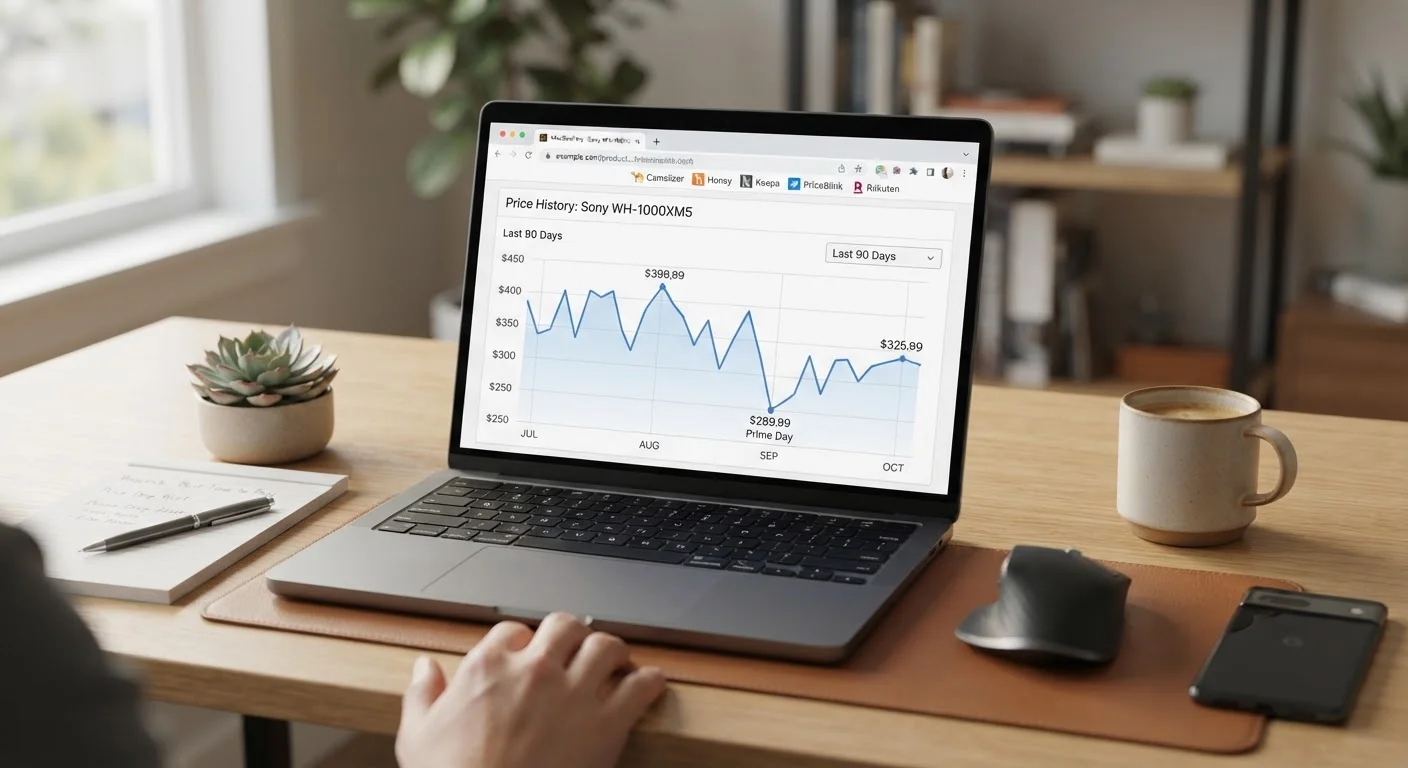
CamelCamelCamel tracks Amazon price history going back years. Paste a product URL and you get a chart showing every price fluctuation - including the suspicious spike that happened three weeks before Cyber Monday. Honey (now owned by PayPal) does similar work across a broader range of retailers and flags whether the current 'sale' price is actually lower than recent averages.
The key habit: compare the Cyber Monday price against the 90-day average, not the listed MSRP. If the sale price is at or above the 90-day average, the deal is not real regardless of how big the discount badge looks.
Learn to read price history charts before you commit to any purchase - the data patterns are more readable than most people expect.
Cashback Portals
Even when a discount is genuine, cashback portals like Rakuten, TopCashback, and BeFrugal add a layer of real savings on top. On Cyber Monday, many portals run elevated cashback rates specifically to capture holiday traffic. A 6% cashback on a $400 electronics purchase is $24 back with zero additional effort - stack that on top of a verified price drop and you're extracting double value.
$12.4B
U.S. Cyber Monday online spending in 2023
Adobe Analytics reported Cyber Monday 2023 as the biggest U.S. online shopping day in history, driven by electronics and apparel discounts.
61%
Shoppers who don't verify prices before buying
A 2022 NerdWallet survey found 61% of U.S. holiday shoppers made no effort to check whether a sale price was genuinely lower than the recent average.
Up to 6%
Extra cashback available via portals on Cyber Monday
Rakuten and TopCashback typically boost cashback rates for top retailers during Cyber Monday to capture holiday shopping traffic.
35%
Of holiday 'deals' priced at or above pre-sale levels
A 2019 Which? investigation found roughly 35% of Black Friday and Cyber Monday deals were cheaper or the same price at other points in the year.
Browser Extensions That Flag Price Drops in Real Time
The Camelizer (a CamelCamelCamel extension) overlays a price history chart directly on Amazon product pages without leaving the tab. Karma and Capital One Shopping do similar work across multiple retailers, automatically applying coupons and flagging whether better prices exist elsewhere. Running one or two of these during your Cyber Monday browsing session turns passive shopping into active verification.
Don't Install Too Many Coupon Extensions
Running multiple browser extensions simultaneously - Honey, Capital One Shopping, Rakuten, Karma - can cause conflicts, missed cashback triggers, and tracking errors. Pick one cashback extension and one price tracker, and stick with them consistently. Check the portal terms: some cashback stacking combinations void rewards entirely.
Cashback Portals Must Be Activated Before You Shop
Most cashback tracking works via affiliate referral cookies, which are set when you click through from the portal to the retailer. If you navigate directly to a retailer's site and then try to claim cashback, it won't apply. Always start your shopping session from inside the portal dashboard or by activating the browser extension before loading the retailer's page.
Categories Where Real Cyber Monday Deals Actually Exist
Not every product category delivers legitimate Cyber Monday savings. Knowing where genuine discounts concentrate helps you allocate your verification effort and your budget.
Consumer Electronics and Accessories
This is the single most reliable Cyber Monday category. TVs, headphones, laptops, and smart home devices see genuine year-over-year price competition, particularly from Amazon, Best Buy, and direct-brand storefronts. Model-year transitions are a key driver - retailers discount current models when manufacturers are close to releasing successors, and Cyber Monday timing often aligns with that cycle.
Software and Subscriptions
Digital products carry near-zero inventory cost, which means software companies can offer deep discounts without meaningful margin damage. Antivirus subscriptions, creative software, VPN services, and productivity tools routinely hit genuine lows on Cyber Monday. Unlike physical goods, these deals also carry no shipping lag, making them some of the safest same-day purchases of the event.
Direct-to-Consumer Brands
DTC brands that control their own pricing - mattress companies, luggage brands, fitness equipment makers - tend to run legitimately lower prices on Cyber Monday because they're competing for wallet share without a wholesale middleman's margin to protect. These brands also typically offer clearer price history through their own sites, making verification easier.

Where to Be Skeptical
Toys, apparel, and home décor frequently show inflated 'original' prices. These categories are saturated with private-label and off-brand products that were never sold at the listed reference price. They also tend to reappear at identical prices in January clearance and end-of-season sales - often without any meaningful discount relative to normal retail. See how Black Friday compares to end-of-season clearance by category before deciding whether Cyber Monday is actually your best window.
Building a Repeatable Deal-Verification System
Spotting one fake deal is luck. Having a process that catches them consistently is a system. Here's the routine that works regardless of retailer or product category.
- Build your list before Cyber Monday. Identify specific items - model numbers, not just product categories - at least two weeks in advance. Vague intent produces impulse buys. Specific lists produce verified savings.
- Set a price alert now. CamelCamelCamel, Honey, and Google Shopping all support price alerts. You'll get notified if the item drops before Cyber Monday, which happens more often than most shoppers realize. Early access 'deals' sometimes precede the main event by days.
- Establish your 90-day baseline. Before Cyber Monday, note the current price and the 90-day average from a tracker. Write it down. When the sale hits, compare the Cyber Monday price against that baseline - not against the inflated 'was' price shown by the retailer.
- Check multiple retailers simultaneously. Google Shopping, PriceGrabber, and NexTag aggregate pricing across stores. A product showing '40% off' at one retailer may be selling at 5% less than normal at a competitor with no discount badge at all.
- Stack cashback last. Once you've verified the price is genuinely lower than the baseline, add your cashback portal on top. Activate the portal before clicking through to the retailer - most cashback is tracked via referral link and won't apply retroactively.
The Only Benchmark That Matters: 90-Day Price History
Ignore the retailer's 'original price.' The only meaningful comparison is the verified 90-day average from an independent price tracker. A Cyber Monday price that beats the 90-day average is a real deal. A price that matches or exceeds it is not, regardless of how large the discount badge appears. Make this a non-negotiable step before any significant purchase during Cyber Monday.
Fake Deals Are Especially Common on Marketplace Listings
Third-party sellers on Amazon, Walmart Marketplace, and similar platforms control their own reference prices. This makes inflated 'original price' manipulation easier and harder to detect than with first-party retail listings. When buying from a marketplace seller on Cyber Monday, always verify the seller's rating, check the product's price history independently, and confirm that the listed 'original price' has any basis in the product's actual sales history.
For a complete pre-Cyber Monday preparation checklist - including account setup, browser tool configuration, and timing tactics - see Your Cyber Monday Game Plan: From Wishlist to Checkout.

The same principles that apply to Cyber Monday apply to Black Friday and other high-hype sale events. If you want to see how this myth-busting framework extends to Black Friday specifically, Black Friday Myths That Cost Shoppers Real Money covers the same terrain for that event.