

Key Takeaways
Winter Clearance Calendar
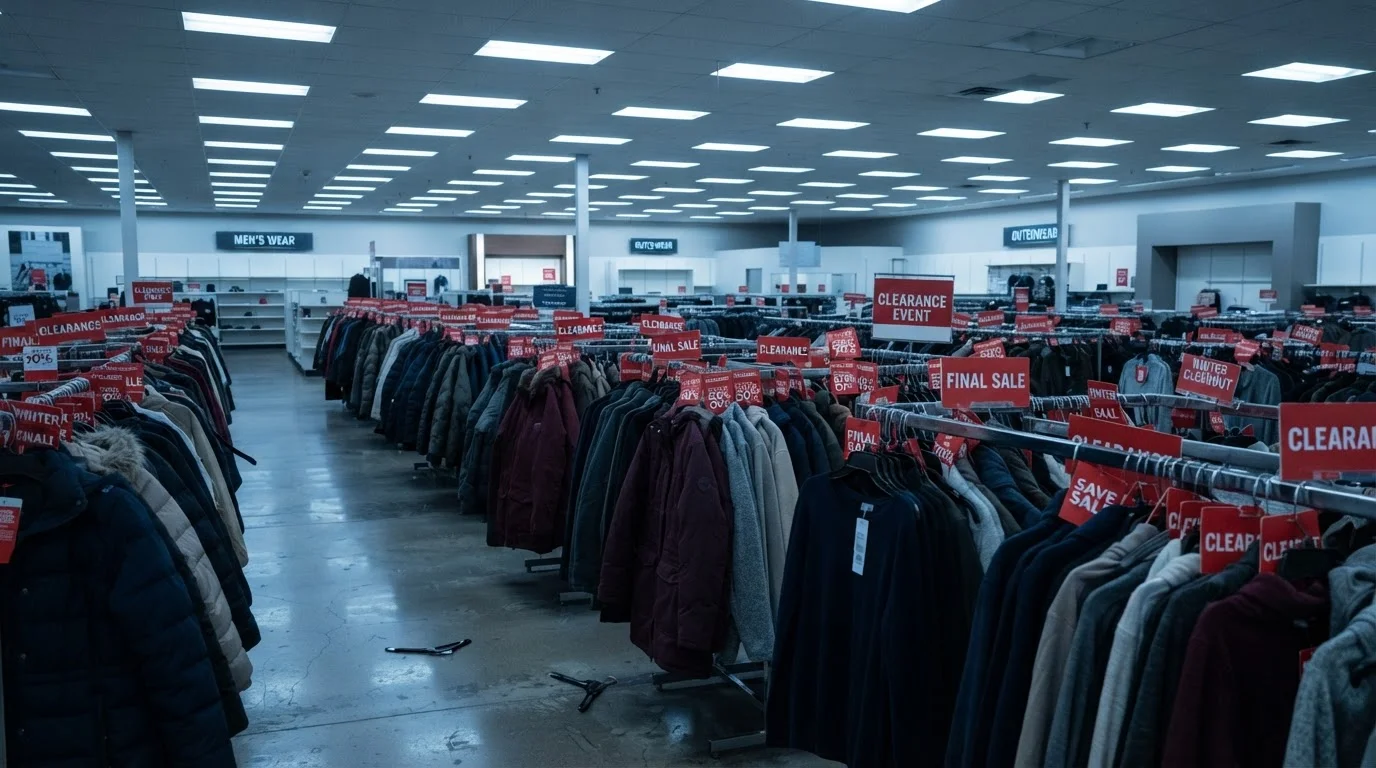
A winter clearance calendar maps the specific weeks between late December and early March when retailers systematically cut prices on seasonal inventory - apparel, outerwear, home goods, and holiday décor - to free up shelf space for spring merchandise. Unlike one-day sales, these markdowns deepen in predictable waves tied to inventory turnover targets and fiscal quarter deadlines. Understanding this calendar means you're shopping when prices are structurally lowest, not just when marketing says so.
Retailers use automated markdown optimization software that triggers price reductions based on sell-through rates, weeks-of-supply metrics, and planogram changeover dates - all of which cluster in recognizable windows each year.
Why December 26 Is Not the Bottom
Every year, shoppers flood stores on December 26 convinced they're about to catch the deepest discounts of winter. They're not. They're catching the first markdown - typically 25-40% off - which is just the opening bid in a weeks-long price descent that retailers have already planned down to the day.
Here's what's actually happening on December 26: stores are processing a surge of returns, restocking shelves, and applying automated system markdowns that were pre-scheduled before the holiday. The algorithm isn't done cutting yet. Retailers know from historical sell-through data that early post-Christmas shoppers are less price-sensitive than they think - they're motivated by novelty and FOMO, not patience. Stores exploit that.
The real calendar looks like this: December 26 is wave one. The second week of January is wave two. Late January - often tied to fiscal quarter-end - is wave three, and frequently where prices actually bottom out on high-ticket items. A fourth wave exists in mid-to-late February for stubborn inventory, though selection by then is sparse.
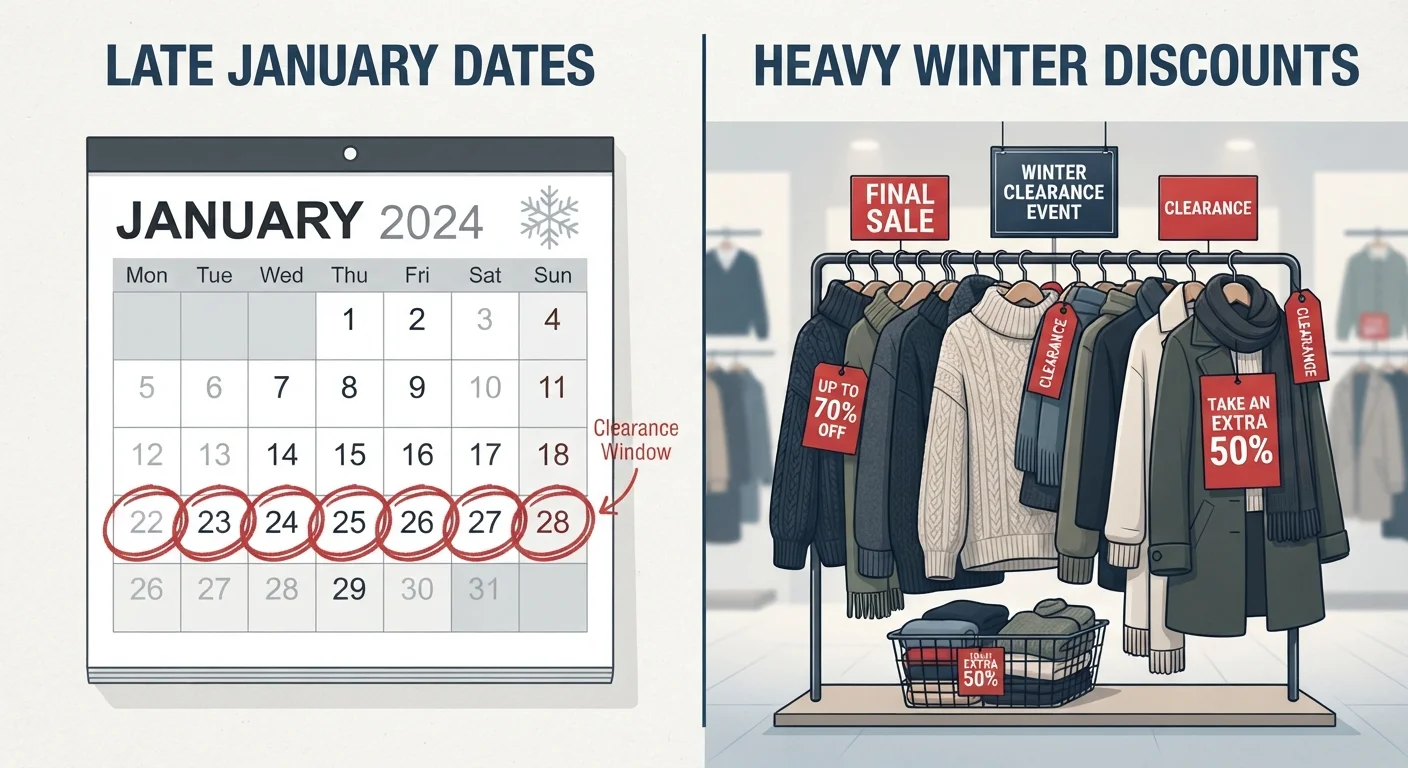
Understanding this progression changes how you shop. Instead of elbowing through crowds on December 26 for a 30% discount, you can target specific categories on specific weeks and capture 60-70% discounts with far less competition. The trade-off is selection: the longer you wait, the fewer choices remain. But for anyone buying basics - a black parka, neutral throw pillows, standard bulb holiday lights - that trade-off strongly favors patience.
For context on how this fits into the broader retail discount year, the full retail pricing calendar maps every major discount window by category.
The Markdown Wave Schedule: Week by Week
Retailers don't cut prices randomly. They follow a markdown cadence driven by inventory management systems that track sell-through rate - the percentage of a product sold versus what was stocked. When a product's sell-through falls below a threshold, the system triggers a price reduction. Those thresholds are typically hit in sequence, creating the wave pattern below.
40-70%
Typical discount depth by late January
Industry markdown data shows most major apparel retailers reach 40-70% off winter inventory in the final week of January as fiscal quarter-end pressure peaks.
Week 3
Optimal week to shop post-holiday
Retail analyst data consistently identifies the third week of January as the best combination of discount depth and remaining selection across apparel and home goods categories.
50%+
Holiday décor discount within 48 hours post-Christmas
Most major chains apply automated markdowns of 50% or more to holiday décor items within one to two days after December 25, when future sell-through potential drops to near zero.
20-40%
January mattress and furniture discount range
January's model-year changeover produces consistent 20-40% discounts on furniture and mattresses at major retailers as they clear prior-year inventory before new product introductions.
Late Feb
Price floor for winter sports equipment
Ski and snow sports gear reaches its lowest seasonal prices in late February and early March, when retailers begin transitioning floor space to spring outdoor merchandise.
Week 1: December 26 - January 1
Typical discount depth: 25-40% off. This is the well-known post-Christmas sale. Holiday décor, gift sets, and seasonal food items take the deepest initial cuts - often 50% immediately - because they have zero value past the holiday. Apparel and home goods start at 30-40% off. This week rewards shoppers who want holiday items for next year (wrapping paper, ornaments, artificial trees) and those who can't wait on selection.
Week 2-3: January 2-18
Typical discount depth: 40-60% off. This is the most productive window for most shoppers. By now, initial excitement has faded, foot traffic is down, and retailers are watching sell-through numbers closely. A second automated markdown fires around January 6-10 in most major chains. Outerwear, winter boots, cold-weather accessories, and winter bedding hit 50% off in this window. This is also when online retailers push clearance hardest, running additional sitewide coupon codes on top of already-reduced prices.
“Retailers don't mark down because they want to be generous - they mark down because unsold inventory is a cost. The markdown schedule is a cost-management tool, not a favor to shoppers. Once you understand that, you can read the schedule like a map.”
— Jan Rogers Kniffen, Retail industry consultant and former department store executive
Week 4: January 19-31
Typical discount depth: 60-75% off. Fiscal quarter-end pressure kicks in here for retailers whose Q4 closes January 31. Floor sets for spring merchandise are scheduled, and anything that doesn't sell before the planogram swap becomes a problem. Expect the steepest apparel discounts of the season in this week. Furniture and mattress retailers also push hard here - January is historically their strongest sale month. If you're targeting outerwear, snow boots, or winter bedding and can wait until this window, the savings are substantial.
February: The Secondary Floor
Typical discount depth: 70-80%+ on remaining inventory. By early February, the clearance rack is a different beast - stripped of popular sizes and colors, but priced at levels that make sense for what's left. Retailers at this stage are recovering any margin they can before writing off unsold inventory. If your needs are flexible on specifics, February can surface extraordinary deals. Home goods and winter décor tend to survive into this window longer than apparel.
How retailers actually schedule these markdowns is more systematic than most shoppers realize - understanding the logic helps you predict the next cut before it's announced.
Category-by-Category Timing Breakdown
Not every product hits its price floor in the same week. Here's where each major winter category actually bottoms out - and why.

Outerwear and Cold-Weather Apparel
Price floor: January 19-31. Coats, parkas, snow pants, and insulated boots have high margins and retailers are reluctant to cut them early. But by late January, space pressure is acute - spring jackets and transitional clothing need floor space. This is when you'll see 60-70% off on full-priced winter coats. Stick to classic styles and neutral colors if shopping late; fashion-forward pieces disappear in the first two weeks.
Shop Late January for Outerwear Specifically
If you can only make one strategic winter clearance trip, make it between January 19 and January 31 with outerwear as your primary target. That window captures the convergence of automated markdown waves and fiscal quarter-end pressure, and outerwear margins are high enough that retailers are still cutting aggressively even at deep discounts. Common sizes sell out fast - prioritize early in the window if you wear a standard size.
Stack Clearance With Coupon Codes
Many retailers allow percentage-off coupon codes to apply on top of clearance prices online, often without advertising this combination. Before checking out any clearance purchase, run a quick search for active promo codes for that retailer - codes like EXTRA20 or CLEARANCE15 frequently stack. This can turn a 50% clearance item into a 60-65% deal with minimal effort.
Use Price Alerts to Catch the Markdown Moment
Set price alerts on your target items in late December, before the clearance season begins. When the first markdown fires, you'll get an immediate notification and can decide in real time whether to buy or hold for the next wave. This removes the guesswork and prevents you from missing a cut because you weren't checking manually.
Holiday Décor
Price floor: January 1-7. Holiday décor has the sharpest initial cut and the fastest inventory depletion. Items like artificial trees, string lights, ornament sets, and wrapping paper hit 50-75% off immediately after December 25 and sell through fast. If you want good selection for next year's holiday, shop here within the first week of January. By week two, the best items are gone.
Winter Bedding and Home Textiles
Price floor: February 1-15. Flannel sheets, comforters, wool blankets, and throw pillows take longer to clear because their utility isn't strictly seasonal - someone might buy a flannel comforter in February. Retailers know this and don't panic-cut as early. By mid-February, however, spring home décor transitions are imminent and you'll find 50-70% off across bedding categories.
Small Appliances (Seasonal)
Price floor: Late January. Seasonal small appliances - space heaters, humidifiers, electric blankets - follow the outerwear timeline closely. January 15-31 is the sweet spot. These items are also excellent candidates for online clearance purchasing, where price drops tend to be cleanest and comparison is easy.
Furniture and Mattresses
Price floor: January (entire month). January is structurally the best month for furniture and mattress purchasing. Manufacturers launch new models in February, pushing retailers to liquidate prior-year inventory. This is less a clearance dynamic and more a model-year changeover - but the result is the same: genuine discounts of 20-40% on floor models and discontinued lines. Why January is the best month for mattresses explains this pattern in detail and shows how it applies to other categories too.
Winter Sports Gear
Price floor: Late February - early March. Ski and snowboard equipment, sleds, and ice skates follow a later clearance cycle because the season is still active through February in most of the country. Retailers don't panic until they see the season ending. Late February and the first week of March deliver the best cuts - often 40-60% off - though selection is limited. For a broader look at outdoor gear pricing patterns across the full year, the outdoor gear pricing calendar is worth reviewing.
Regional Variation in Clearance Timing
Winter clearance timing can shift by one to two weeks depending on your climate region. Retailers in warm-weather markets (Florida, Southern California, Texas) begin winter clearance earlier because consumer demand for cold-weather goods drops faster after Christmas. If you're shopping in a warm-weather market, the optimal windows described here may run roughly one week earlier than listed. Check your local store's clearance section in the first week of January to gauge how aggressively they're cutting.
Clearance Is Not the Same as a Sale
Standard sales (like a "30% Off Everything" promotion) are temporary price reductions that return to full price after a set period. Clearance markdowns are permanent reductions on specific units that will continue to drop until sold. A clearance item tagged at 40% off today may be 60% off next week if it doesn't sell - no coupon required. This distinction matters because it changes your decision logic: with clearance, patience is often rewarded, while with standard sales, the deal expires.
Liquidation vs. Retailer Clearance
Items that don't sell through retailer clearance channels often flow into liquidation - sold in bulk to discount chains like TJ Maxx, Marshalls, or Burlington. These items arrive on off-price shelves with no predictable schedule, typically months after the original clearance window. If you miss winter clearance season entirely, off-price retailers are a secondary option, but you lose control over timing and selection.
How Fiscal Calendars Drive Deeper Discounts Than You Expect
Most shoppers think about clearance in terms of seasons. Retailers think about it in terms of quarters. That misalignment is one of the biggest exploitable gaps in retail pricing.
Many large retailers operate on a fiscal calendar that ends January 31 or February 1. As that deadline approaches, inventory on the balance sheet becomes a liability. Store managers face pressure to hit sell-through targets, and markdown authorization that would normally require approval from a regional manager gets bypassed to move units. This is why the last two weeks of January often produce the sharpest, least-advertised price cuts of the season - they're driven by internal accounting pressure, not marketing strategy.
Similarly, spring floor sets - the planogrammed layouts that determine what goes where in a store - are typically delivered and installed between late January and mid-February. Any winter merchandise that hasn't sold by installation day needs to go somewhere: either an overflow rack (which gets heavily discounted), the back room (clearance at an even steeper cut), or liquidation channels (where you'll never see it). Knowing this timeline tells you that the week before a retailer's floor set changeover is often a hidden price floor.
You can sometimes find out when a retailer's floor set is scheduled by asking a sales associate directly - staff usually know. Alternatively, watch for when stores start receiving and unpacking new seasonal merchandise: that's your signal that the final clearance push is imminent.
For clothing specifically, these timing dynamics play out across multiple retailers simultaneously in late January - the clothing sale calendar maps which major retailers make their deepest cuts and when.
Online vs. In-Store: The Timing Isn't the Same
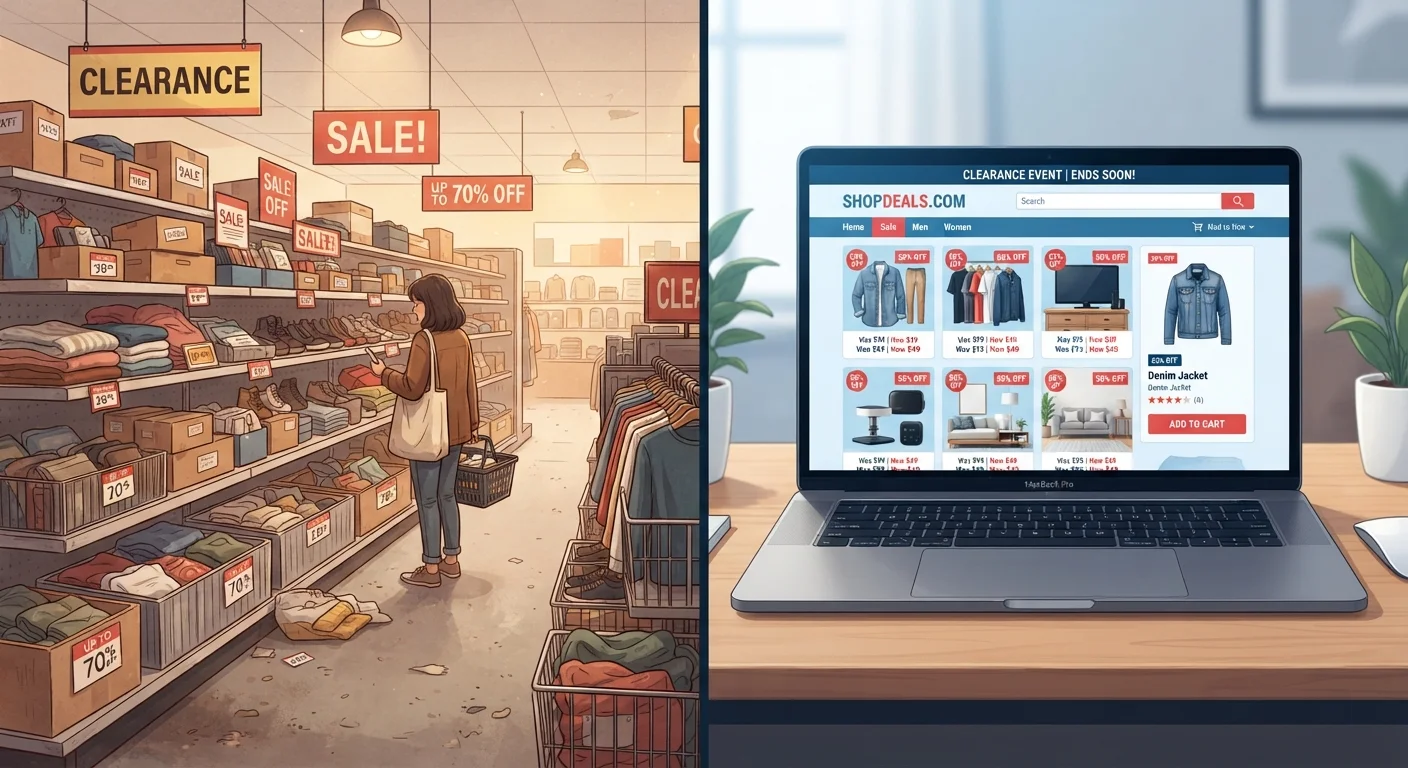
A common mistake is treating online and in-store clearance as equivalent. They're not - the timing, selection dynamics, and markdown patterns differ meaningfully, and the best strategy often involves using both in sequence.
Online clearance advantages: Prices tend to drop earlier online, often with an additional promo code or sitewide percentage stacked on top of the clearance price. Online inventory is searchable, filterable, and allows price comparison across multiple retailers in minutes. The downside is that sell-through is faster - a popular item at 60% off can sell out in hours, with zero restocking. What's gone online is usually gone permanently.
In-store clearance advantages: Physical clearance racks get progressively cheaper over time. An item marked 40% off this week may be 60% off next week if it doesn't sell - the markdown happens to the specific unit on the rack, not to a price in a database. In-store clearance also surfaces items that weren't listed online, particularly returned merchandise and floor models. The in-store experience rewards repeat visits and patience.
The optimal sequence: Check online first to benchmark prices and grab anything you're confident about. Then visit stores in the third and fourth weeks of January, when in-store markdowns are deepest and competition has dropped off. For anything size-sensitive (clothing, shoes), act online earlier - popular sizes disappear fastest.
For a detailed breakdown of which channel wins by category during winter clearance, the department store vs. online outlet comparison covers the tradeoffs precisely. And if you want to build out a full winter clearance shopping approach, the complete winter clearance shopping guide walks through markdown tracking and restocking traps in detail.
Building Your Personal Clearance Calendar
Generic advice about "shopping in January" doesn't capture the precision available to a prepared buyer. Here's how to build a clearance calendar that's specific to your actual shopping targets.
Step 1: Identify Your Target Categories Before December
Make a list of what you actually need - a new winter coat for next year, replacement bedding, holiday décor for 2025. Having a specific target prevents impulse purchases and focuses your attention on the weeks that matter for each item.
Step 2: Map Each Category to Its Price Floor Window
Use the category breakdown above to assign a "check date" to each item on your list. Your outerwear check date is January 19-31. Your holiday décor check date is January 1-7. Your winter bedding check date is February 1-15. Treating this like a scheduled appointment removes the guesswork.
Step 3: Set Price Alerts Now
Tools like Google Shopping alerts, Camelcamelcamel (for Amazon), and Honey's price tracker let you set a target price for specific items and receive a notification when the price drops to that level. Set these alerts in late December so you capture the first markdown and can decide whether to act or wait for a deeper cut.
Shop Late January for Outerwear Specifically
If you can only make one strategic winter clearance trip, make it between January 19 and January 31 with outerwear as your primary target. That window captures the convergence of automated markdown waves and fiscal quarter-end pressure, and outerwear margins are high enough that retailers are still cutting aggressively even at deep discounts. Common sizes sell out fast - prioritize early in the window if you wear a standard size.
Stack Clearance With Coupon Codes
Many retailers allow percentage-off coupon codes to apply on top of clearance prices online, often without advertising this combination. Before checking out any clearance purchase, run a quick search for active promo codes for that retailer - codes like EXTRA20 or CLEARANCE15 frequently stack. This can turn a 50% clearance item into a 60-65% deal with minimal effort.
Use Price Alerts to Catch the Markdown Moment
Set price alerts on your target items in late December, before the clearance season begins. When the first markdown fires, you'll get an immediate notification and can decide in real time whether to buy or hold for the next wave. This removes the guesswork and prevents you from missing a cut because you weren't checking manually.
Step 4: Visit Stores on Weekdays, Not Weekends
Clearance racks on weekends get picked over fast. Monday and Tuesday are the best days to shop in-store clearance - the previous week's markdown has been applied, new items have been added to clearance from the weekend's returns, and competition is minimal. If you're targeting a specific retailer, a mid-week visit in the third or fourth week of January is your best bet for both depth of discount and breadth of selection.
Step 5: Know When to Walk Away
Not every clearance item is a deal. A $400 coat marked down to $200 is still $200 - only a deal if you'd have paid $200 for it in the first place. Clearance pricing anchors against an original retail price, which is sometimes inflated. Before buying, check whether the same item (or a comparable one) is available at a similar price through a discount retailer, off-price store, or last season's inventory. Understanding how clearance cycles actually work helps you separate genuine markdowns from manufactured urgency.
Also worth knowing: the holiday discount calendar that precedes winter clearance - which holiday sale events actually deliver real discounts - shapes what's left on clearance racks in January. Categories that sold well during holiday events have less inventory to clear; categories that underperformed arrive in January with deeper initial cuts.
Regional Variation in Clearance Timing
Winter clearance timing can shift by one to two weeks depending on your climate region. Retailers in warm-weather markets (Florida, Southern California, Texas) begin winter clearance earlier because consumer demand for cold-weather goods drops faster after Christmas. If you're shopping in a warm-weather market, the optimal windows described here may run roughly one week earlier than listed. Check your local store's clearance section in the first week of January to gauge how aggressively they're cutting.
Clearance Is Not the Same as a Sale
Standard sales (like a "30% Off Everything" promotion) are temporary price reductions that return to full price after a set period. Clearance markdowns are permanent reductions on specific units that will continue to drop until sold. A clearance item tagged at 40% off today may be 60% off next week if it doesn't sell - no coupon required. This distinction matters because it changes your decision logic: with clearance, patience is often rewarded, while with standard sales, the deal expires.
Liquidation vs. Retailer Clearance
Items that don't sell through retailer clearance channels often flow into liquidation - sold in bulk to discount chains like TJ Maxx, Marshalls, or Burlington. These items arrive on off-price shelves with no predictable schedule, typically months after the original clearance window. If you miss winter clearance season entirely, off-price retailers are a secondary option, but you lose control over timing and selection.