Key Takeaways
Retail Markdown Machine
The markdown machine is the system retailers use to systematically reduce prices on slow-moving or seasonal inventory over time. It combines sales velocity data, inventory age, storage costs, and calendar targets to trigger price cuts at predetermined thresholds. Rather than arbitrary discounting, it's a structured process designed to clear shelf space before new merchandise arrives.
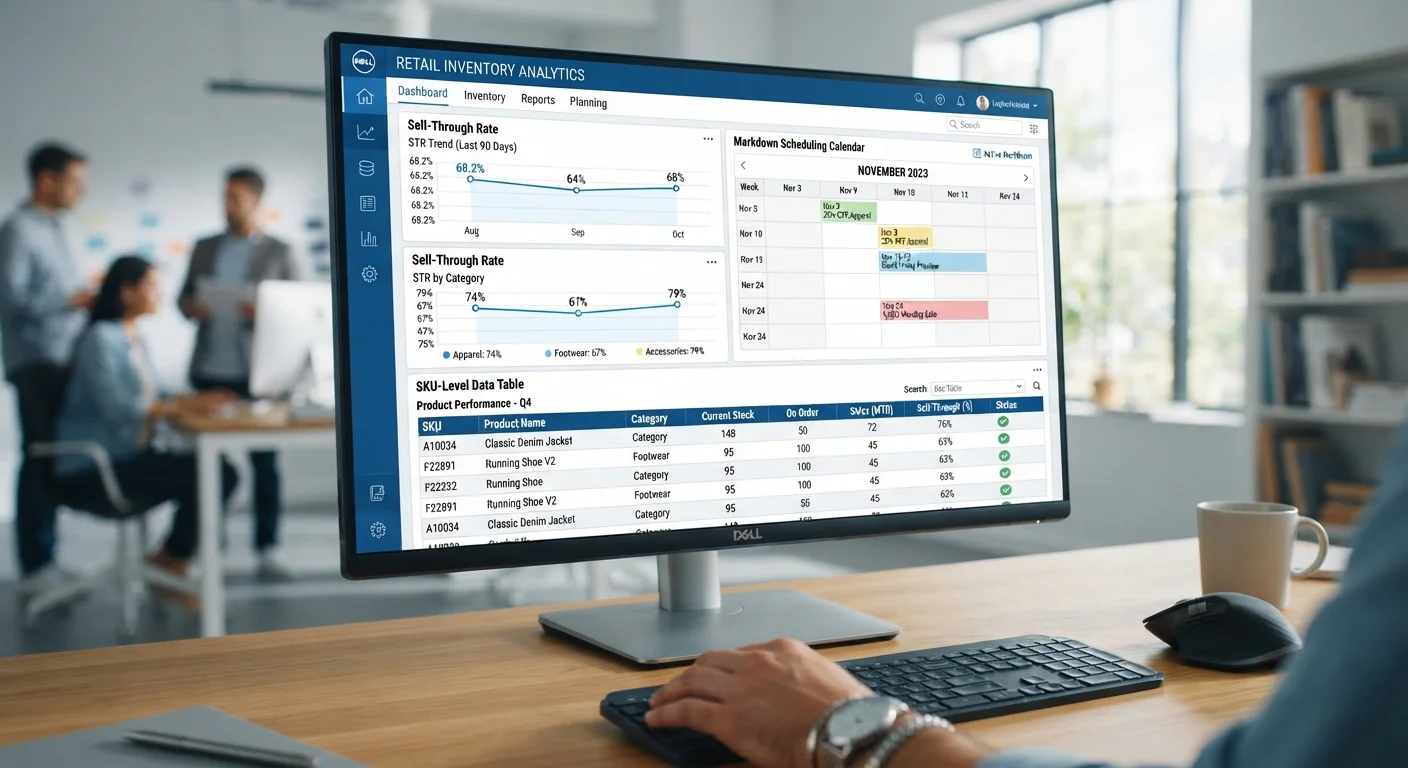
Most large retailers use automated inventory management software (such as Oracle Retail or JDA/Blue Yonder) that calculates optimal markdown timing and depth using algorithms that weigh holding costs against projected sell-through rates.
Why Clearance Pricing Isn't Random
Most shoppers assume clearance pricing is a reactive scramble - a retailer panicking over surplus stock. The reality is the opposite. Markdown decisions at mid-to-large retailers are governed by inventory management systems that process data continuously and flag items for price cuts based on hard metrics, not managerial hunches.
Understanding that system is the difference between a shopper who stumbles onto a deal and one who engineers it. The markdown machine runs on three inputs: sell-through rate, days in inventory, and holding cost. When an item falls below a sell-through threshold for a set number of days, the system queues it for a price reduction. The depth and timing of that reduction are determined by store policy, seasonal calendar, and how aggressively the retailer needs to clear floor space.
This isn't unique to big-box retailers. Even mid-sized regional chains use structured markdown schedules - they just may rely on spreadsheets and buyer judgment rather than enterprise software. The logic is the same: time is money, floor space is finite, and new merchandise has a hard arrival date.
For shoppers, this means clearance pricing follows a learnable pattern. Once you understand the inputs, you can anticipate when prices will drop and by how much - removing the guesswork from your shopping strategy.
The Three Triggers That Start a Markdown
Retailers don't mark down inventory on a whim. Three specific conditions - individually or in combination - trigger the markdown process:
1. Sell-Through Rate Falls Below Threshold
Sell-through rate measures what percentage of received inventory has sold in a given period. If a retailer receives 200 units of a jacket and sells 140 in six weeks, the sell-through rate is 70%. Most retailers set internal thresholds - commonly 65-75% for apparel - below which an item gets flagged for markdown review. Items that never reach that threshold after their initial selling window are fast-tracked to clearance.
2. Days in Inventory Exceeds Target
Every SKU has a target selling window. A summer dress might have a 10-week window; a flat-screen TV might have 16 weeks. Once an item ages past its window without selling, holding it becomes more expensive than taking a markdown loss. The longer it sits, the deeper the cut required to move it before the next selling season.
3. New Merchandise Arrival Is Scheduled
This is the most rigid trigger of all. When a planogram reset is scheduled - meaning new products are arriving and need floor space - anything occupying that space has to go. This is why end-of-season clearance depths can feel sudden: it's not that the item became less valuable, it's that the shelf space became more valuable.
65-75%
Typical sell-through threshold before markdown
Most mass-market apparel retailers flag items for markdown review when sell-through falls below this range within the target selling window.
4-8 weeks
Time to deepest in-store clearance price
Based on standard tiered markdown schedules at major U.S. department stores, items typically reach their deepest retail discount within 4-8 weeks of entering the clearance cycle.
$623B
U.S. retail inventory held annually
According to the National Retail Federation, U.S. retailers collectively hold over $600 billion in inventory at any given time, making markdown optimization a critical financial lever.
30-40%
Average first clearance markdown depth
Retail industry analysts report that initial clearance markdowns at U.S. department and specialty stores typically range from 25-40% off original retail price.
~10 cents
Liquidation value per dollar of retail price
Retail liquidators typically pay 5-15 cents on the dollar for overstock merchandise, illustrating why retailers prefer deep in-store markdowns over liquidation whenever possible.
These three triggers explain why clearance items at the same store can be discounted at wildly different rates. An item flagged only by age might see a modest first cut; an item blocking new-season merchandise might get slashed 50% immediately.
How the Tiered Markdown Schedule Works
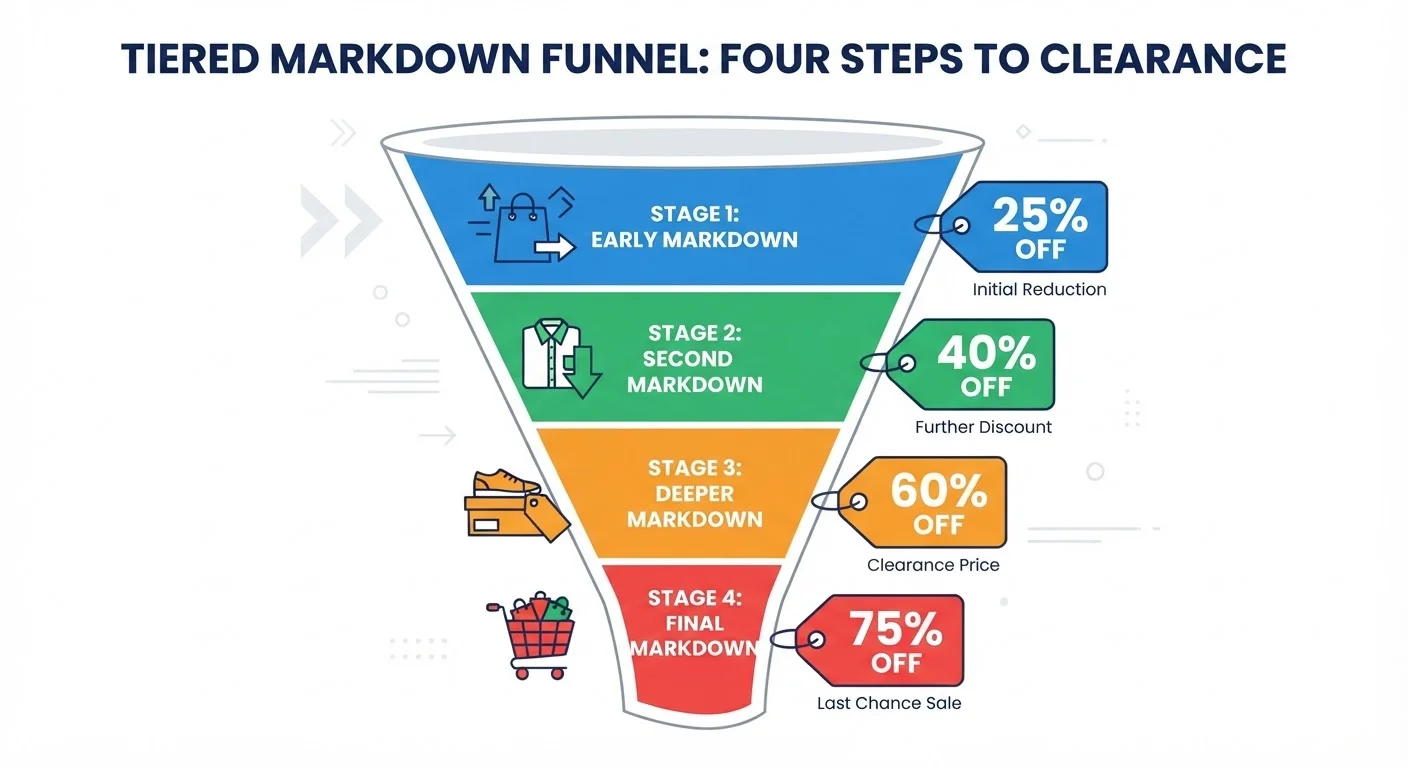
Once an item enters the markdown queue, most retailers follow a tiered discount structure. The standard playbook at major department stores and mass-market chains looks like this:
- Tier 1 (Week 1-2): 20-30% off original price. The item gets moved to a clearance rack or tagged, but the retailer is still testing demand at a modest discount.
- Tier 2 (Week 3-5): 40-50% off. If the Tier 1 cut didn't generate sufficient velocity, a deeper cut is applied. This is often when deal-hunters start paying attention.
- Tier 3 (Week 6-8): 60-75% off. The retailer is now primarily concerned with recovering floor space, not margin. Items at this stage are priced to move fast.
- Tier 4 (Week 9+): 70-90% off or liquidation. Items that survived earlier tiers get either a final deep discount or are removed from the sales floor and sent to liquidators, outlet channels, or clearance events.
The exact timing varies by retailer and category, but the structure is consistent. This is why seasoned clearance shoppers wait. The risk is stock-out - if you wait for Tier 3 and the item sells out at Tier 2, you lose. The decision to act or wait is fundamentally a risk-reward calculation based on how many units the store is likely carrying.
For a deeper breakdown of how these cycles differ by product type, see markdown cycles by category - apparel, electronics, and home goods each move on different timelines.
Wait for the Second Markdown, Then Decide
The first markdown rarely represents the best value - it's the retailer testing demand. The second markdown (usually 4-6 weeks in) is when the retailer signals genuine urgency to move stock. This is typically the best balance of price depth and remaining inventory. If stock is still abundant after the second cut, waiting for a third markdown is a reasonable bet.
Stack Clearance With Cashback Portals
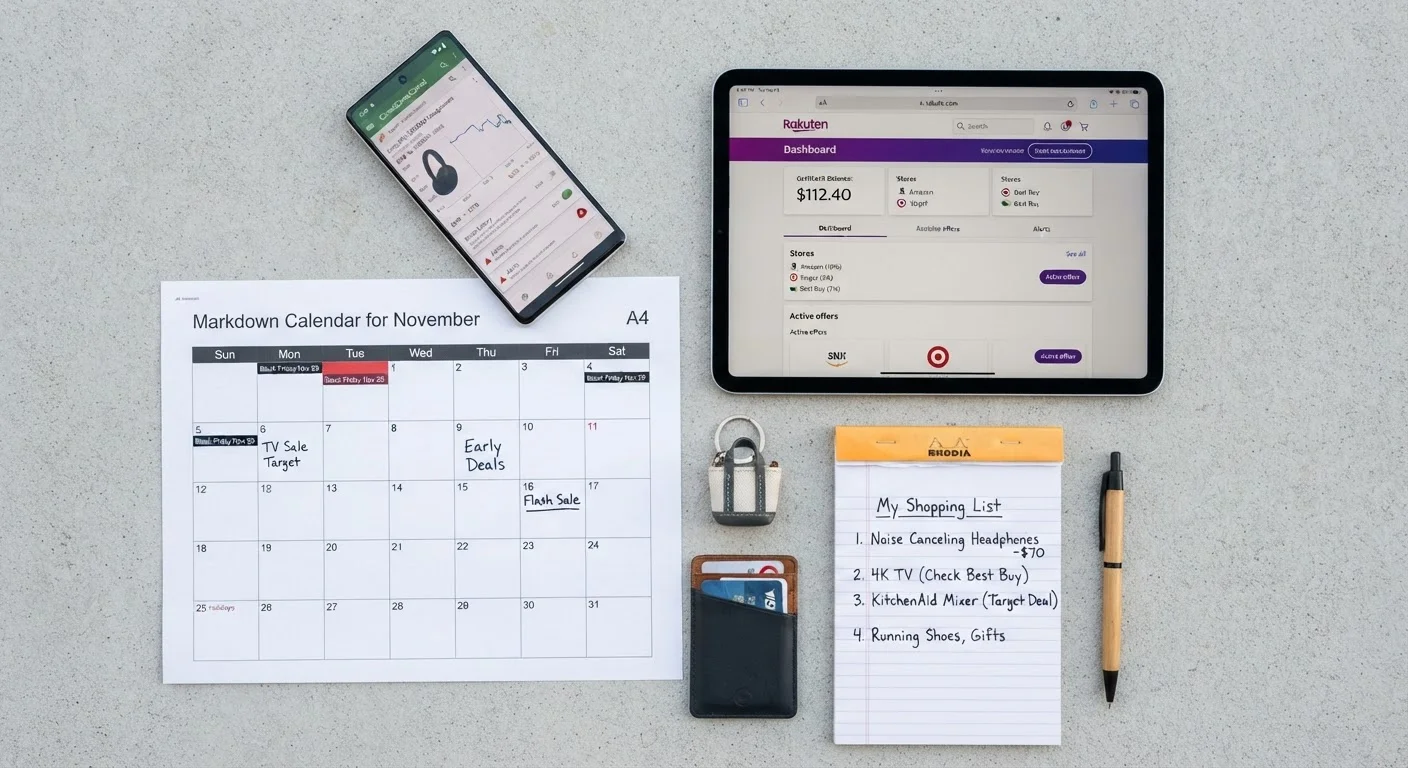
Always check cashback portals like Rakuten, TopCashback, or your credit card's shopping portal before purchasing clearance items online. Retailers rarely exclude clearance from portal tracking, and a 5-10% cashback rate on top of a 60% markdown can add up to meaningful savings. Set a portal reminder as part of your standard checkout routine.
Learn Your Store's Markdown Day
Most retailers reset markdowns on the same day each week. For Target, it's often Tuesday; for many grocery chains, markdowns on perishables happen in early morning. Visiting on or just after markdown day means you get first access to freshly cut prices before other deal-hunters arrive. Ask a department associate directly - most will tell you.
Category-Specific Markdown Behavior
Not all products move through the markdown machine at the same speed. Category-level economics shape how aggressively retailers discount and how long items sit before hitting rock bottom.
Apparel
Fashion has the most aggressive markdown schedule of any retail category. The seasonality is hard-coded: spring/summer merchandise must clear by July; fall/winter must move by January. Retailers know this, so apparel markdown cycles run fast and deep. A winter coat that doesn't sell by mid-December is likely to be at 50% off by early January and 70%+ off by late January. The winter clearance calendar maps this out precisely for post-holiday shoppers.
Electronics
Electronics markdowns are driven less by seasons and more by product cycles. When a new model ships, the previous generation enters markdown territory - but the cuts tend to be slower and shallower than apparel. Retailers know electronics buyers are comparison-shopping, so they're less likely to slash prices publicly and more likely to use bundle deals or rebates. The exception is holiday overstock, which can see aggressive markdowns in January.
Home Goods and Furniture
This category runs on long holding cycles and infrequent, deep cuts. Home goods don't spoil seasonally the way apparel does, so retailers tolerate slower sell-through. When cuts do happen, they tend to be large - 40-60% in a single move - because the items are expensive and the retailer wants a clean clearance event rather than a prolonged markdown sequence.
Seasonal Merchandise (Holiday, Outdoor, Garden)
The most predictable category. Retailers know that a Christmas ornament has zero value on December 26 in terms of floor space. Holiday merchandise gets marked down 50% the day after the holiday and drops to 70-90% within two weeks. The same logic applies to summer outdoor furniture in late August. These windows are brief and reliable - explore the summer blowouts hub for timing guidance on warm-weather categories.
The Role of Inventory Visibility: Online vs. In-Store
One factor that significantly affects markdown depth is whether the retailer can see exactly how much stock remains. Online retailers have real-time, unit-level inventory visibility. That transparency changes how they manage markdowns.
When stock drops below a threshold - say, fewer than 10 units remaining - an online retailer may actually raise the clearance price slightly, knowing scarcity will close the sale. Conversely, when hundreds of units remain and velocity is low, the algorithm may cut more aggressively to accelerate sell-through before storage costs compound.
In-store clearance operates differently. Stock is distributed across locations, and the markdown system may not reflect real-time unit counts per store. This creates opportunities: an item that's nearly sold out nationally might still be sitting in volume at a specific location, available at the same deep discount. It also creates risk - you may arrive expecting stock and find the rack picked clean.
The channel question also affects where you should shop during clearance season. Department stores vs. online outlets during winter clearance breaks down where each channel genuinely wins - it's not as simple as assuming online is always better.
Online Clearance Doesn't Always Mirror In-Store
Retailers often manage online and in-store inventory as separate pools with different markdown schedules. An item that's 50% off in-store may be only 30% off online, or vice versa. Always check both channels before purchasing, and don't assume the deepest price is where you expect to find it. The department stores vs. online outlets comparison details exactly when each channel tends to win.
Liquidation Is the End of the Line
Once a retailer routes merchandise to a liquidator, that stock re-enters the market through secondary channels - discount retailers, online liquidation sites, or third-party marketplace sellers. These prices can be lower than the retailer's final clearance price, but the experience comes with more risk: no return policy, mixed condition, and uncertain authenticity. For brand-new items, the retailer's final clearance price is almost always the better deal.
Reading the Signs: How to Spot Where an Item Is in Its Markdown Cycle
You don't need access to a retailer's internal systems to gauge where an item sits in its markdown cycle. Visible signals on the sales floor and online tell you almost everything you need to know.
Price Tag Color Codes
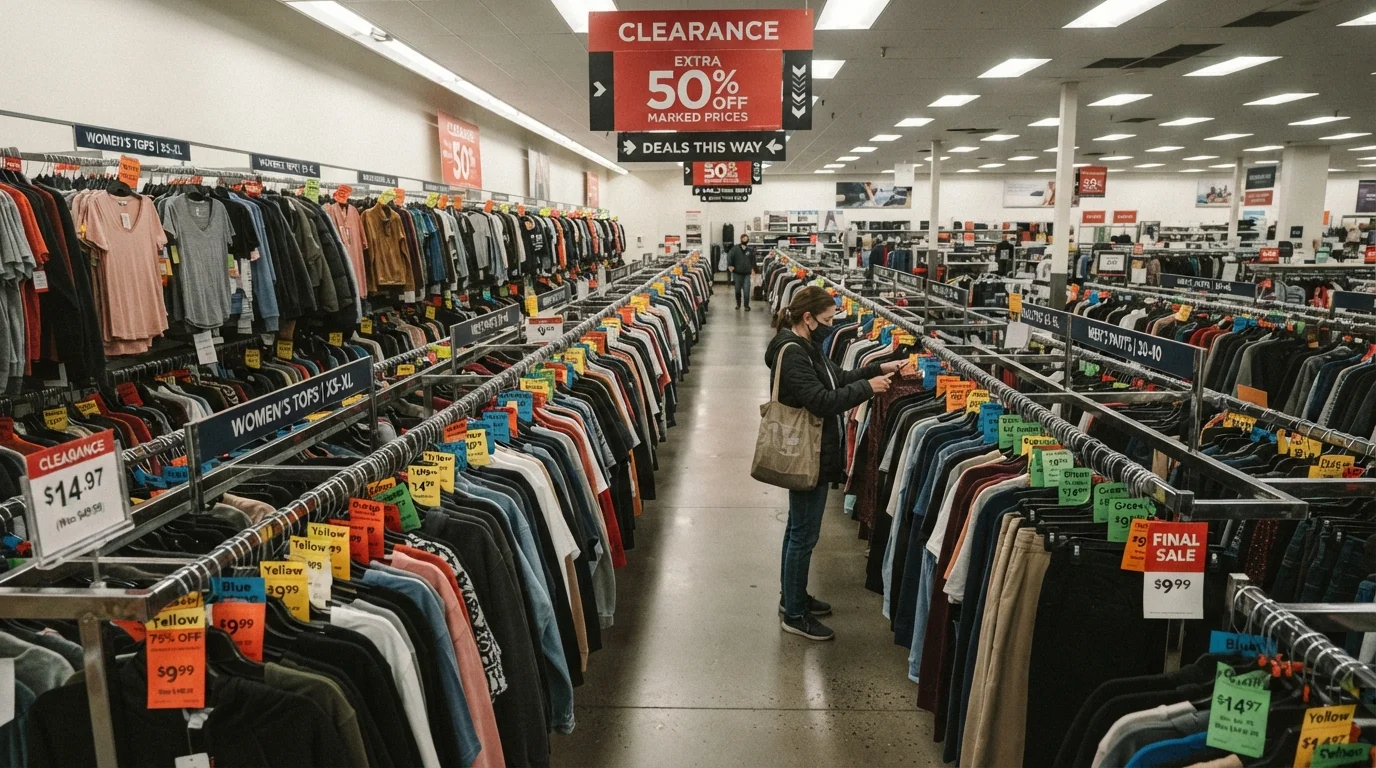
Many retailers use color-coded tags to signal markdown status. At Target, for example, red tags signal clearance, and the last two digits of the price often indicate the discount level (e.g., prices ending in .08 signal a final clearance cut). Walmart uses yellow clearance tags. These systems vary by chain, but once you learn the code for your regular stores, you can read the rack in seconds.
Multiple Strikethroughs
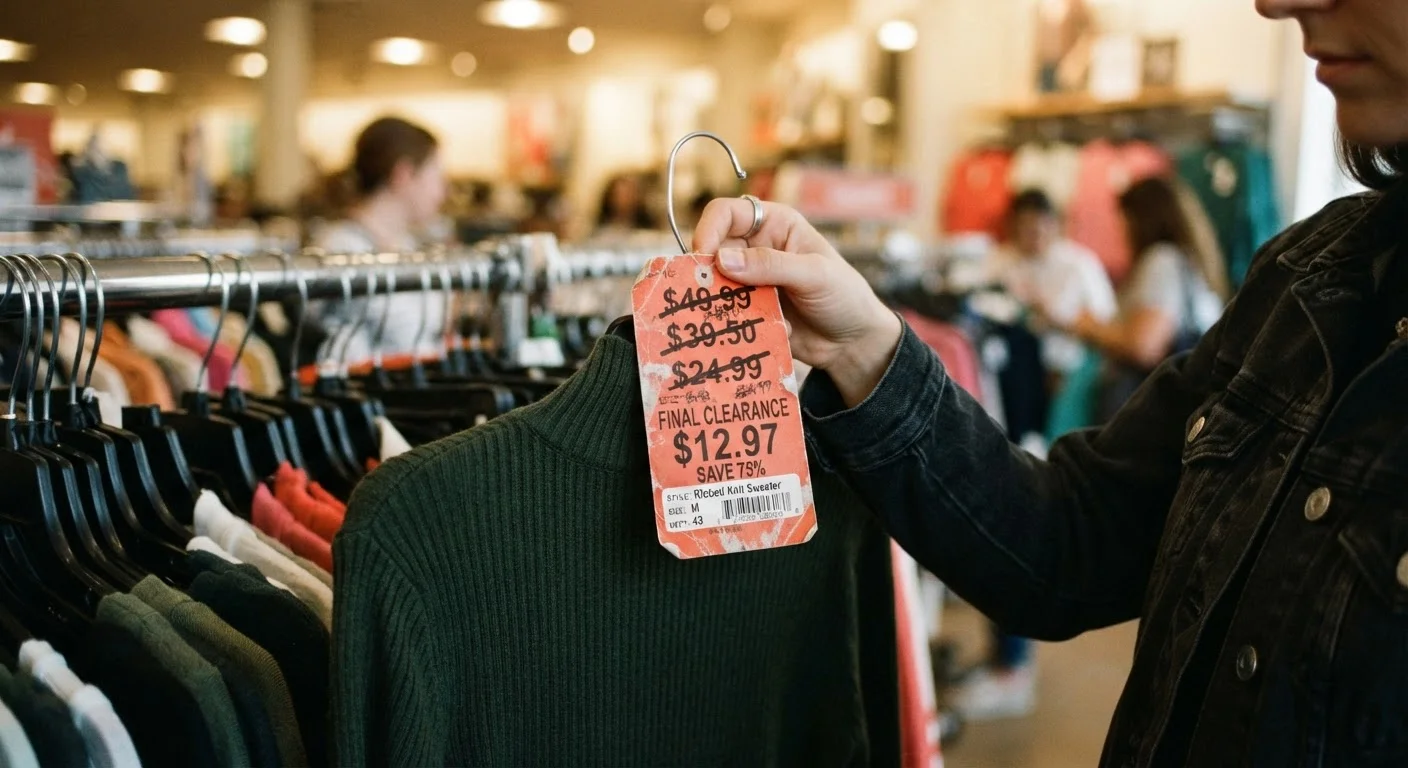
A clearance tag with two or three crossed-out prices is a tell. Each strikethrough represents a previous markdown event. Three crossed-out prices mean the item has survived two earlier cuts - it's likely near its floor price or headed for liquidation on the next cycle.
Low Unit Count Per Size or SKU
Clearance racks with only one or two of any given size or color signal late-stage markdown. Most shoppers have already filtered through the rack, and what remains is either odd sizes or overlooked items. If you find your size at this stage, it's worth buying - you're almost certainly at or near the deepest discount.
Placement on the Floor
Watch where clearance merchandise is physically located. Items moved to the back of the store, stacked on end caps, or placed in marked clearance sections are earlier in the cycle. Items consolidated into a single, smaller rack near the fitting rooms or stockroom door are often in late-stage liquidation mode - the retailer is pulling space back gradually.
For a systematic approach to acting on all of this in real time, the winter clearance shopping guide and the end-of-season clearance checklist both offer structured frameworks you can use on the floor.
“Markdown optimization is not about discounting - it's about recovering the maximum value from inventory before it becomes a liability. Every week you wait costs you margin; every week you cut too early costs you revenue. The algorithm is just trying to find the point where those two curves intersect.”
— Russ Chouinard, Retail inventory strategy consultant and former merchandise planning director
When Retailers Pull Items Instead of Cutting Deeper
There's a ceiling on how deep a retailer will mark down merchandise internally. Once the projected revenue from continued markdowns falls below the cost of liquidating through a third-party channel, most chains pull the item rather than keep cutting.
This threshold varies, but many retailers won't go below 75-80% off before routing excess stock to:
- Liquidators - Companies like Via Trading or Direct Liquidation purchase bulk overstock at pennies on the dollar and resell to discount retailers or secondary market sellers.
- Outlet stores - Many major brands operate outlet locations that receive unsold mainline inventory. This is a legitimate continuation of the markdown cycle at a controlled price point.
- Charity donations - For items with no viable resale path (damaged, discontinued), donation creates a tax deduction that partially offsets the loss.
- Returns to vendor (RTV) - In some category agreements, vendors accept back unsold inventory. This is more common in electronics and publishing than in apparel.
For shoppers, the practical implication is this: if you're waiting for 80% off on a popular item, you may be waiting for a price that never comes at retail. The retailer will pull the item first. This is why understanding Tier 3 as typically the floor - not Tier 4 - is important for realistic shopping strategy.
Online Clearance Doesn't Always Mirror In-Store
Retailers often manage online and in-store inventory as separate pools with different markdown schedules. An item that's 50% off in-store may be only 30% off online, or vice versa. Always check both channels before purchasing, and don't assume the deepest price is where you expect to find it. The department stores vs. online outlets comparison details exactly when each channel tends to win.
Liquidation Is the End of the Line
Once a retailer routes merchandise to a liquidator, that stock re-enters the market through secondary channels - discount retailers, online liquidation sites, or third-party marketplace sellers. These prices can be lower than the retailer's final clearance price, but the experience comes with more risk: no return policy, mixed condition, and uncertain authenticity. For brand-new items, the retailer's final clearance price is almost always the better deal.
Building a Clearance Strategy Around the Markdown Machine
Now that you understand how the system works, here's how to translate that into a practical shopping approach:
- Know your stores' markdown days. Most retailers run new markdowns on a specific day of the week - Target often resets on Tuesdays, while many grocery chains mark down meat and bakery items in the morning. A quick ask to a department associate or a few weeks of observation will reveal the pattern.
- Track items before they hit clearance. Use price-tracking tools (Honey, CamelCamelCamel, Google Shopping alerts) to monitor the item at full price so you have a baseline. When it drops, you'll know immediately.
- Set a decision rule before you shop. Decide in advance: will you buy at Tier 2 (40-50% off) to secure availability, or wait for Tier 3 (60-75%) and accept the risk of stock-out? This prevents in-aisle indecision that leads to either overpaying or losing the item.
- Visit stores 2-3 weeks into the clearance cycle. This is the sweet spot - stock is still available but early-cycle buyers have moved on, and the second or third markdown is typically already applied.
- Check inventory online before driving to the store. Most major retailers now show in-store inventory online. Use this to verify that your target location has stock before making the trip.
- Combine clearance with cashback. Clearance prices aren't always excluded from cashback portals. Stacking a 6-8% cashback rate on top of a 60% markdown discount meaningfully increases your effective savings.
The markdown machine runs on a schedule. The more precisely you can align your shopping with that schedule, the more consistently you'll land the deals that most shoppers miss entirely.
Wait for the Second Markdown, Then Decide
The first markdown rarely represents the best value - it's the retailer testing demand. The second markdown (usually 4-6 weeks in) is when the retailer signals genuine urgency to move stock. This is typically the best balance of price depth and remaining inventory. If stock is still abundant after the second cut, waiting for a third markdown is a reasonable bet.
Stack Clearance With Cashback Portals
Always check cashback portals like Rakuten, TopCashback, or your credit card's shopping portal before purchasing clearance items online. Retailers rarely exclude clearance from portal tracking, and a 5-10% cashback rate on top of a 60% markdown can add up to meaningful savings. Set a portal reminder as part of your standard checkout routine.
Learn Your Store's Markdown Day
Most retailers reset markdowns on the same day each week. For Target, it's often Tuesday; for many grocery chains, markdowns on perishables happen in early morning. Visiting on or just after markdown day means you get first access to freshly cut prices before other deal-hunters arrive. Ask a department associate directly - most will tell you.