

| Best month to buy a TV | January (post-CES, new models announced) (Historical price tracking data, CamelCamelCamel) |
| Best month to buy a mattress | March or Memorial Day weekend (May) (Retail industry markdown cycle analysis) |
| Best window for large appliances | May-June (prior-year model clearance) (Consumer Reports buying guides, 2023) |
| Best time to buy winter clothing | January-February (post-season clearance) (Retail markdown calendar data) |
| Best window for new cars | September-October (prior model-year clearance) (Automotive industry sales data) |
| Best month for outdoor furniture | August-September (end-of-season clearance) (Historical retailer markdown patterns) |
| Best window for laptops | Late July-mid-August (back-to-school peak competition) (NRF back-to-school spending data, 2023) |
| Typical TV price drop post-CES | 20-40% off prior-year models (CamelCamelCamel price history aggregates) |
| Black Friday categories that genuinely deliver | TVs (loss-leaders), gaming bundles, small appliances (NRF holiday pricing analysis) |
| Typical outdoor furniture clearance discount | 50-70% off display/prior-season models (Retail clearance markdown data) |
Why the Popular Sale Dates Are Often the Wrong Dates
Black Friday, Cyber Monday, Prime Day - these events dominate shopping coverage because they're easy to write about. They're loud, they're finite, and retailers spend millions making sure you hear about them. What that noise drowns out is a quieter, more profitable truth: most product categories hit their annual price floor at a completely different time of year.
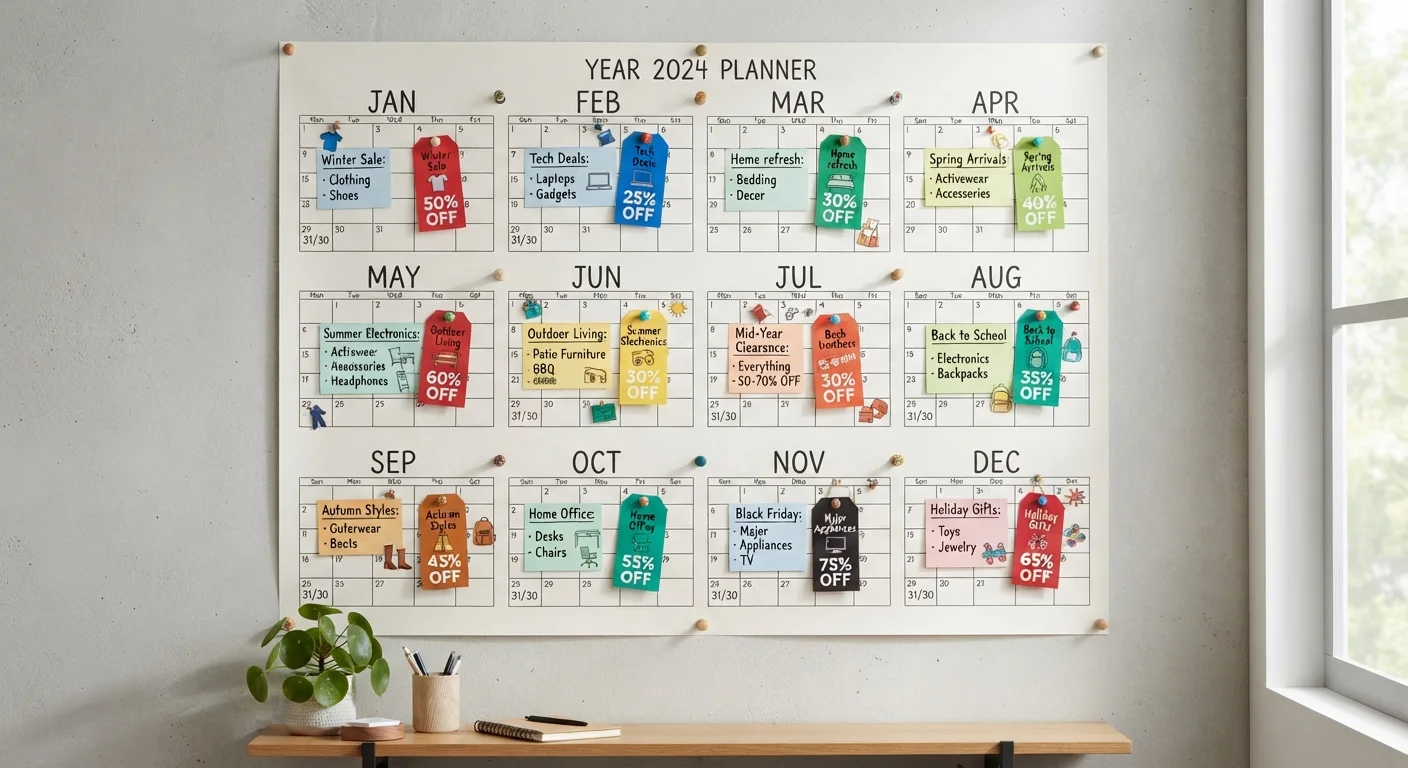
The retail calendar isn't random. Prices follow inventory cycles, model-year transitions, and clearance mandates that operate on predictable schedules. Once you map those schedules by category, you stop reacting to retailer-manufactured urgency and start shopping on your own timeline - usually saving more money with far less competition.
Black Friday prices aren't always the lowest of the year, and the data consistently backs that up. This guide gives you the full-year map by category so you can plan purchases months in advance instead of scrambling every November.
| Best month to buy a TV | January (post-CES, new models announced) (Historical price tracking data, CamelCamelCamel) |
| Best month to buy a mattress | March or Memorial Day weekend (May) (Retail industry markdown cycle analysis) |
| Best window for large appliances | May-June (prior-year model clearance) (Consumer Reports buying guides, 2023) |
| Best time to buy winter clothing | January-February (post-season clearance) (Retail markdown calendar data) |
| Best window for new cars | September-October (prior model-year clearance) (Automotive industry sales data) |
| Best month for outdoor furniture | August-September (end-of-season clearance) (Historical retailer markdown patterns) |
| Best window for laptops | Late July-mid-August (back-to-school peak competition) (NRF back-to-school spending data, 2023) |
| Typical TV price drop post-CES | 20-40% off prior-year models (CamelCamelCamel price history aggregates) |
| Black Friday categories that genuinely deliver | TVs (loss-leaders), gaming bundles, small appliances (NRF holiday pricing analysis) |
| Typical outdoor furniture clearance discount | 50-70% off display/prior-season models (Retail clearance markdown data) |
The Month-by-Month Category Breakdown
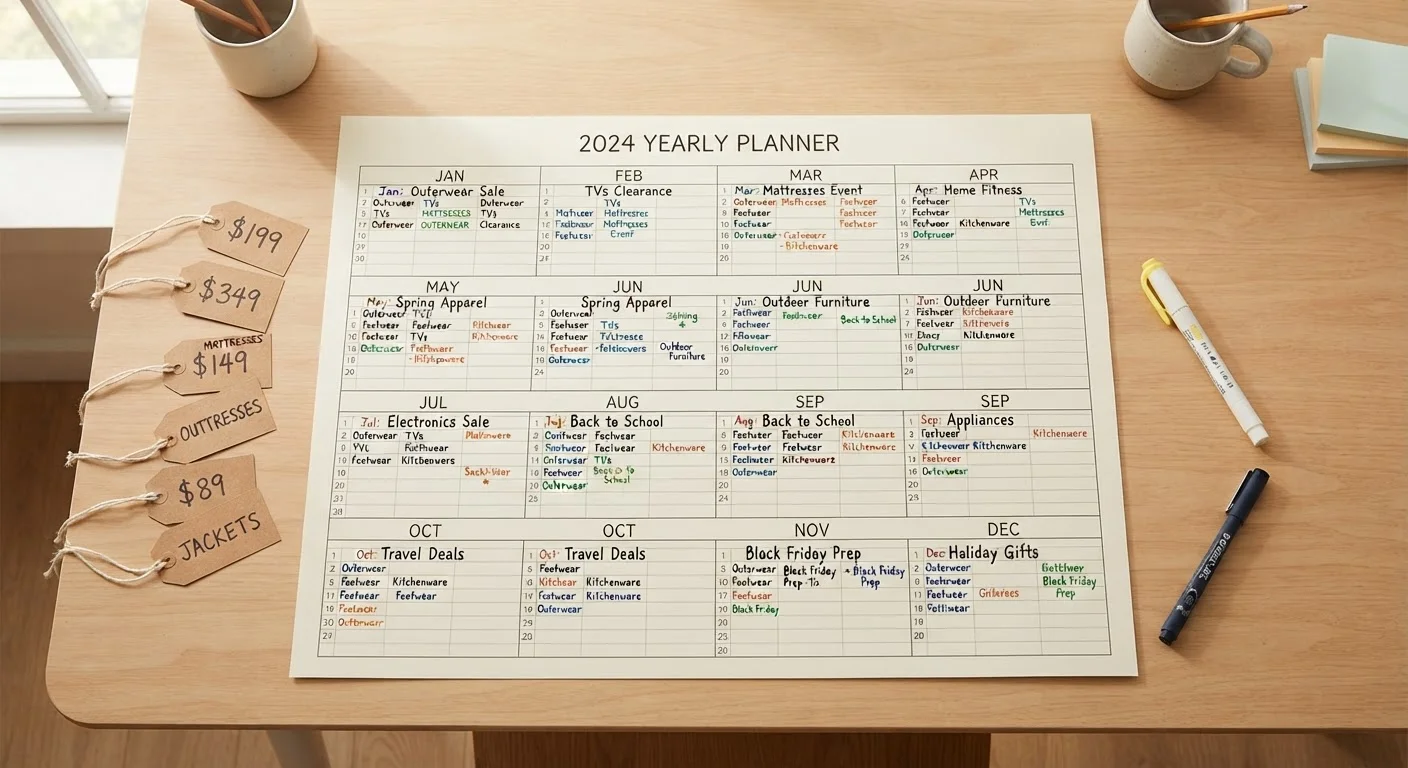
Think of this as a reference you return to before any major purchase. The windows below represent when prices typically bottom out based on historical markdown patterns - not when retailers claim they're discounting.
January - February: The Real Post-Holiday Payoff
Most shoppers assume December is deal season. The smarter move is waiting until the second or third week of January, when retailers need to clear holiday inventory and hit Q1 targets. Categories that bottom out in this window:
- TVs and home theater: Manufacturers release new models ahead of CES (Consumer Electronics Show) in early January. Last year's models drop 20-40% as stores create shelf space. The 10-21 days following CES is historically the best window to buy a large-format TV.
- Holiday décor and seasonal items: Clearance markdowns of 50-90% typically begin December 26 and deepen through January 15.
- Winter clothing and outerwear: Retailers clear winter inventory aggressively in January and February. Expect 40-70% off coats, boots, and cold-weather accessories. The clothing sale calendar breaks this out retailer by retailer.
- Fitness equipment: New Year's resolution demand spikes in early January, but by late January and February, unsold equipment goes on clearance. Waiting just three weeks into January frequently yields 20-30% savings over the peak New Year pricing.
March - April: Mattresses, Tax Refunds, and Spring Clearing
March is quieter than most people realize, which is exactly why it's productive for certain categories.
- Mattresses: Presidents' Day (mid-February) gets attention, but March is actually the stronger month for mattress deals. Memorial Day is the peak mattress sales event, so retailers often pre-discount in March to drive early-season volume. Look for 30-50% off during late March.
- Luggage and travel gear: Spring travel planning drives demand in April, but inventory from the prior fall/winter cycle goes on clearance March through mid-April before summer stock arrives. Mid-March is optimal.
- Vacuum cleaners and floor care: Spring cleaning drives new inventory drops in April. Retailers clear prior-model vacuums in late March to early April - often the lowest prices of the year on name-brand models.
40%
Average TV price drop in January vs. peak
Based on historical CamelCamelCamel price tracking data showing post-CES markdowns on prior-year TV models.
70%
Discount depth on winter clothing in January clearance
Major retailers including Macy's, Nordstrom, and department chains historically mark winter apparel 50-70% off in January.
30-50%
Mattress savings during March pre-season promotions
Mattress retailers run significant pre-Memorial Day promotions in March to generate early-season volume ahead of their peak event.
60%
AC unit discount in mid-August vs. June prices
Air conditioner prices drop sharply starting mid-August as retailers clear seasonal inventory before fall merchandising resets.
2-3 weeks
Optimal wait after a sale event opens before buying
Prices on most sale items continue to improve 2-3 weeks into a promotional window as retailer competition intensifies.
May - June: Appliances, Outdoor, and Graduation Gear
Memorial Day weekend is the legitimate anchor event here, but the window extends further than most shoppers exploit.
- Large appliances (refrigerators, washers, dryers): New models ship to retailers September-November, which means current-year models peak in price during spring. However, the prior model year hits clearance pricing in May-June as floor space is needed. If you can buy a one-year-old model, late May to mid-June is the window.
- Outdoor furniture and grills: Counterintuitively, late May through June isn't the cheapest time - that's peak demand. Wait until August-September for 30-50% reductions, or buy display models in June. The outdoor gear pricing calendar has the full seasonal breakdown.
- Laptops (student/back-to-school): Back-to-school sales begin in late June for many retailers. The actual price floor for laptops in the consumer segment typically lands between late July and mid-August - not at graduation time in May. Buying in May means paying a premium.
July - August: Electronics, Clothing, and Back-to-School
This two-month stretch contains more genuine discount opportunities than any other period outside of January.
- Prime Day / competing sales: Amazon's Prime Day (typically mid-July) has expanded into a broader retail event, with Target, Walmart, and Best Buy running parallel sales. The strongest categories are small electronics, smart home devices, and kitchen gadgets. For context on whether these prices are genuinely low, price history charts will tell you the truth before you commit.
- Back-to-school clothing: The peak clearance window for summer apparel runs late July through mid-August. If you're flexible on color and can buy slightly ahead of the next season, this is when to stock up. See when major retailers actually discount clothing for specific timing by store.
- Laptops and tablets (student SKUs): As noted above, late July to mid-August is the real floor. Competition between retailers during this window is intense, and rebate offers tend to be most generous here.
- Air conditioners and fans: Demand drops sharply in August even in warm climates. Retailers clear AC inventory aggressively starting in mid-August - prices regularly hit 40-60% below June levels.
September - October: Cars, Appliances, and Fall Transition
September is underrated for large purchases. New car model years arrive, new appliance lines roll in, and retailers face genuine pressure to move current inventory.
- New cars: The September-October window is historically the best time to negotiate on prior-year models at dealerships. Lots need to clear space for incoming model-year vehicles, and end-of-quarter pressure in September can produce additional incentives. This is the one category where walking in at month-end matters.
- Current-year appliances: As new appliance models arrive in stores, September-October represents the last significant clearance push for current-year floor models. The discount isn't as deep as May-June for prior-year models, but availability is higher.
- Patio and outdoor furniture: The real clearance window for outdoor furniture is late August through September. Retailers want this category off the floor before fall. Discounts of 50-70% are common on display models.
- Camping and outdoor gear: End-of-season clearance on tents, sleeping bags, and hiking gear peaks in September-October. This is the optimal buy window if you're planning for next spring.
November - December: When to Use Holiday Sales Strategically
Holiday sale events are not worthless - they're just frequently misapplied. The categories where Black Friday and Cyber Monday actually deliver year-best prices are narrower than marketing suggests.
- Genuine Black Friday winners: Doorbuster TVs (loss-leaders at specific retailers), gaming consoles and bundles, small kitchen appliances, and Blu-ray/streaming device bundles. These are the categories where November legitimately competes with or beats other windows.
- Cyber Monday strengths: Software subscriptions, clothing from direct-to-consumer brands, and luggage. Online-native brands tend to run their best promotions here.
- What to avoid buying in November-December: Mattresses (Memorial Day is better), appliances (May-June and September are better), outdoor furniture (already heavily discounted since August), and winter clothing (January clearance will go deeper).
For a detailed breakdown of which holiday events actually move the needle by category, the holiday sales calendar by event is worth bookmarking alongside this guide.
Regional and Retailer Variation Matters
The windows listed here reflect national averages and majority patterns. Individual retailers may run promotions earlier or later based on their own inventory positions, regional demand, and competitive dynamics. Always cross-check against price history for the specific retailer where you plan to buy - not just the category average. A window that's optimal at one retailer may be two weeks off at another.
New vs. Prior Model: Know What You're Buying
Many of the deepest discounts in this calendar apply to prior-year or prior-season models, not the newest available. For most categories - TVs, appliances, outdoor furniture - the prior-year model is functionally identical for most buyers and represents excellent value. However, for laptops and smartphones, verify that the older model still receives software and security updates before purchasing at a clearance price.
Holiday Sale Events Aren't Worthless - Just Misapplied
This article positions holiday events as less reliable than the retail calendar, but that doesn't mean skipping them entirely. The key is knowing which specific categories those events genuinely serve (TVs, gaming, small appliances) versus which categories will be cheaper if you simply wait. Using both frameworks together - the retail calendar plus selective holiday event shopping - yields the best overall results.
How to Verify a Price Is Actually at Its Floor
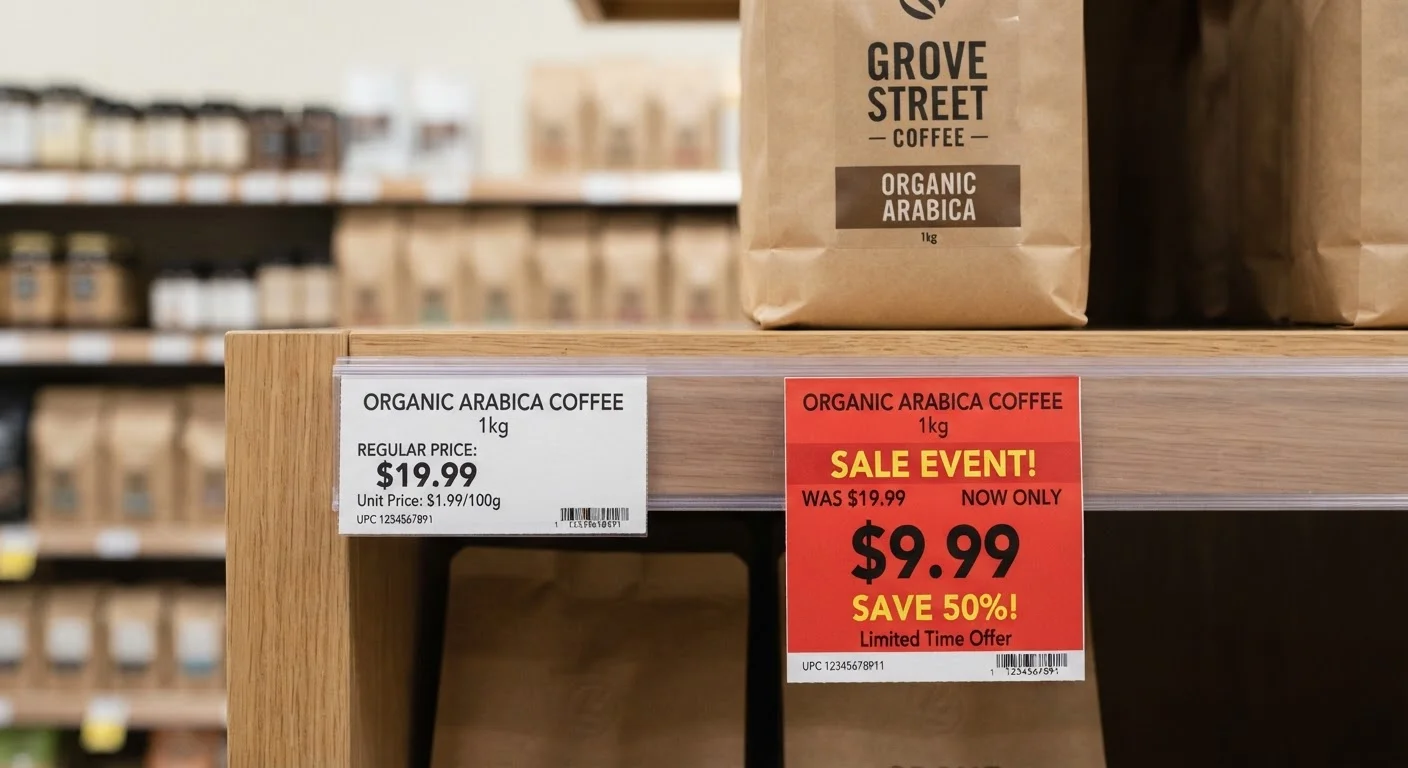
The retail calendar gives you the right window to shop. Price history data tells you whether the specific item you're looking at is actually at a low point - or whether the retailer has inflated the reference price to manufacture a fake discount.
Two steps every buyer should take before committing to any purchase over $50:
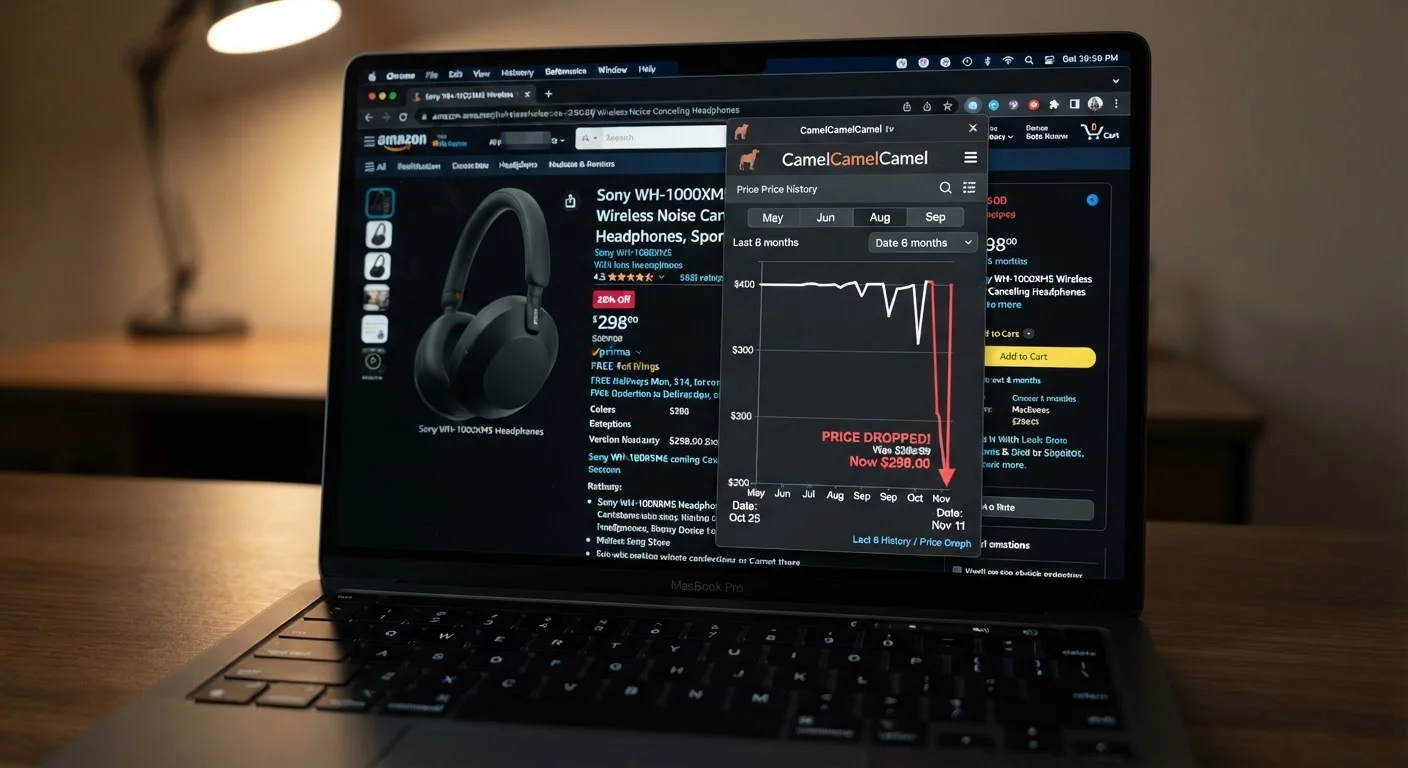
- Check 90-day price history: Tools like CamelCamelCamel (for Amazon), Honey, or Capital One Shopping overlay price history directly on product pages. If a "sale" price is the same as the regular price from three weeks ago, it's not a sale. Reading price history data correctly is a learnable skill that pays dividends on every major purchase.
- Set price alerts, don't just check once: If you're in the right seasonal window but the price hasn't dropped yet, set an alert and wait. Most price drops happen mid-week (Tuesday-Thursday), not on weekends when traffic is highest.
Understanding how clearance cycles work also helps you predict when retailers will be forced to markdown - rather than waiting for them to announce it.
Model-year transition
The period when manufacturers release updated product versions, forcing retailers to discount current inventory to create shelf space. Timing varies by category: TVs in January, cars in September-October, appliances in fall.
Clearance markdown
A price reduction applied to inventory a retailer needs to clear, typically at end of season or when new models arrive. Unlike promotional sales, clearance markdowns often represent the genuine price floor with no reversal planned.
Loss leader
A product sold at or below cost to drive store traffic, with the expectation that customers will purchase additional full-margin items. Doorbuster TVs during Black Friday are a classic example.
Price history
A chronological record of a product's price changes over time, typically 90-180 days. Tools like CamelCamelCamel track this for Amazon listings, allowing buyers to assess whether a "sale" price is genuinely low.
End-of-season sale
A markdown event triggered by the shift to new seasonal inventory. These are often deeper and more predictable than holiday promotional events because they're driven by inventory math rather than marketing budgets.
Price alert
An automated notification from a price-tracking tool that triggers when a product drops below a specified price threshold. Setting alerts during the right seasonal window allows buyers to capture price floor moments without constant manual checking.
Reference price inflation
The practice of artificially raising a product's listed "original" or "was" price before a sale event to make the discount appear larger than it actually is. Price history tools expose this tactic by showing the product's actual price over time.
Building Your Personal Buying Calendar
The most actionable use of this information is to create a 12-month purchase list organized by category, then match each item to its optimal buying window. Here's a simple framework:
- List everything you expect to buy in the next 12 months - appliances nearing end of life, planned electronics upgrades, seasonal gear, clothing needs.
- Assign each item to its category and cross-reference against the month-by-month breakdown above.
- Set calendar reminders two weeks before the optimal window opens so you can research models and set price alerts in advance - not reactively.
- Build in a 2-week buffer after the window opens before buying. Initial sale prices often improve further as retailers compete and inventory ages.

The difference between a shopper who saves 15% and one who saves 40% on the same product is usually just timing - not coupons, not loyalty points, and not luck. Retailers operate on inventory math and quarterly targets. When you understand those pressures, you can position yourself to benefit from them rather than getting caught up in the artificial urgency they manufacture around major sale events.
Compare that approach against how most people shop - chasing holiday sales without knowing whether those events actually deliver for the specific categories they need - and the advantage of a structured buying calendar becomes obvious.
For a direct comparison of how end-of-season clearance stacks up against Black Friday by category, see Black Friday vs. end-of-season sales. That analysis makes clear why the retail calendar approach consistently outperforms event-based shopping.
CamelCamelCamel
Free Amazon price history tracker that shows 90-day and all-time price charts for any product. Essential for verifying whether a sale price is genuinely at its floor before you buy.
Google Shopping Price Tracking
Google's built-in price tracking alerts notify you when a product you're watching drops in price across multiple retailers. Particularly useful for appliances and electronics across the category windows outlined in this guide.
Honey / PayPal Honey
Browser extension that automatically checks for coupon codes at checkout and shows price history for products on Amazon and other major retailers. Pairs well with a timing-based buying strategy.
Capital One Shopping
Browser extension that compares prices across retailers in real time and provides price history data. Useful for confirming you're buying at the right retailer during an optimal calendar window.
NRF Retail Calendar
The National Retail Federation publishes an annual retail holiday and promotion calendar. Useful for tracking officially announced sale events and cross-referencing against the organic markdown windows in this guide.
Consumer Reports Buying Guide
Consumer Reports publishes category-specific buying guides that note the best times of year to purchase major items like appliances, mattresses, and cars - useful as a validation layer alongside price history data.