

Key Takeaways
Off-Season Pricing
Off-season pricing refers to the predictable discount cycle retailers follow when demand for a product category drops. When fewer consumers are actively shopping for an item, retailers reduce prices to move inventory and maintain cash flow. These windows often yield deeper discounts than headline sale events like Black Friday.
Retailers track sell-through rates - the percentage of inventory sold in a period - and discount aggressively when rates fall below targets. Understanding this mechanism lets shoppers anticipate price floors rather than react to them.
The Mattress as a Master Class in Retail Timing
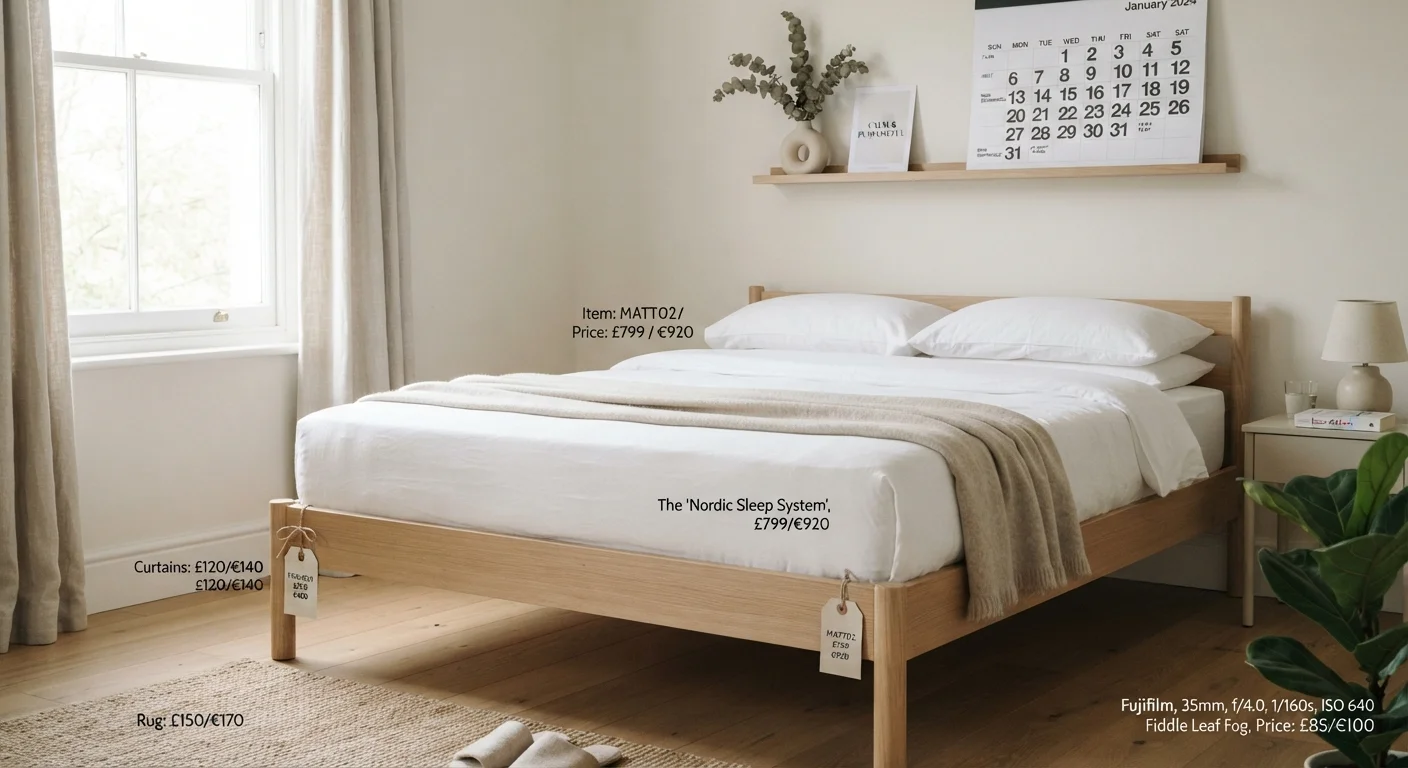
Mattresses are an unusual product. You don't buy them often, you don't browse them casually, and almost nobody wakes up on January 1st thinking about their sleep surface. That behavioral reality is exactly why January produces the steepest mattress discounts of the year.
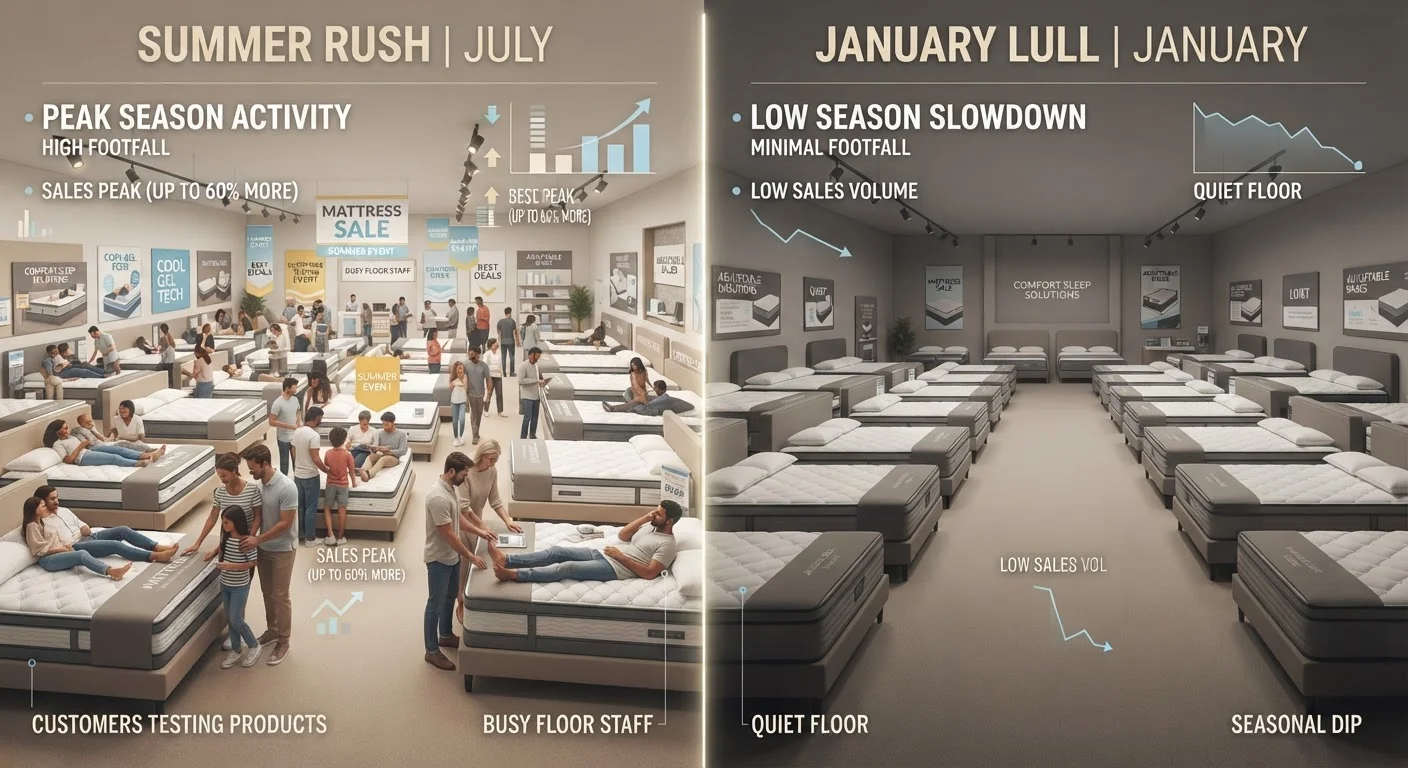
Here's the chain of causation: Holiday spending drains household budgets and attention through November and December. By January, mattress showrooms see traffic fall to annual lows. Meanwhile, manufacturers ship new model year inventory starting in late winter, which means retailers need to clear current floor models to make room. Low demand plus inventory pressure equals aggressive pricing - not as a gift to consumers, but as a survival mechanism for the retailer's cash flow and floor space.
This isn't retail mythology. Industry data consistently shows January and February as the lowest average price months for mattresses, with discounts frequently running 30-50% off standard retail pricing. That's not a promotional stunt - it's structural.
The deeper insight is this: the mattress example is a template. Every product category has a version of this same cycle. Understanding why January works for mattresses gives you a framework you can apply to appliances, outdoor gear, electronics, apparel, and almost anything else you plan to buy. The variables change; the logic doesn't.
The Mechanism: Why Retailers Discount at Predictable Times
To use this framework, you need to understand what actually drives a retailer to cut prices. It's not altruism - it's inventory math. Retailers track a metric called sell-through rate: the percentage of units sold versus units received in a given period. When sell-through falls below their target, they have two options: hold the inventory (which carries storage costs and ties up capital) or discount to accelerate movement. Discounting almost always wins.
Three forces determine when a category hits its pricing floor:
- Seasonal demand curves - consumer interest in a category rises and falls predictably across the year. Mattresses peak around moving season (spring/summer) and Memorial Day sales. January is the trough.
- Model year cycles - manufacturers in categories like mattresses, appliances, electronics, and cars release new versions on predictable schedules. When new models arrive, current inventory becomes a liability retailers need to liquidate.
- Post-promotional inventory hangover - after major sale events (Black Friday, holiday sales), retailers are left with specific SKUs that didn't clear. These get progressively discounted in the weeks that follow.
30-50%
Typical January mattress discount vs. peak season
Industry pricing data consistently shows January and February as the lowest average price months for mattresses across both in-store and direct-to-consumer retailers.
6-8 weeks
Optimal lead time for off-season purchase planning
Consumer purchasing research suggests that planning major purchases 6-8 weeks before need allows adequate time to capture the pricing low without urgency-driven decisions.
73%
Shoppers who buy on impulse at peak demand
According to a 2023 consumer survey by the National Retail Federation, nearly three-quarters of major household purchases are made reactively rather than strategically timed.
40%
Average post-Labor Day outdoor furniture discount
Retail analytics from multiple tracking services show outdoor furniture discounts averaging 35-45% in the two weeks following Labor Day as retailers clear summer inventory.
$1,200+
Estimated annual savings from systematic purchase timing
Applying off-season timing across four major annual purchases (mattress, furniture, electronics, apparel) at average discount differentials yields over $1,200 in savings versus reactive purchasing.
The interaction of these three forces creates predictable discount windows that have nothing to do with whether a sale event is happening. In fact, end-of-season clearance often outperforms Black Friday precisely because there's no marketing infrastructure propping up the price - the discount exists purely to move product.
Online vs. In-Store Pricing Dynamics
Off-season pricing windows apply to both physical and online retail, but the mechanisms differ slightly. Brick-and-mortar retailers face literal floor space constraints - a new sofa model arriving means an old one must leave. Online retailers face warehousing costs and conversion rate targets. Both produce discounts in the same windows, but online discounts can shift faster and recover faster. Setting a price alert captures the dip regardless of speed.
New Model Arrival Dates Vary by Brand
The model year cycle that drives mattress discounts in January doesn't fall on exactly the same date for every brand. Premium brands may introduce new collections in February or March, which can extend the discount window slightly. Check manufacturer announcements or retailer floor change schedules - typically available by calling the store - to confirm when new inventory arrives in your specific target category.
Mapping the Pattern: Category-by-Category Optimal Windows
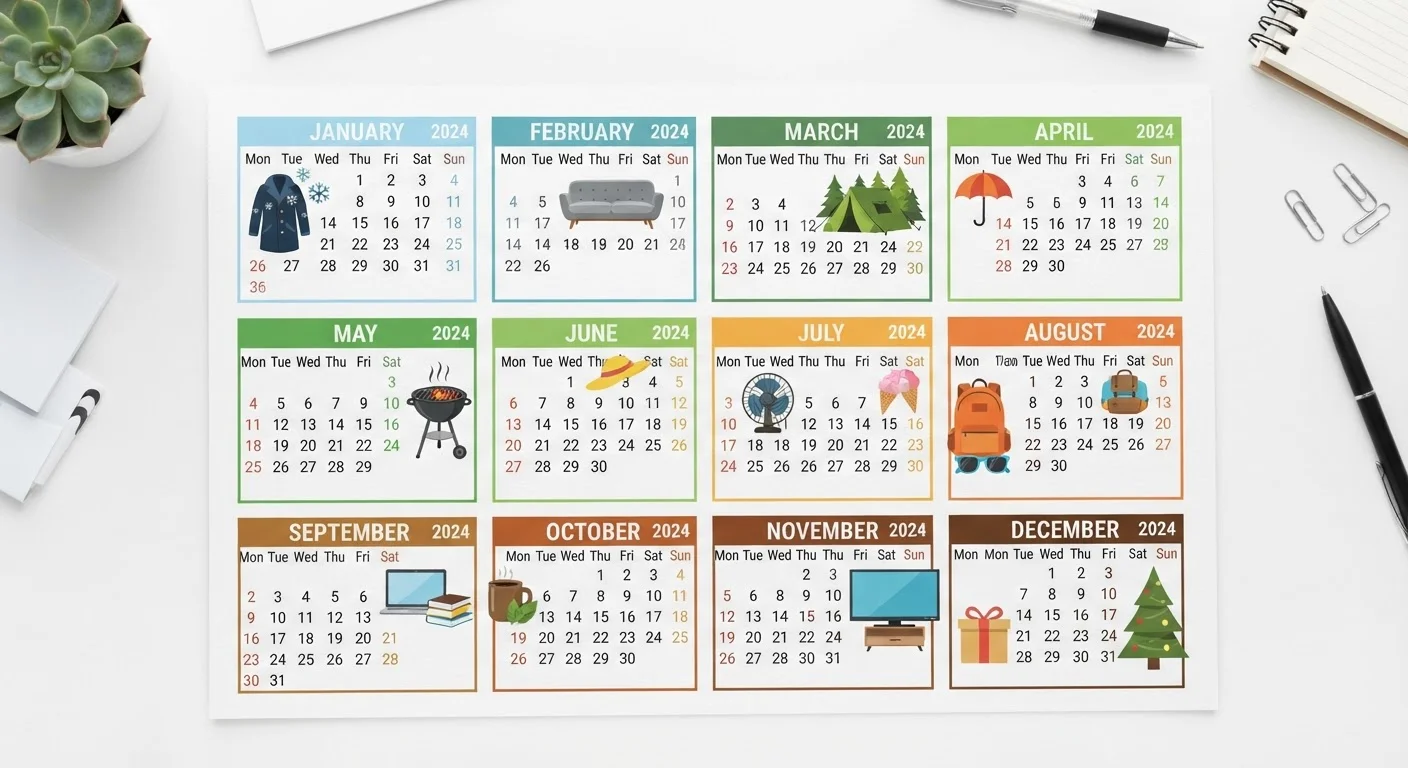
Apply the three-force framework above to a range of categories and a clear annual calendar emerges. Here are the most actionable windows beyond mattresses:
Furniture (January-February)
The logic mirrors mattresses almost exactly. Post-holiday traffic crashes, spring collections are incoming, and January is when retailers discount aggressively across sofas, dining sets, and bedroom furniture. If you're furnishing a space, Q1 is structurally the best time to buy.
Winter Apparel (January-February, then again in late August)
Apparel retailers clear current-season inventory hard in January to make room for spring lines. Discounts of 50-70% on coats, boots, and cold-weather gear are routine. The counterintuitive move is buying next winter's coat in February at clearance prices rather than October at full retail. The winter clearance calendar shows exactly which weeks yield the steepest cuts.
Televisions (January-February)
CES (Consumer Electronics Show) runs in early January, and manufacturers announce next-generation models. Retailers immediately face the same pressure as mattress stores: current inventory needs to move. January and February are historically the lowest price months for large-format TVs - often beating Black Friday on a model-for-model comparison.
Fitness Equipment (Late January-February)
New Year's resolution demand spikes in early January, which is exactly when you should not buy a treadmill or set of weights. Wait 3-4 weeks. By late January, the resolution wave breaks, demand drops sharply, and retailers - particularly those who over-ordered expecting sustained demand - begin discounting. The window is narrow but real.
Outdoor and Recreational Gear (August-September)
Camping, hiking, and water sports gear peaks in demand through summer. By late August, retailers are clearing summer inventory ahead of fall transitions. This is when to buy tents, kayaks, and hiking gear - not in May when you're motivated but prices are at their highest. See the outdoor gear savings hub for category-specific timing.
Grills and Patio Furniture (August-September)
Identical logic to outdoor gear. Labor Day marks the transition point, and the weeks immediately following it see significant discounts on outdoor entertaining equipment.
Use Price History Before Buying Anything Over $75
Before committing to any significant purchase, pull up the price history. CamelCamelCamel covers Amazon's full catalog, while Google Shopping shows price trends across multiple retailers. If the current price is near the 12-month low, act. If it's at or near the high, wait. This 90-second check can save more than an hour of coupon hunting.
Build Your Annual Shopping Calendar in January
January is both the best time to buy a mattress and the best time to plan your full-year purchases. While you're in planning mode, map out every major purchase you anticipate in the next 12 months and match each one to its optimal buying window. This single annual exercise consistently outperforms reactive deal-hunting for total dollar savings.
Stack Off-Season Timing With Cashback for Maximum Savings
Off-season pricing and cashback portals are complementary strategies. Once you've identified the optimal buying window, route your purchase through a cashback portal (Rakuten, TopCashback, or a card-linked offer) to add 2-10% back on top of the already-discounted price. The combination of structural timing plus cashback frequently beats any promotional sale event discount.
The Counterintuitive Rule: Buy When Nobody Else Is
There's a simple heuristic that underlies all of this: the best time to buy is when demand is lowest, not when your motivation is highest.
Most consumers make purchasing decisions reactively - they want a mattress because their current one is failing, they want a grill because summer is arriving, they want outdoor gear because they just booked a camping trip. That reactive impulse is the most expensive way to shop, because your urgency aligns perfectly with peak demand and peak pricing.
The shoppers who consistently pay less operate on a different system. They identify what they'll need in the next 6-12 months, map it against the optimal buying window, and purchase slightly ahead of their need - capturing the pricing low without the urgency premium.
This isn't complicated to implement. It requires a short list and a calendar, not a sophisticated financial strategy. If you know you'll need a new sofa by spring, buying it in January rather than April costs you less than almost any coupon or loyalty program will save you. As the data consistently shows, timing your purchase outperforms discount-hunting tactics across virtually every durable goods category.
“The best time to buy is when everyone else has stopped looking. Retailers don't discount to reward patience - they discount because they have to. Position yourself on the receiving end of that pressure.”
— Phil Lempert, Retail industry analyst and consumer trends expert
How to Build Your Personal Buying Calendar
The goal isn't to memorize every category's pricing cycle - it's to build a simple personal system. Here's how to construct one:
Step 1: Audit your upcoming purchases
List everything you're likely to buy in the next 12 months that costs more than $100. Include items you'll need because of a predictable life event (moving, seasonal change, a planned project) as well as items you've been deferring.
Step 2: Identify each category's demand season
For each item, ask: when does consumer interest in this category peak? That's when prices are highest. Avoid that window. Then ask: when is the model year or seasonal transition? That's when inventory pressure builds - and when discounts appear.
Step 3: Confirm with price history tools
Don't rely on intuition alone. Use CamelCamelCamel for Amazon products, Google Shopping's price history graph, or Honey's price tracking feature to verify that the category actually dips when theory predicts it should. A few minutes of data review replaces months of hope-based shopping.
Step 4: Set alerts and create intentional lead time
For most categories, 4-8 weeks of lead time is sufficient to plan around the optimal window. Set a price alert at your target price point and let the tool notify you rather than checking manually. This keeps the system low-effort and sustainable.

The full year mapped by category is covered in the retail pricing calendar, which gives you a month-by-month view of where discount windows cluster across the major spending categories. Use it as a reference alongside your personal list.
What This Framework Tells You About Sale Events
Once you internalize the off-season pricing logic, your perspective on promotional sale events shifts considerably. Black Friday, Amazon Prime Day, and Labor Day sales aren't inherently bad - they occasionally produce genuine discounts on specific categories. But they are not the reliable, category-wide savings events that marketing presents them as.
The reason is structural: major sale events happen at fixed calendar points that are often misaligned with the natural inventory pressure cycle of specific categories. A mattress discounted 20% on Black Friday is frequently available at 40% off in January, simply because January is when the actual pressure to move inventory peaks.
This doesn't mean ignoring sale events. It means applying a filter: does this category's natural pricing low align with this sale event? If yes, the sale event amplifies a real discount opportunity. If no, the sale event is likely offering a marginal discount on an item that will be cheaper in a different month. The holiday sales calendar by category gives you a concrete breakdown of which events actually deliver for which product types.
The bottom line: sale events are a marketing mechanism layered on top of a pricing reality. The pricing reality - driven by inventory cycles and demand curves - is the more reliable signal. When the two align, buy with confidence. When they don't, wait for the structural window.
Use Price History Before Buying Anything Over $75
Before committing to any significant purchase, pull up the price history. CamelCamelCamel covers Amazon's full catalog, while Google Shopping shows price trends across multiple retailers. If the current price is near the 12-month low, act. If it's at or near the high, wait. This 90-second check can save more than an hour of coupon hunting.
Build Your Annual Shopping Calendar in January
January is both the best time to buy a mattress and the best time to plan your full-year purchases. While you're in planning mode, map out every major purchase you anticipate in the next 12 months and match each one to its optimal buying window. This single annual exercise consistently outperforms reactive deal-hunting for total dollar savings.
Stack Off-Season Timing With Cashback for Maximum Savings
Off-season pricing and cashback portals are complementary strategies. Once you've identified the optimal buying window, route your purchase through a cashback portal (Rakuten, TopCashback, or a card-linked offer) to add 2-10% back on top of the already-discounted price. The combination of structural timing plus cashback frequently beats any promotional sale event discount.
Applying the January Mattress Logic All Year Long
The mattress example is compelling precisely because it's so clear-cut: one month, one mechanism, predictable results. But the broader lesson is that retail pricing is a system, not a random sequence of deals and non-deals. Systems can be understood, mapped, and exploited.
Every category you spend money on has a version of January - a month or window when the confluence of low demand and high inventory pressure creates the steepest discount. Your job isn't to monitor every category constantly. It's to do the one-time work of identifying those windows for the items most relevant to your life, then plan your purchases accordingly.
The winter clearance hub is a useful starting point for Q1 purchases specifically, covering the post-holiday and late-winter windows where multiple categories converge on their annual pricing lows.
Think of it this way: the person who buys a mattress in January instead of June on a $1,200 purchase might save $400-600. Do that across three or four major purchases per year - furniture, appliances, electronics, apparel - and you're looking at thousands of dollars in annual savings from nothing more than a calendar adjustment. No couponing, no loyalty program stacking, no time spent browsing flash sales. Just deliberate timing applied systematically.
That's the real lesson January teaches: the best deal isn't found - it's scheduled.