
Rental Properties vs. REITs: Two Paths Into Real Estate Investment
Owning physical rentals and investing in REITs both offer real estate exposure. Here's how their risks, returns, and effort levels compare.
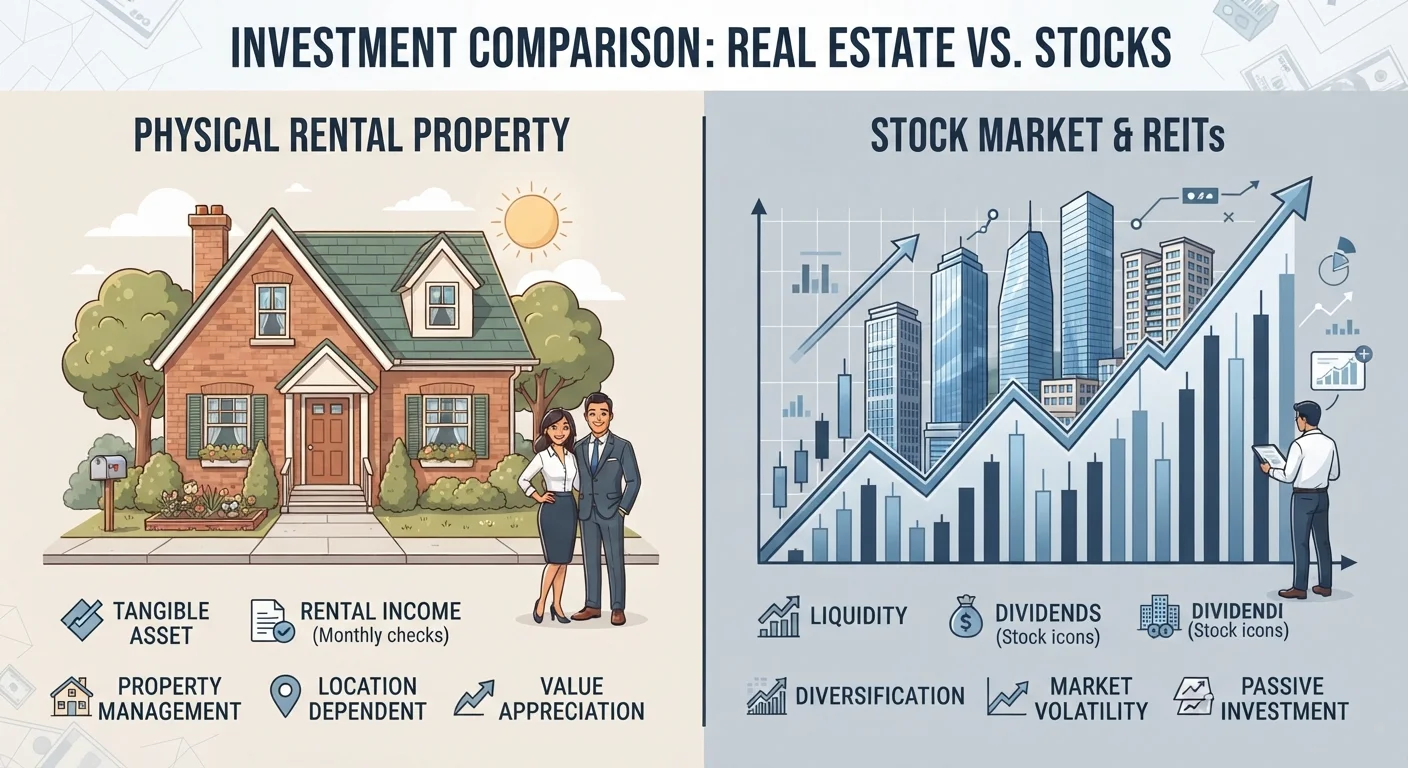
Photo: SaverSteals.com editorial
—— In This Article
Key Takeaways
- Rental properties require substantial upfront capital and ongoing active management from the investor.
- REITs are publicly traded funds offering real estate exposure with stock-like liquidity and low minimum investment.
- Direct rentals offer leverage and depreciation tax benefits unavailable to standard REIT investors.
- REITs provide instant diversification across many properties and property types.
- Both carry distinct risk profiles — vacancy and maintenance risk for rentals; market volatility for REITs.
- Your available capital, time, and risk tolerance should drive which path suits your situation.
What Each Investment Actually Involves
Understanding the difference between rental properties and REITs starts with recognizing what you're actually purchasing. When you buy a rental property, you acquire a physical asset — a house, condo, or apartment building — and take on both the rights and obligations of an owner. That means collecting rent, handling repairs, screening tenants, and navigating local landlord-tenant laws. For a fuller picture of what property ownership entails as an investment strategy, see our guide to property investment fundamentals.
A Real Estate Investment Trust (REIT) works differently. REITs are companies that own, operate, or finance income-generating real estate across a range of property types — from apartment complexes and office buildings to hospitals and data centers. Investors buy shares of the REIT through a brokerage account, much like buying stock. The REIT's management team handles all property-level decisions.
This fundamental distinction — active ownership versus passive shareholding — shapes nearly every trade-off between the two approaches. For a broader look at where each falls on the investment involvement spectrum, our overview of active vs. passive real estate investing provides useful context.
Comparing the Key Dimensions
The right choice between these two paths depends on how they align with your capital, time, and financial goals. The table below lays out the core differences across the dimensions that matter most to most investors.
| Criterion | Rental Properties | REITs |
|---|---|---|
| Minimum capital required | High (down payment + closing costs) | Low (cost of one share or fraction) |
| Liquidity | Low — can take months to sell | High — tradeable on exchanges |
| Management involvement | Active — landlord responsibilities | Passive — fund managers handle operations |
| Use of personal leverage | Yes — mortgage financing typical | No — shares purchased at face value |
| Diversification | Limited — concentrated in few assets | Broad — across many properties and sectors |
| Depreciation deduction | Available to investor | Not directly available to shareholder |
| Income tax treatment | Rental income (various deductions apply) | Mostly ordinary income dividends |
| Market price volatility | Lower short-term price fluctuation | Subject to daily equity market swings |
One area worth special attention is leverage. Rental property buyers typically finance 70–80% of a purchase with a mortgage, which amplifies both gains and losses. REITs use leverage at the fund level, but individual investors don't take on personal debt to buy shares. This difference significantly affects both risk and potential return.
Risk Profiles: Different Dangers, Not Necessarily More or Less
Both investment types carry real risk — they just manifest differently. Rental property owners face vacancy risk (periods with no rental income), maintenance and capital expenditure risk (unexpected repairs), and concentration risk (typically one or a few properties in one market). Tenant-related problems — late payments, property damage, or eviction proceedings — are a genuine operational concern. Our article on the honest trade-offs of owning rental property examines these challenges in practical detail.
REIT investors face market risk — share prices fluctuate with broader equity markets, sometimes diverging from the underlying real estate values. Interest rate sensitivity is also a noted characteristic of many REITs, as rising rates can compress valuations and increase borrowing costs at the fund level. For a deeper look at how experienced investors weigh these factors, see our coverage of how real estate investors think about risk.
Liquidity Risk Is Often Underestimated in Rentals
Unlike stocks or REIT shares, a physical rental property cannot be quickly converted to cash. Selling typically involves listing, negotiation, inspections, and a closing period that can span 30 to 90 days or more. In a slow market, it may take considerably longer. This illiquidity means investors should not rely on rental property equity as an accessible emergency reserve.
Neither investment guarantees returns, and past performance of either asset class does not predict future results. Readers should consult a licensed financial adviser before making investment decisions based on their individual circumstances.
Tax Treatment and Income Structure
Tax considerations differ significantly between the two approaches. Rental property owners can deduct mortgage interest, property taxes, insurance, repairs, and — importantly — depreciation, a non-cash deduction that reduces taxable rental income. Profits on the eventual sale may qualify for long-term capital gains treatment if the property is held for more than one year.
REIT dividends are generally taxed as ordinary income, which can be a higher rate than long-term capital gains for many investors. However, current U.S. tax law allows a deduction of up to 20% on certain qualified business income, which can apply to REIT dividends held in taxable accounts — though the rules are nuanced and subject to change. Investors should consult a qualified tax professional about their specific situation.
90%
Minimum taxable income REITs must distribute
Under U.S. tax law, REITs are required to distribute at least 90% of their taxable income annually to maintain their REIT status.
~$1.5T
Estimated US REIT market capitalization
The National Association of Real Estate Investment Trusts (Nareit) has reported the combined market cap of US REITs at approximately $1.5 trillion in recent years.
20–25%
Typical down payment for investment property
Most conventional lenders require a 20–25% down payment for non-owner-occupied investment properties, significantly raising the capital barrier to entry.
The income structures also differ: rental income arrives monthly as rent payments and must be actively managed, while REIT dividends are distributed quarterly by most funds and require no action from the investor.
Which Path Fits Your Situation?
There is no universally superior option. Rental properties tend to suit investors who have access to significant capital for a down payment, are willing to invest time in management (or pay a property manager), and want the direct control and potential tax advantages of physical ownership. The effort and expertise involved are real — particularly when managing long-term versus short-term rental strategies, which each carry their own operational demands.
REITs suit investors who prioritize liquidity, want exposure to real estate without the responsibilities of ownership, or are working with smaller amounts of capital. They also make it easier to diversify across different property types like residential, commercial, and mixed-use without acquiring multiple assets individually.
Some investors use both — holding physical rentals for leverage and tax benefits while maintaining REIT positions for liquidity and diversification. Understanding what you're committing to with either choice is the essential first step.
This article is for general informational and educational purposes only and does not constitute financial, investment, tax, or legal advice. Real estate investing involves risk, including the possible loss of principal. Consult a qualified financial adviser, accountant, or attorney before making investment decisions.

Real Estate Editorial Team
Real Estate Editorial Team is the collective byline for our editorial team and contributor network. Articles published under this byline or an editorial pen name are researched, written, and reviewed according to our editorial standards for clarity, consistency, and independence before publication.
View author profile