
Free Weights vs. Resistance Machines: Weighing the Trade-Offs
Both free weights and machines build strength, but they suit different goals and skill levels. Here's a balanced look at each approach.
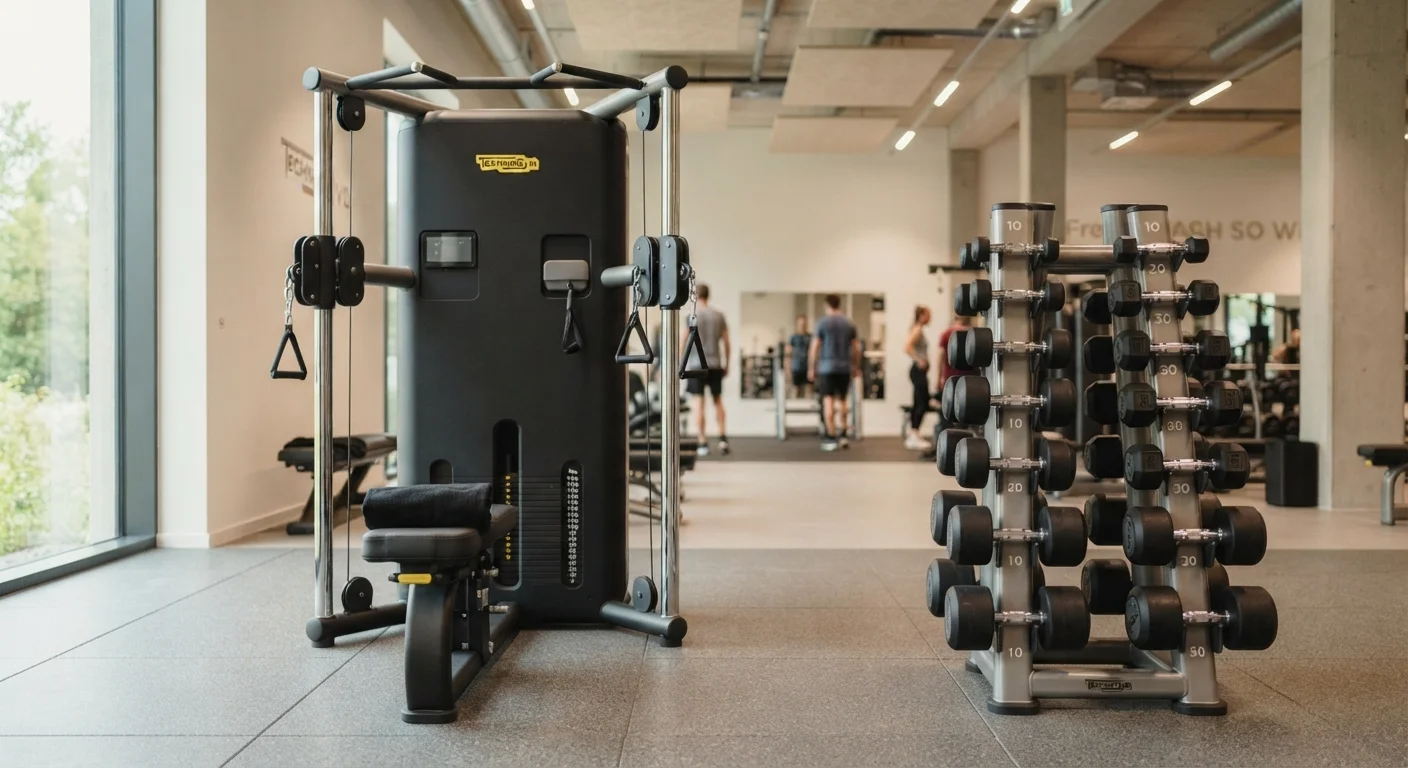
Photo: SaverSteals.com editorial
—— In This Article
Key Takeaways
- Free weights engage more stabilizer muscles and transfer better to everyday movement patterns.
- Resistance machines offer guided motion, making them safer for beginners and those rehabilitating injuries.
- Neither tool is universally superior — the best choice depends on your goals, experience, and physical condition.
- Most gym-goers benefit from combining both approaches rather than committing exclusively to one.
- Proper form matters more than the equipment type when it comes to building strength safely.
Greater stabilizer muscle recruitment per exercise
Free weights require your body to actively control the load in three dimensions, engaging smaller stabilizing muscles that machines bypass. This leads to more comprehensive strength development over time.
Stronger carryover to real-world movement
Functional movements like picking up a heavy bag or catching a fall use multi-planar strength. Free weights train this type of coordinated, whole-body force production more directly than fixed-path machines.
Greater exercise variety from minimal equipment
A standard set of dumbbells or a barbell can replace dozens of individual machines, making free weights especially practical and cost-effective for home training.
Adjustable to natural movement patterns
Unlike machines calibrated to a standardized body geometry, free weights adapt to individual limb length and joint angle, reducing the risk of training in a biomechanically awkward position.
Higher technical learning curve for beginners
Movements like barbell squats and deadlifts require coaching to perform safely. Mistakes in form under load can increase injury risk, particularly for the lower back and knees.
Spotter or safety equipment often required
Heavy free-weight lifts — especially the bench press and squat — carry a real risk if performed to failure without a spotter or appropriate safety bars, limiting solo training options.
Less precise muscle isolation
When the goal is targeting a specific muscle in isolation (e.g., during rehabilitation), free weights make it difficult to exclude surrounding muscles from contributing to the movement.
What Sets These Two Approaches Apart
Both free weights — including dumbbells, barbells, and kettlebells — and resistance machines (cable systems, selectorized weight stacks, plate-loaded machines) apply mechanical load to your muscles to stimulate adaptation. The fundamental difference lies in how that load is delivered and stabilized.
With free weights, you control the path of movement in three dimensions. Your body must recruit stabilizing muscles throughout the lift to keep the weight on track. With machines, the movement path is predetermined by the equipment's design, removing much of that stabilization demand and guiding the primary muscles through a fixed arc.
Understanding this distinction helps clarify when each tool is the smarter choice — and why forcing an either/or decision rarely serves your fitness goals. If you're also weighing whether strength training belongs in your routine at all, see our look at how cardio and strength training affect your body differently.
The Case for Free Weights
Free weights have earned their reputation as a foundation of strength training for good reason. Their demands extend well beyond the target muscle group.
Greater stabilizer muscle recruitment per exercise
Free weights require your body to actively control the load in three dimensions, engaging smaller stabilizing muscles that machines bypass. This leads to more comprehensive strength development over time.
Stronger carryover to real-world movement
Functional movements like picking up a heavy bag or catching a fall use multi-planar strength. Free weights train this type of coordinated, whole-body force production more directly than fixed-path machines.
Greater exercise variety from minimal equipment
A standard set of dumbbells or a barbell can replace dozens of individual machines, making free weights especially practical and cost-effective for home training.
Adjustable to natural movement patterns
Unlike machines calibrated to a standardized body geometry, free weights adapt to individual limb length and joint angle, reducing the risk of training in a biomechanically awkward position.
Exercise science consistently shows that compound free-weight movements — squats, deadlifts, overhead presses — recruit a broader network of muscles than machine equivalents. A 2021 review published in the Journal of Strength and Conditioning Research found that free-weight exercises produced significantly greater muscle activation in stabilizers compared to matched machine exercises. That fuller recruitment translates to strength gains that carry over into daily activities and athletic movement.
Free weights are also highly adaptable. A single pair of adjustable dumbbells can deliver dozens of exercises across all major muscle groups, making them practical for home-based strength routines where space and budget are limited.
The Case for Resistance Machines
Machines are not a shortcut for people who don't know better — they solve specific, legitimate problems that free weights cannot.
Higher technical learning curve for beginners
Movements like barbell squats and deadlifts require coaching to perform safely. Mistakes in form under load can increase injury risk, particularly for the lower back and knees.
Spotter or safety equipment often required
Heavy free-weight lifts — especially the bench press and squat — carry a real risk if performed to failure without a spotter or appropriate safety bars, limiting solo training options.
Less precise muscle isolation
When the goal is targeting a specific muscle in isolation (e.g., during rehabilitation), free weights make it difficult to exclude surrounding muscles from contributing to the movement.
A Note on Injury Rehabilitation
If you are recovering from a musculoskeletal injury, consult a physical therapist or sports medicine professional before using either free weights or machines for the affected area. Machines are commonly used in rehabilitation settings because they allow controlled, isolated loading — but the appropriate tool, load, and range of motion should be determined by a qualified clinician, not self-selected based on general guidance.
Machines isolate target muscles effectively. For rehabilitation, where a healthcare provider wants to load a specific muscle without stressing surrounding joints, machines offer precision that free weights cannot replicate safely. Similarly, when you're learning a new movement pattern, a machine's guided path lets you feel the correct muscular engagement before adding coordination demands.
Fatigue management is another advantage: machines allow you to train close to failure without requiring a spotter, since the weight stack drops safely if you can't complete a rep. This is particularly useful for exercises like the leg press or chest press late in a workout when stabilizer muscles are already fatigued.
For a broader look at how common assumptions about equipment shape (and sometimes derail) training progress, our piece on exercise myths backed by science is worth reading alongside this comparison.
How to Decide What Belongs in Your Program
Rather than choosing one approach exclusively, consider what each does best and build accordingly.
~20%
Greater stabilizer activation with free weights
Research in the Journal of Strength and Conditioning Research has documented meaningfully higher stabilizer muscle activation in free-weight exercises compared to machine equivalents.
Equal
Muscle hypertrophy outcomes when volume is matched
Multiple studies comparing free weights and machines found similar gains in muscle size when total training volume and progressive overload were equivalent across both modalities.
If you're a beginner: Starting with machines for major compound movements lets you develop a feel for resistance training with reduced injury risk. Once basic movement patterns feel natural, progressively introducing free-weight versions of those movements builds coordination and functional strength.
If you're managing an injury or returning from one: Work with a physical therapist or qualified trainer to determine which tool best protects the affected area. Machines often allow earlier loading of a recovering muscle group without stressing vulnerable joints.
If you're an intermediate or advanced lifter: Free weights should anchor most of your program. Machines serve well as supplementary tools for isolating lagging muscle groups or adding volume safely toward the end of a session.
Most well-designed training programs — including those built around weekly structure — incorporate both. See how these tools fit into a broader schedule in our complete guide to building a balanced weekly workout plan.
This article is for general informational purposes only and does not constitute medical or professional fitness advice. Consult a qualified healthcare provider or certified fitness professional before beginning any new exercise program, particularly if you have existing health conditions or injuries.

Health Editorial Team
Health Editorial Team is the collective byline for our editorial team and contributor network. Articles published under this byline or an editorial pen name are researched, written, and reviewed according to our editorial standards for clarity, consistency, and independence before publication.
View author profile