
Stacking Beauty Discounts: How Coupons, Rewards, and Sales Can Work Together
Learn the mechanics of combining beauty coupons, loyalty points, and promotional sales without violating retailer policies.
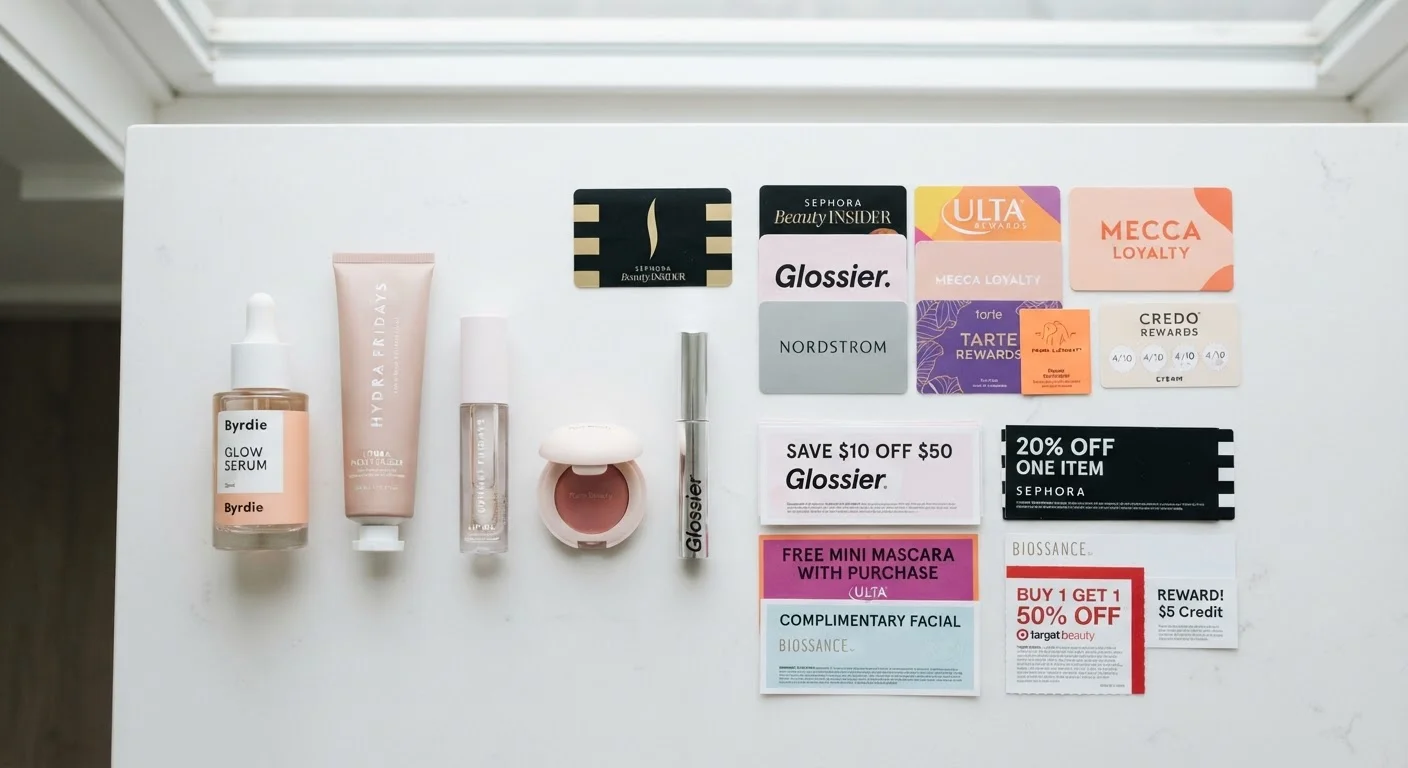
Photo: SaverSteals.com | Explore More. Shop Smarter. editorial
—— In This Article
Key Takeaways
- Stacking works when retailer policy explicitly permits combining a coupon, reward redemption, and a sale price simultaneously.
- Manufacturer coupons and store coupons often can stack, but always verify the fine print before checkout.
- Loyalty point redemptions may be excluded from promotions - read each program's terms carefully.
- Tracking expiry dates and sale cycles prevents missed opportunities and policy violations.
- A systematic pre-checkout checklist reduces errors and maximizes legitimate savings.
Understanding How Beauty Discount Stacking Works
Discount stacking - applying more than one savings mechanism to a single purchase - is one of the most effective ways to reduce out-of-pocket spending on beauty. But it only works within the rules each retailer sets. Before attempting any combination, it helps to understand what you're actually combining.
There are three primary discount layers in beauty retail: manufacturer coupons (issued by the product brand), store or retailer coupons (issued by the retailer), and promotional sale pricing (a temporary markdown applied at the item level). Loyalty reward redemptions - such as points converted to dollars off - function as a fourth layer. Each layer has its own origin and its own set of restrictions.
For a full breakdown of the terminology used across these discount types, see the Beauty Coupon Glossary - it covers stackable offers, threshold discounts, and other terms you'll encounter throughout this process.
It's also worth knowing that stacking isn't the only path to savings. Coupon-free strategies - such as loyalty tier perks and purchase timing - can be equally effective depending on your shopping habits.
Retailer Policies Override General Advice
Stacking rules vary significantly from one retailer to another and can change without notice. The steps in this guide represent common practices, not universal rules. Always verify the specific policy of the retailer where you're shopping before combining discounts. Relying on assumptions - or on how a different retailer handled a similar situation - is the most common reason a stacking attempt fails at checkout.
What You'll Need Before You Start
Stacking discounts successfully requires a bit of preparation. Gather the following before beginning the checkout process - whether in-store or online.
What you will need
Retailer loyalty app or account portal
Used to load digital coupons, check point balances, and confirm which promotions are currently active on your account.
Retailer's coupon policy page
The official policy document clarifies which discount types can be combined and which categories or items are excluded.
Coupon organizer (physical or digital)
Keeps manufacturer and store coupons sorted by expiry date so you can identify which to apply first.
Price-tracking or deal-alert tool
Notifies you when a specific product drops to a sale price, allowing you to time coupon and reward redemptions accordingly.
Step-by-Step: Stacking Coupons, Rewards, and Sale Prices
Follow these steps in order. Skipping ahead - especially to the checkout phase - often leads to errors that are difficult to reverse once a transaction is processed.
Read the retailer's coupon stacking policy
Before loading any coupons or planning a purchase, locate and read the retailer's official policy on combining discounts. This is typically found in the help center under terms like "coupon policy" or "promotional terms." Look specifically for language about whether store coupons and manufacturer coupons can be used together, whether rewards redemptions are permitted during sale events, and which product categories are excluded.
Identify all active discounts available to you
Compile every discount currently available for your intended purchase. This includes: any manufacturer coupon (from product packaging, brand websites, or coupon inserts), any store coupon (loaded to your loyalty account or available as a printed slip), the current sale price if the item is marked down, and your redeemable loyalty point balance. List them separately - this makes it easier to assess which combinations are permitted.
Cross-reference each discount against the stacking policy
With your list of available discounts in hand, match each one against the retailer's policy. Confirm: Can a manufacturer coupon be combined with a store coupon for this item? Is the sale price stackable with a coupon, or does the promotional pricing exclude coupons? Can loyalty points be redeemed in the same transaction as a coupon? Flag any combination that the policy does not clearly permit.
Apply discounts in the correct order
Order of application matters, particularly online. As a general rule: sale pricing applies automatically to the item; manufacturer coupons are applied next; store coupons follow; loyalty point redemptions are typically applied last, just before final payment. However, the correct sequence varies by retailer - some systems require loyalty redemptions to be applied before coupons are entered. Confirm the sequence in the policy or by testing with a small purchase first.
Review the order summary before completing payment
Before finalizing the transaction - whether in-store or online - review the itemized breakdown to confirm every expected discount has been applied correctly. Check that the sale price is reflected, that each coupon has reduced the subtotal as expected, and that any point redemption appears as a credit. If a discount is missing, stop and resolve it before paying. Reversing a completed transaction is time-consuming and not always possible.
Avoiding Common Stacking Mistakes
Even experienced shoppers run into stacking restrictions that aren't immediately obvious. Loyalty point redemptions, for instance, are frequently excluded from promotional sale events - the retailer's terms may state that points cannot be applied when an item is already marked down. Similarly, some store coupons explicitly exclude items already on clearance or participating in a buy-one-get-one offer.
Another common pitfall is assuming that a coupon found via a third-party app or website is valid and current. Expired or counterfeit coupons are a real issue in beauty retail, and attempting to use them - even unknowingly - can result in the entire transaction being voided.
For a deeper look at what shoppers most frequently get wrong, the truth behind beauty promo stacking myths addresses the most persistent misconceptions directly. If you shop across categories, the same caution applies - tool coupon stacking misunderstandings and pet supply coupon mechanics illustrate how exclusion rules vary by vertical.
This guide is part of a broader beauty savings playbook that covers the full arc from finding valid coupons to organizing them across the year. For ongoing management of your stacking strategy, keeping your beauty coupon strategy organized offers practical habits for tracking balances and expiry dates so savings opportunities don't slip by.

Beauty Editorial Team
Beauty Editorial Team is the collective byline for our editorial team and contributor network. Articles published under this byline or an editorial pen name are researched, written, and reviewed according to our editorial standards for clarity, consistency, and independence before publication.
View author profile