
Pet Supply Coupons: How Manufacturer and Retailer Discounts Actually Work
Learn the mechanics behind pet supply coupons — where they originate, how stacking rules apply, and what fine print to watch for.
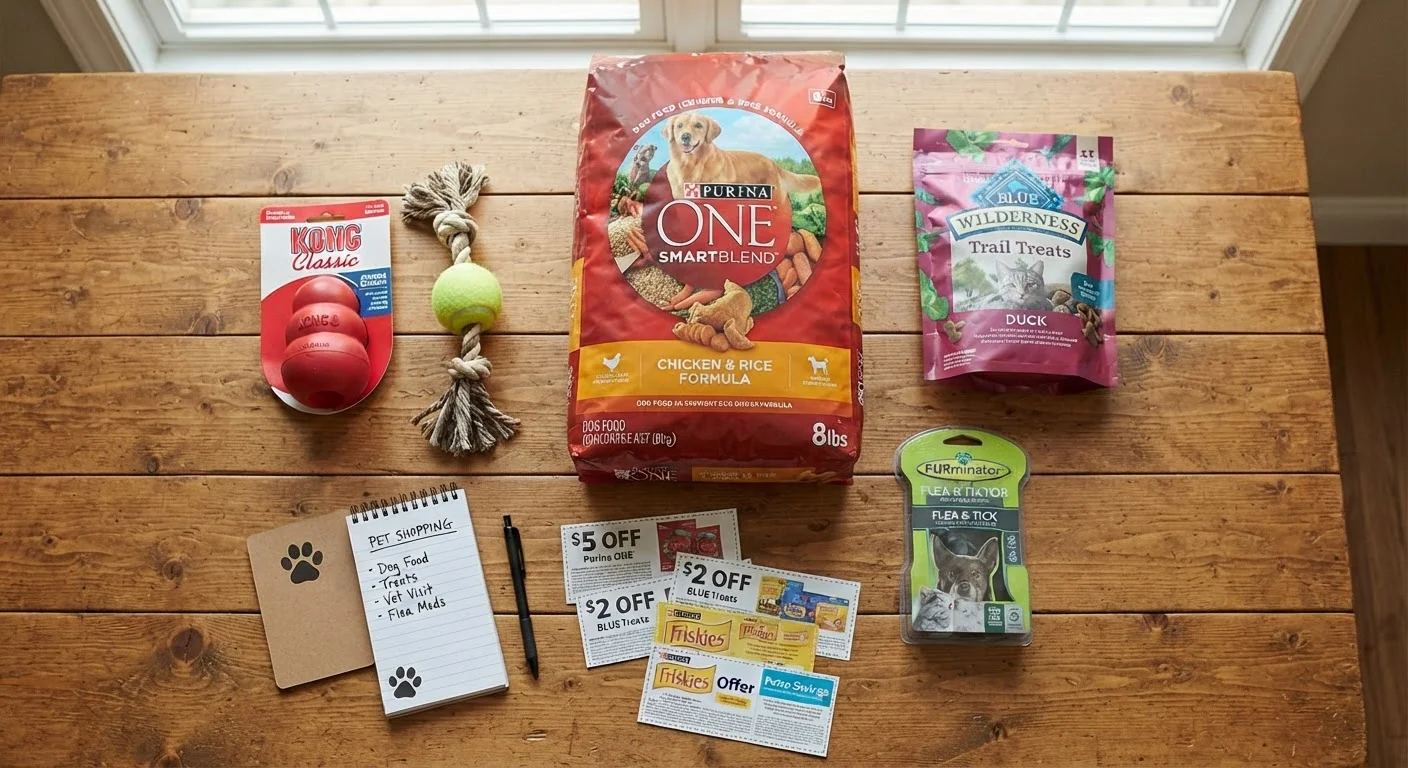
Photo: SaverSteals.com | Explore More. Shop Smarter. editorial
—— In This Article
Key Takeaways
- Manufacturer and retailer coupons come from different sources and follow different redemption rules.
- Many retailers allow one manufacturer coupon and one store coupon per item — this is called stacking.
- Fine print on pet supply coupons often restricts eligible sizes, formulas, or purchase quantities.
- Digital coupons must typically be activated before checkout; they don't apply automatically.
- Subscription or auto-ship discounts and coupons may not combine, depending on retailer policy.
Two Sources, Two Sets of Rules
Every pet supply coupon traces back to one of two origins, and knowing which type you have determines where it's valid and how it's redeemed.
Manufacturer coupons are issued by the company that produces the product — a pet food brand, a flea treatment maker, or a toy manufacturer. When you redeem one, the retailer submits it for reimbursement. This means most major stores will accept manufacturer coupons regardless of where you obtained them, because the retailer recovers the discount value from the brand.
Retailer coupons (also called store coupons) are funded and controlled entirely by the store offering them. A pet supply chain might issue these through its loyalty app, email newsletters, or printed mailers. Because the store absorbs the cost itself, these coupons typically work only at that specific retailer — sometimes only through a specific channel like the app.
Understanding this distinction matters when planning a purchase. A manufacturer coupon for a specific kibble formula can often follow you to whichever store has that item in stock. A store coupon for the same item is locked to one retailer. For a broader look at how this dynamic plays out across retail categories, the article on manufacturer vs. store coupons in beauty retail explains the same underlying mechanics in a parallel context.
How Stacking Works — and When It Doesn't
Stacking refers to applying multiple discounts to the same item. The most common form in pet supply shopping is combining one manufacturer coupon with one store coupon on a single product. Many large pet supply retailers explicitly permit this, but the rules vary and are worth verifying before checkout.
~60%
Pet owners who look for coupons before purchasing
Consumer survey data consistently shows the majority of pet owners actively seek discounts on food and supplies before making a purchase decision.
2x
Common per-transaction coupon limit
Many manufacturer coupon terms cap redemption at two identical coupons per shopping trip, a limit enforced at the register or during digital checkout.
$100B+
Annual U.S. pet industry spending
The American Pet Products Association has reported annual U.S. pet industry expenditures exceeding $100 billion, underscoring the scale of the market coupons operate within.
A few practical realities about stacking:
- One-per-item limits: Retailers typically allow one manufacturer coupon and one store coupon per item, not two manufacturer coupons on the same product.
- Category exclusions: Prescription pet medications, veterinary diet foods, and certain specialty items are frequently excluded from coupon stacking — even when standard products aren't.
- Sale item restrictions: Some store coupons explicitly exclude items already marked down, while others apply on top of sale prices. The coupon terms spell this out.
- Subscription conflicts: Auto-ship programs often carry their own discount, and retailers may not allow an additional coupon on top of that rate.
The mechanics of coupon stacking are consistent enough across retail categories that a guide focused on common coupon stacking misreads in tools surfaces pitfalls that apply equally to pet supplies.
Fine Print That Frequently Catches Shoppers
Coupon terms in pet supplies tend to be more granular than shoppers expect, because manufacturers often produce dozens of size and formula variations. A coupon for a "chicken recipe" dry food may exclude the grain-free version of the same line. A discount for bags "30 lbs. or larger" won't apply to the 24-lb. bag, even if the price difference is negligible.
Activate Digital Coupons Before You Shop
Most retailer apps require you to manually 'clip' or activate a digital coupon in your account before the transaction. Doing this at the store or during online checkout is often too late — the coupon won't retroactively apply. Make it a habit to review your available digital coupons before adding items to your cart.
The most common fine-print traps to watch for:
- Size minimums
- Many manufacturer coupons for pet food apply only to larger bag sizes. Check the ounce or pound threshold, not just the product name.
- Formula exclusions
- "Select varieties" clauses can exclude specific recipes within a product line. Read the excluded varieties list if one is printed on the coupon.
- Quantity limits
- "Limit 2 per transaction" or "one coupon per household" terms are common and enforced at point of sale, especially for high-value coupons.
- Digital activation requirements
- Digital coupons issued through a loyalty account must usually be clipped or activated before the transaction begins. Forgetting this step is the single most common reason a valid coupon goes unused.
Because pricing for the same pet product can differ substantially across channels even before coupons are applied, it helps to understand the baseline. The article why the same pet item costs different amounts in different places explains what drives those gaps and where discounts tend to have the most impact.
This article is for informational purposes only. Coupon policies, terms, and availability vary by retailer and are subject to change. Always verify terms directly with the issuing retailer or manufacturer before purchase.
Frequently Asked Questions

Pets Editorial Team
Pets Editorial Team is the collective byline for our editorial team and contributor network. Articles published under this byline or an editorial pen name are researched, written, and reviewed according to our editorial standards for clarity, consistency, and independence before publication.
View author profile