
The Truth Behind Beauty Promo Stacking Myths
Can you always stack a coupon with a sale? Is doubling always better? Separating fact from fiction in beauty discount stacking.
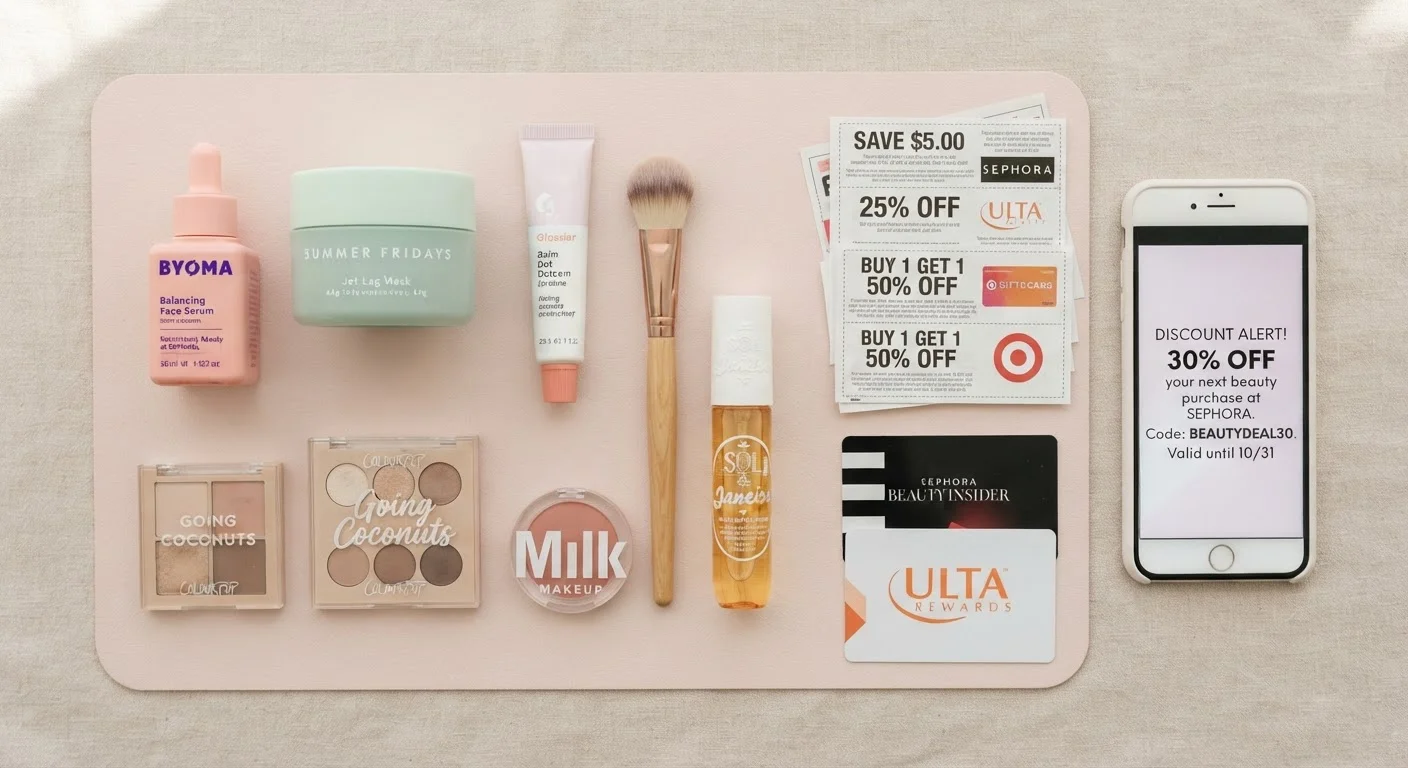
Photo: SaverSteals.com | Explore More. Shop Smarter. editorial
—— In This Article
Key Takeaways
- Stacking a coupon with a sale is not always permitted - retailer policies vary widely.
- Loyalty points and manufacturer coupons often follow different rules and may not combine freely.
- Higher percentage discounts do not always mean the lowest final price after exclusions apply.
- Reading the fine print on each promotion is the only reliable way to know what stacks.
- Some beauty retailers allow coupon stacking only on full-price items, not clearance.
Why Stacking Myths Persist in Beauty Shopping
Beauty retail is built around promotions - loyalty tiers, manufacturer offers, seasonal markdowns, and digital codes all compete for attention. That density of discounting creates fertile ground for misconceptions. When something works once at one retailer, shoppers reasonably assume it works everywhere. That assumption is almost always wrong.
Stacking rules are set at the retailer level, modified by brand agreements, and updated regularly. What applied last quarter may not apply today. The myths below are drawn from the most frequently misunderstood aspects of beauty promo stacking - each one costs real money when acted on without verification.
For shoppers navigating similar fine-print challenges in other categories, clothing promo code stacking rules follow comparable - but not identical - logic.
Myth
You can always stack a coupon on top of a sale price.
Fact
Coupons and sale prices can combine at some retailers, but many explicitly prohibit it - especially for manufacturer coupons applied to promotional pricing.
The assumption that a coupon automatically layers over any sale is one of the most common and costly misconceptions in beauty shopping. Manufacturer coupons, distributed by brands rather than stores, are governed by redemption terms that frequently restrict use on items already marked down. Retailer coupons may be more flexible, but still carry exclusion clauses. The only way to know with certainty is to read the promotion's terms before checkout - not after.
Myth
Loyalty points are just like cash and can be applied to any purchase.
Fact
Loyalty points typically come with their own redemption rules, including minimum thresholds, product category restrictions, and blackout periods around major sales events.
Loyalty programs at major beauty retailers often restrict point redemption during high-traffic promotional windows - such as anniversary sales or holiday events - precisely when shoppers most want to use them. Points may also carry expiry dates or require a minimum balance before redemption is unlocked. Understanding your program's specific mechanics is essential. For a full breakdown of relevant terms, see the Beauty Coupon Glossary for definitions like threshold discounts and reward blackouts.
Myth
A bigger percentage discount always means you pay less.
Fact
A higher headline percentage means little if the promotion excludes the products you actually want or applies only to a narrow subset of items.
A 30% off promotion that excludes prestige skincare, hair tools, and fragrance - common carve-outs in beauty retail - may deliver less real savings than a 15% offer with broader applicability. Always check which SKUs or categories qualify before comparing discount percentages across promotions. The headline number is marketing; the exclusion list is the truth.
Myth
Using two coupons at once is always considered stacking.
Fact
Stacking specifically refers to combining discounts of different types - such as a manufacturer coupon plus a store coupon - not simply presenting multiple coupons for separate items.
Applying one coupon per qualifying item is generally not stacking. Stacking occurs when more than one discount type is applied to the same item or transaction - for example, a brand-issued coupon combined with a retailer loyalty discount on the same product. Retailers that permit stacking typically specify permitted combinations explicitly. For a deeper look at how these mechanics work across categories, Stacking Beauty Discounts walks through the logistics in detail.
Myth
Promo stacking rules are the same across all beauty retailers.
Fact
Stacking policies differ significantly between drugstores, specialty beauty chains, and department store beauty counters - even for the same brand's products.
A manufacturer coupon for a skincare brand may stack with a loyalty offer at one drugstore chain and be declined at a competing chain selling the identical product. Specialty beauty retailers tend to have more structured, published stacking policies, while department store counters may operate under separate brand-level rules entirely. Shoppers who assume uniformity often find discounts rejected at checkout. The Complete Strategic Playbook covers how to navigate these differences across retailer types.
Myth
Digital coupons and paper coupons from the same retailer can always be combined.
Fact
Most retailers treat digital and paper coupons as equivalent coupon types, meaning only one may apply per transaction or per item.
The format of a coupon - digital versus printed - generally does not change its classification in a retailer's system. Presenting a paper coupon alongside its digital equivalent for the same product will typically result in only one being accepted. Retailers issuing both formats usually intend them as alternative delivery methods, not as independently stackable discounts. Always check whether a coupon's terms specify "one coupon per item" regardless of format.
How to Verify What Actually Stacks Before You Buy
The most reliable approach is direct verification. Before building a cart around combined discounts, check three things: the coupon's own terms, the retailer's current stacking policy (usually in the FAQ or promotion details page), and whether the specific items in your cart are listed as exclusions.
Clearance and Sale Items Often Excluded
Many beauty coupons - including both manufacturer and retailer-issued ones - explicitly exclude already-reduced merchandise. Applying a coupon at checkout does not guarantee it will activate on a sale-priced item. Check the exclusion list before you build your cart around a discount that may not apply.
Loyalty program terms, in particular, deserve a close read. Redemption windows, point expiry, and category blackouts can change with program updates. If you're unsure whether a promotional period affects your ability to redeem points, contact the retailer directly - their customer service teams can confirm redemption eligibility before you commit to a purchase.
Retailer Policies Override Assumptions
No universal rule governs how beauty promotions combine. Each retailer sets its own stacking policy, and those policies can change without advance notice. Always verify the current terms directly on the retailer's website or at checkout before assuming two discounts will apply together.
Shoppers interested in building a systematic approach to beauty savings - beyond individual promotions - will find the Beauty on a Budget hub a useful starting point for broader strategy.
This article is for informational purposes only. Retailer policies and promotion terms change frequently; always verify current terms directly with the retailer before making purchasing decisions.

Beauty Editorial Team
Beauty Editorial Team is the collective byline for our editorial team and contributor network. Articles published under this byline or an editorial pen name are researched, written, and reviewed according to our editorial standards for clarity, consistency, and independence before publication.
View author profile