

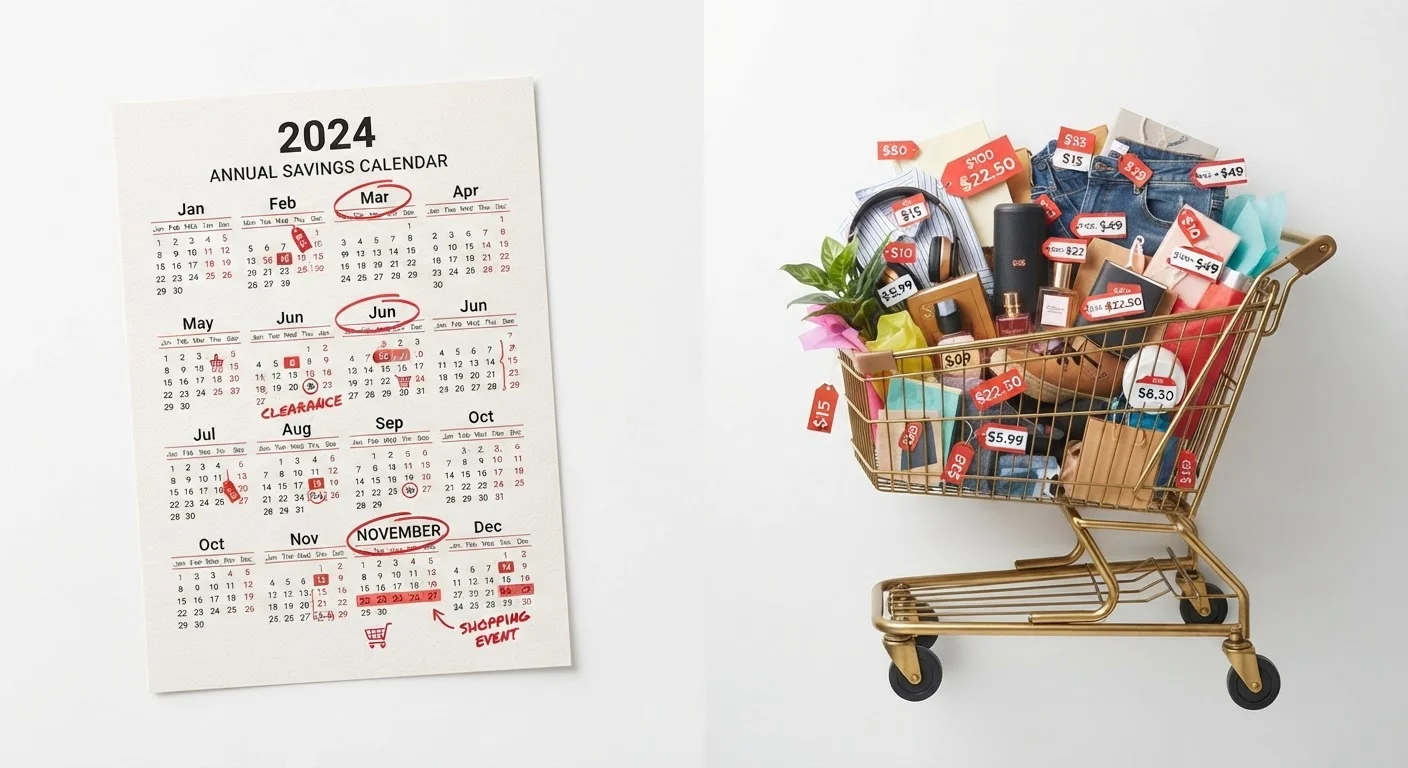
Key Takeaways
Why Timing Beats the Coupon Stack
Coupons feel like free money. They're visible, immediate, and satisfying to redeem. But the math tells a different story. A 15% coupon on a patio set in June - peak demand - still leaves you paying 50% more than you'd spend buying the same set in September when retailers are actively clearing floor space for fall inventory.
This isn't an edge case. It's the rule. Retail pricing is fundamentally demand-driven, and demand is seasonal. The moment a product category enters its high-use window, prices firm up, coupons get stingier, and inventory moves fast enough that retailers have no motivation to discount aggressively. You're competing with everyone else who also wants that thing right now.
Contrast that with off-season buying. When demand drops, retailers face a hard choice: hold inventory (which ties up capital and floor space) or move it fast with deep discounts. They almost always choose the latter. That's your window - and it's far more reliable than hoping a coupon app surfaces a meaningful code. See our breakdown of how off-season pricing logic works across categories for a deeper look at how this pattern repeats.
The goal of this article is to systematically dismantle the myths that keep shoppers locked into peak-season buying - and replace them with a timing framework you can actually apply.
Myth
A good coupon will always beat waiting for a sale.
Fact
Typical coupons save 10-20% at best; seasonal clearance routinely delivers 40-70% off the same item.
The math on this one is unambiguous. A 20% coupon on a $300 patio set saves you $60. Buying that same set in late August - when the retailer needs the floor space - saves you $120 to $210 depending on how far into clearance cycle you catch it. The coupon was never competing on equal ground.
The reason coupons feel like a better strategy is psychological: they're actionable right now. Timing-based savings require patience and planning, which feels harder even when the dollar return is dramatically higher. Retailers know this, which is why they'd rather offer a 15% coupon than wait for you to discover they'd go to 50% off in eight weeks anyway. Check out why coupons underperform more than most shoppers realize for a detailed look at the savings gap.
Myth
The best time to buy seasonal items is during the season you'll use them.
Fact
Peak season is almost always the worst time to buy - demand is highest, inventory moves fast, and retailers have zero incentive to discount.
Buying a snow blower in November, a swimsuit in July, or a space heater in December is the default behavior most retailers count on. They price accordingly. When demand is predictably high, markdowns are rare, coupons are shallow, and sale events are mostly promotional theater.
The better move: buy your snow blower in March when the retailer needs to reclaim warehouse space. Buy your air conditioner in September when last season's units are being cleared. Buy outdoor furniture in August or September, not May. This feels counterintuitive because you won't use the item immediately - but the savings window is real and repeatable. clearance shopping myths digs into how end-of-season cycles actually work and when to engage them.
Myth
Black Friday and Prime Day are the best annual deals available.
Fact
These events generate urgency more reliably than genuine discounts; category-specific off-season windows typically beat them on the items that matter most.
Black Friday and Prime Day are real events with real discounts - but they're also heavily managed. Retailers use them to move specific high-margin items, create loss leaders on a handful of products, and generate volume on items that weren't going to sell otherwise. The discounts on the things you actually need are often modest.
Research consistently shows that televisions, for example, are frequently cheaper in January and February than on Black Friday - the post-Super Bowl window is a genuine discount period that gets far less attention. Appliances often see better pricing in September and October. If you're treating Prime Day and Black Friday as your primary savings strategy, you're optimizing for the calendar retailers want you to use, not the one that maximizes your savings.
[in_content_images:2]This doesn't mean skipping those events - if a deal is genuinely good, take it. But don't buy something just because it's Black Friday. Buy it when the price is right for that specific category.
Myth
Waiting for a deal means you'll miss out or the item will sell out.
Fact
Scarcity during clearance is rare; most off-season discounts apply across broad inventory that retailers are actively trying to move.
Fear of missing out (FOMO) is the psychological mechanism retailers exploit most effectively. Limited time, limited stock, countdown timers - all of these cues push you to buy now rather than evaluate the price rationally. The reality of clearance cycles is the opposite of scarcity: retailers are sitting on inventory they need to move and are actively motivated to sell it to you.
The exceptions are genuinely limited-edition items or products with narrow production runs - in those cases, FOMO is warranted. But for commodity purchases like appliances, furniture, sportswear, and electronics accessories, the clearance supply is substantial. The risk of waiting is missing the deepest markdown by a few weeks, not losing the product entirely.
[in_content_images:3]The practical hedge: set a price alert on tools like CamelCamelCamel or Google Shopping, and buy when the price hits your target - whether that's during an off-season window or an unexpected flash sale. Reactive buying based on manufactured urgency is the most expensive shopping habit most people never audit.
Myth
Grocery and household staples don't have seasonal pricing patterns worth tracking.
Fact
Pantry staples, cleaning products, and personal care items all follow promotional cycles tied to manufacturer calendars and retail reset periods.
Grocery pricing isn't as dramatically seasonal as furniture or outdoor gear, but it's far from random. Retailers operate on promotional calendars - typically 12-week cycles - in which specific categories rotate through deep discount windows. Baking supplies spike in promotions before Thanksgiving and Christmas; grilling items go on sale Memorial Day through July 4th; cleaning products get featured in January (New Year cleaning) and March/April (spring cleaning).
Understanding these cycles for your regular purchases is the grocery equivalent of off-season buying. Stock up on cleaning supplies in January when the promotional pricing is aggressive. Buy baking staples in early November before they sell through at full price. The couponing basics framework is most powerful when applied during these promotional windows rather than as a generic weekly habit.
The Annual Buying Calendar: Your Real Savings Map
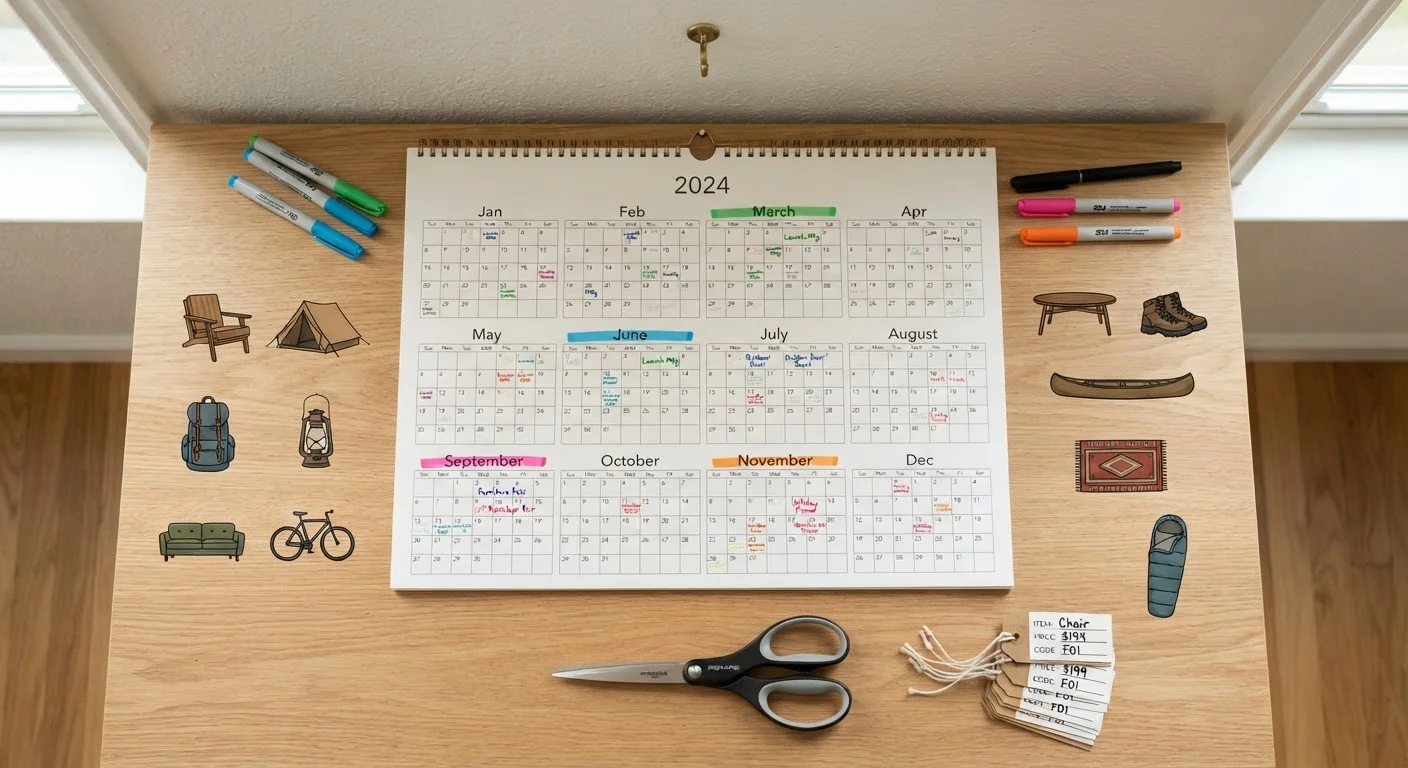
Once you accept that timing is the primary lever, the next step is knowing when each category hits its discount floor. Below are the windows most shoppers miss - not the obvious Black Friday dates, but the quieter, deeper clearance cycles that reward patience.
Furniture and Mattresses: January and July
New model lines drop in February and August, which means January and July are when retailers aggressively clear outgoing inventory. Discounts of 30-60% are common. January is particularly strong for mattresses - mattress retailers run some of their deepest promotions in January, a pattern that extends to bedroom furniture broadly.
Outdoor and Lawn: August through October
Grills, patio furniture, lawn mowers, and garden tools all hit clearance mode as summer winds down. Retailers need the floor space for holiday merchandise. This is also when summer blowout sales deliver genuine value - not promotional theater. Expect 40-70% off on major items. If you can wait until October, selection thins but prices drop further.
Winter Apparel and Holiday Décor: December 26 - January 15
Post-holiday clearance is one of the most underutilized windows. Retailers who overstocked are desperate to move units before Q1 inventory resets. The catch: you need to shop by size and color availability rather than perfect selection. For anyone with flexibility, the savings justify the trade-off. See how to work winter clearance windows strategically for the full playbook.
Electronics: February and the Week After Major Launch Events
Consumer electronics discounting is less about the calendar and more about product cycles. When a new flagship phone, TV, or laptop launches, the previous generation drops - often 20-35% within weeks. Tracking release schedules for your target category is more reliable than waiting for a coupon code that may never appear.
Gym Equipment: January's Second Half
Retailers stock heavy for the New Year's resolution surge. By mid-January, they know which items didn't sell and begin marking down. February is even better. Buying a treadmill or weight set in late January beats any coupon you'd find on the same item in March at full price.

40-70%
Typical off-season discount on outdoor furniture
Retailers clearing floor space for fall inventory routinely mark down patio and garden items by this margin in August-October.
15%
Average coupon face value on major retail items
Consumer savings research consistently shows that most distributed coupons offer between 10% and 20% off, well below off-season clearance depth.
30-60%
Furniture discount in January model-year clearance
As new furniture lines arrive in February, January becomes one of the deepest discount windows for bedroom and living room pieces.
3-6 months
Planning horizon that captures most off-season windows
Shoppers who plan non-urgent purchases 3-6 months ahead can almost always align their buy with a category's annual discount floor.
Putting Timing and Tactics Together
Timing isn't a reason to abandon all other savings tactics - it's the foundation you build on. Once you're buying at the right moment in a product's price cycle, layering cashback and legitimate coupon stacking can add another 5-15% on top of an already discounted price.
Don't Let Coupon Availability Drive the Purchase Decision
Finding a coupon for a product is not a signal that now is the right time to buy it. Coupons are distributed by manufacturers and retailers to accelerate demand on their timeline, not yours. Before redeeming any coupon on a major purchase, check whether you're in the peak-demand window for that category. If you are, the coupon is likely a fraction of what you'd save by waiting. On recurring consumables, coupons remain valuable - just verify the promotional cycle aligns with a genuine low-price window.
Off-Season Buying Requires Planning Ahead - Don't Impulse Buy the Wrong Item
The pitfall of off-season buying is purchasing something you don't actually need just because the price is exceptional. Before committing to any clearance or off-season purchase, confirm you have a concrete, near-term use case. Buying a second patio set because it's 60% off in September creates a storage problem, not a savings win. Apply the same discipline to timing-based deals that you would to any other purchase decision.
The sequence matters: start with timing, then check for stackable offers. Going in the opposite direction - finding a coupon first and buying immediately - is how you end up paying 40% more than necessary even after the discount. If coupon stacking is part of your approach, make sure you understand the rules to avoid checkout friction - stacking coupons without register errors covers the most common failure points.
For recurring purchases - pantry staples, personal care, cleaning supplies - the calculus is slightly different. These categories don't have strong seasonal demand spikes, so timing matters less. Here, coupon discipline and tools like subscription pricing matter more. But even then, digital coupon tools have a meaningful failure rate; understanding why coupon app savings often don't reach your cart will help you avoid the most common traps.
Your Purchase Timeline Is a Savings Asset
The single most effective change you can make to your shopping habits is building a purchase calendar 3-6 months out. List every significant item you anticipate buying and research its historical discount window. This converts savings from a reactive, coupon-clipping exercise into a proactive system. Consumers who plan ahead consistently pay 30-50% less on major purchases than those who buy at the point of need - with no coupons required.
The broader point: treat your shopping list as a schedule, not a reactive impulse. Anticipate what you'll need in the next 3-6 months and match each item to its optimal buying window. That single habit shift - planning purchases around retail cycles rather than personal urgency - is worth more than any coupon strategy in isolation.