

Key Takeaways
Marketplace Total Cost of Purchase
The true price of buying something from an online marketplace goes beyond the listed price. It includes shipping fees, third-party seller markups, platform buyer protections, return policy limitations, and the trustworthiness of who is actually fulfilling your order. Evaluating all of these factors together gives you a realistic picture of what you're actually paying and risking.
Economists call this the 'total cost of ownership' for a transaction - factoring in not just the sticker price but the expected cost of friction events like returns, disputes, and reshipment.
Why the Listed Price Is a Starting Point, Not the Answer
Most shoppers open three or four tabs, compare the numbers in the top-right corner, and click buy on the lowest one. That habit costs real money. The listed price on any marketplace is a compressed signal that strips out at least four variables that materially affect what the purchase actually costs you.
Those variables: total shipping cost, seller reliability, return and refund friction, and platform buyer protection coverage. Ignore any one of them and the "deal" you thought you found can become a negative experience that ends up costing more than the pricier option would have.
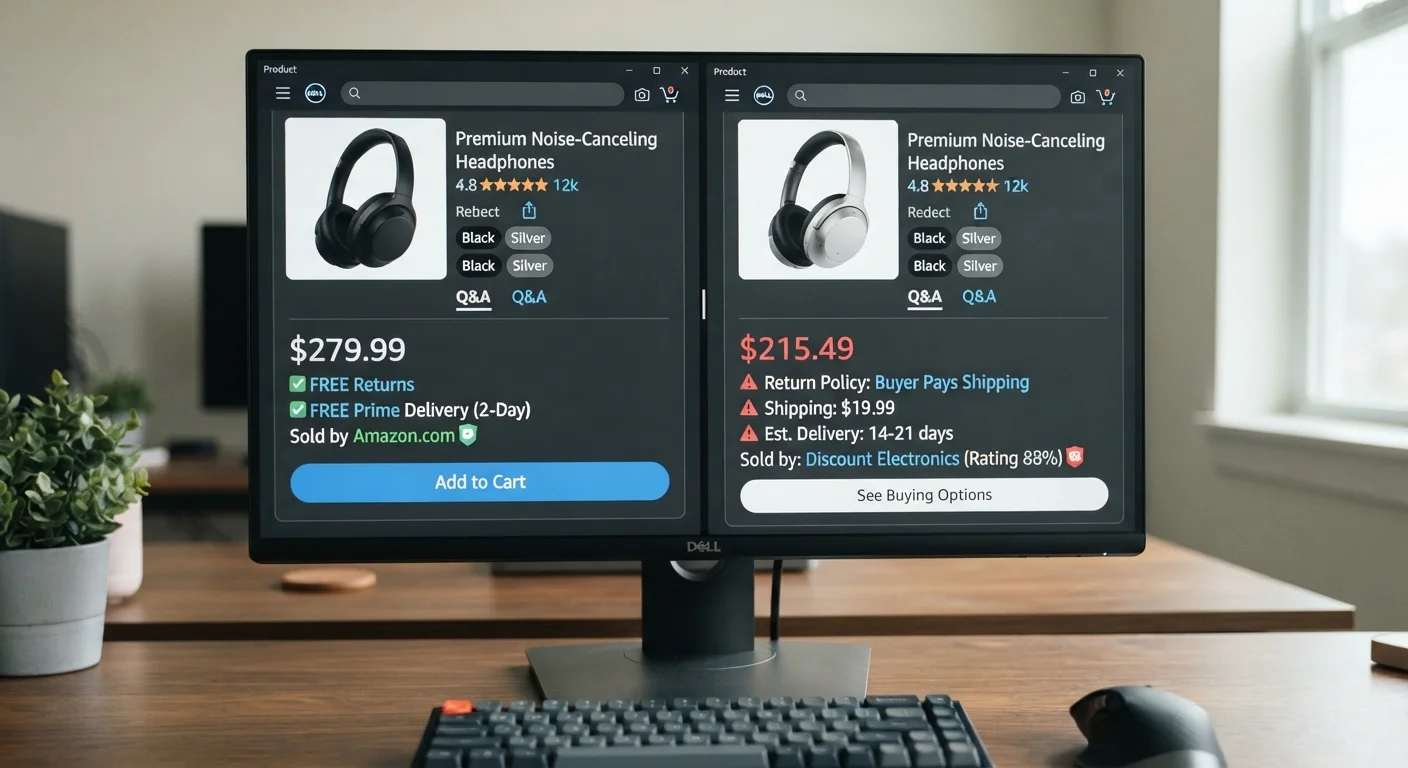
This isn't hypothetical. A $34.99 item from an unknown third-party seller with no return policy and a $6.99 shipping charge is objectively a worse deal than a $39.99 version sold directly by a platform with free Prime shipping and a no-questions-asked 30-day return window - even though the number looks higher. The math is straightforward once you build the habit of running it.
What follows is a framework for doing exactly that: breaking down the components that determine real purchase value across the four dominant marketplaces - Amazon, eBay, Walmart, and Etsy.
60%+
Amazon sales from third-party sellers
Amazon reported that third-party sellers accounted for over 60% of units sold in its store in recent annual filings, underscoring how often buyers are transacting with sellers, not Amazon itself.
6-17%
Typical Amazon referral fee range
Amazon's referral fees vary by product category, ranging from 6% for personal computers to 17% for gift cards and jewelry, costs that sellers pass on through pricing.
30-90 days
Return window gap across major platforms
Walmart's own retail return window is 90 days; Amazon's is 30 days - a 3x difference that matters significantly for high-value or seasonal purchases.
~15%
eBay final value fee (most categories)
eBay charges sellers approximately 13-15% on most categories as a final value fee, one of the highest flat rates among major marketplaces.
90 days
Amazon A-to-Z Guarantee claim window
Buyers have up to 90 days from the estimated delivery date to file an A-to-Z Guarantee claim, provided they first attempt to resolve the issue directly with the seller.
Seller Fees and How They Shape the Prices You See
Online marketplaces don't let sellers list for free. Every platform charges a mix of listing fees, referral percentages, and - if using the platform's own fulfillment network - logistics fees. These costs flow directly into listing prices. Understanding them helps you interpret why prices differ and when a higher-priced listing might actually represent better value.
Amazon
Amazon charges sellers a referral fee between 6% and 17% depending on category, plus a FBA fee for sellers using Amazon's warehouses. Those FBA fees range from around $3.22 to well over $10 per unit depending on size and weight. Sellers who handle their own shipping (Merchant Fulfilled) avoid the FBA fee but often have slower shipping windows. The key implication for buyers: FBA listings tend to be priced slightly higher but come with Prime delivery and Amazon's direct handling of returns.
eBay
eBay charges a final value fee of roughly 12-15% across most categories, collected when an item sells. There's no mandatory fulfillment infrastructure, which gives sellers more pricing flexibility - but also means shipping speed and return handling are entirely seller-dependent. eBay's fee structure sometimes results in lower base prices, particularly on used or collectible items where seller competition is intense.
Walmart Marketplace
Walmart's referral fees range from 6% to 15% and the platform has no monthly seller subscription fee (unlike Amazon). Walmart has been aggressively growing its third-party marketplace, which means more selection - but also more variation in seller quality. The lack of a dominant fulfillment ecosystem comparable to FBA means shipping times vary more widely.
Etsy
Etsy charges a 6.5% transaction fee on the sale price plus shipping, a $0.20 listing fee per item, and optional advertising fees. Because Etsy's seller base skews toward small, independent makers, prices often reflect genuine handcraft labor costs rather than commodity arbitrage. Comparison shopping on Etsy against Amazon rarely makes sense - the products aren't equivalent.
“The price on the screen is what you pay to start the transaction. What you actually spend is determined by everything that happens after you click buy.”
— Juozas Kaziukėnas, Founder, Marketplace Pulse - e-commerce research firm
The takeaway: when you see price differences across platforms, some portion of that gap is the platform's cost structure, not necessarily a better deal for you. A slightly higher price on a platform with lower friction and stronger buyer protection may represent the better total value.
Seller Trust: What the Rating Systems Don't Tell You
Every major marketplace uses some form of star rating or feedback score. None of them fully captures seller trustworthiness, and gaming these systems is well-documented. Here's how to read seller quality more accurately than the aggregate score suggests.
Amazon: The Third-Party Seller Problem
Amazon's marketplace hosts millions of third-party sellers. The Amazon brand creates a halo effect - buyers assume everything sold "on Amazon" has passed some quality threshold. It hasn't. A product listed by a third-party seller ships from that seller's inventory, often from overseas, and Amazon's involvement is limited unless something goes wrong.
What to check: Look at the "Sold by" and "Fulfilled by" fields on every product page. "Sold by Amazon" and "Fulfilled by Amazon" together indicate Amazon is the actual retailer. "Sold by , Fulfilled by Amazon" means Amazon handles logistics but not the product itself. "Sold and Fulfilled by " means Amazon is not in the loop on fulfillment at all.
For high-value purchases, also check the seller's storefront - look at review volume, time in business, and negative review content. A seller with 200 reviews and a 94% rating who launched six months ago warrants more caution than one with 5,000 reviews and a 98% rating over four years.
eBay: Feedback Score Nuance
eBay's feedback system is older and more granular. The percentage score, number of transactions, and detailed seller ratings (DSRs) for shipping, communication, and item accuracy give you more signal than a single star rating. A 99.1% positive score on 10,000 transactions is meaningfully different from 99.1% on 50 transactions - look at the volume, not just the percentage.
eBay also allows buyers to see the content of feedback, which surfaces specific complaints. Patterns in negative feedback - multiple buyers mentioning slow shipping or misrepresented condition - are more reliable than any single review.
Walmart and Etsy
Walmart's marketplace seller ratings are less mature and the review corpus is thinner for many sellers. When Walmart Marketplace sellers have few reviews, lean on the product's overall review count but verify the seller independently where possible. Etsy sellers can be vetted through their shop announcement, how long they've been selling, and the quality of their customer communication - many experienced Etsy sellers post response rate and time metrics on their profiles.
Read Negative Reviews Specifically
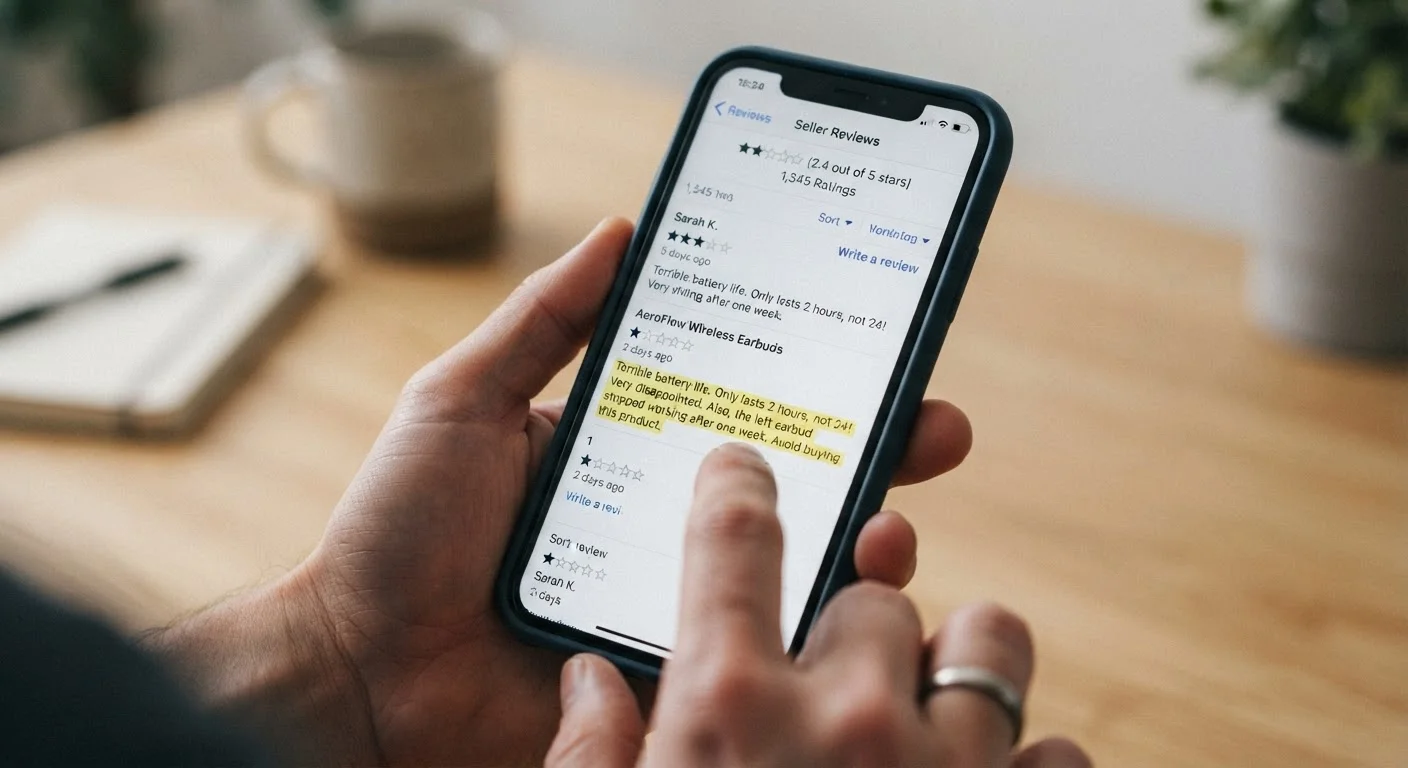
Don't judge a seller by their average rating alone. Sort reviews by lowest rating and look for repeated themes - late shipping, wrong items, poor communication. Two or three buyers reporting the same problem is a stronger signal than 50 five-star reviews from buyers who only mention 'fast shipping.'
Screenshot Listings Before You Buy
Sellers can edit product descriptions, photos, and specifications after a purchase is made. Taking a screenshot of the full listing page - including the seller's stated return policy - gives you documented evidence if the item arrives different from what was advertised. This is especially important on eBay and Etsy.
Use a Credit Card, Not a Debit Card
Credit cards give you a secondary layer of purchase protection through your card issuer's chargeback rights, independent of the marketplace's own protection program. This is particularly valuable on Etsy and smaller marketplace sellers where platform dispute processes are less robust.
One universal habit worth building: before any purchase above $30 from a marketplace seller, spend 90 seconds reading their three most recent negative reviews. Not the overall rating - the actual complaints. That's where the real signal lives.
Return Policies: The Fine Print That Decides Whether a Deal Holds Up
Return policies are where many shoppers get burned, because they assume the platform's policy applies uniformly. It doesn't. On every major marketplace, individual seller return policies can deviate significantly from the platform's baseline - and the baseline itself varies by platform.
Amazon
Amazon's own retail returns are among the most frictionless in e-commerce: 30 days, prepaid return labels on most items, refunds processed quickly. But third-party sellers on Amazon can set their own return windows and conditions, within Amazon's minimum requirements. Some categories, like consumables and digital products, have no return eligibility. Always confirm whether "Amazon's return policy" applies or whether you're subject to a seller-specific policy listed in the product details.
eBay
eBay's return policy is seller-defined first, platform-backstopped second. Many eBay sellers offer 30-day returns on new items but restrict or exclude returns on used or collectible items - which is the majority of eBay's inventory. eBay's Money Back Guarantee does cover situations where an item doesn't arrive or is significantly not as described, but it doesn't cover buyer's remorse if the seller has a no-return policy. Read the return terms on every eBay listing before bidding or buying.
Walmart
Walmart's own retail items sold through the site carry Walmart's standard 90-day return policy - notably more generous than Amazon's 30 days. Marketplace sellers on Walmart must offer at least 30-day returns on most items. The gap between what Walmart sells directly and what marketplace sellers sell is less transparent than on Amazon, so it's worth checking the "Sold by" information on every Walmart.com product page.
Etsy
Etsy has no universal return policy. Each seller sets their own. Many independent Etsy sellers don't accept returns at all on custom or personalized items, which is standard for handmade goods. Before buying anything on Etsy, read the shop's policies section - it's displayed on every storefront. If a seller has no return policy listed, message them and get confirmation in writing via Etsy's messaging system, which creates a record.
The 'Sold by Amazon' Distinction Matters
On Amazon, 'Sold by Amazon' and 'Fulfilled by Amazon' are not the same thing. 'Sold by Amazon' means Amazon is the retailer and your return and warranty rights are with Amazon directly. 'Fulfilled by Amazon' (from a third-party seller) means Amazon handles shipping but the seller is the retailer - and seller-specific policies may apply to returns and disputes.
Platform Policies Change - Verify Before Each Major Purchase
Marketplace buyer protection terms, seller fee structures, and return policy minimums change regularly. Amazon, eBay, and Walmart have all updated their policies multiple times in the past three years. For any high-value purchase, take 60 seconds to verify the current platform policy rather than relying on what you remember from a previous purchase.
Your Credit Card May Have Better Protection Than the Platform
Many premium credit cards offer purchase protection, extended warranty coverage, and dispute rights that exceed what any marketplace provides. If you're buying an expensive item and the seller's return window is short, check your card's benefits - you may have 90-day purchase protection and chargeback rights that effectively override the seller's terms.
Buyer Protection Programs: What They Actually Cover
Every top marketplace offers some form of buyer protection, but the coverage details matter more than the marketing language. "Guaranteed" and "protected" mean different things in different contexts.
Amazon A-to-Z Guarantee
Amazon's A-to-Z Guarantee covers third-party purchases when an item doesn't arrive within the estimated delivery window, arrives damaged or defective, or is significantly different from the listing description. You must first attempt to resolve the issue with the seller before filing a claim, and claims must be filed within 90 days of the estimated delivery date. Amazon will refund the full purchase price including shipping if the claim is approved. It's one of the stronger buyer protection programs available.
eBay Money Back Guarantee
eBay's Money Back Guarantee covers the same core scenarios - item not received, item not as described - but excludes buyer's remorse when a seller has a stated no-return policy. The dispute process on eBay can involve more back-and-forth than Amazon's, particularly for high-value items where sellers may escalate to eBay's managed dispute team. eBay also offers purchase protection through PayPal (or your credit card issuer) as a secondary layer if the platform dispute doesn't resolve in your favor.
Walmart and Etsy
Walmart's marketplace protection is newer and still maturing. It covers the standard scenarios but the dispute process is less documented. For Etsy, buyer protection is limited - Etsy's Purchase Protection Program covers qualifying items when the item is not as described or doesn't arrive, but not all items qualify. Custom and made-to-order items are often excluded from Etsy's protection. Your credit card's purchase protection becomes more relevant on Etsy than on any other major marketplace.
Speaking of credit cards: using a card with strong purchase protection and dispute rights gives you a backstop on every platform. This is especially relevant for high-value purchases. For more on securing your financial data during checkout, see red flags on payment pages and the safe online payments hub.
Building a Pre-Purchase Checklist That Actually Protects You
The goal isn't to spend 20 minutes on every $15 purchase. It's to develop fast, systematic habits that catch the situations where cutting corners costs you. Here's a practical checklist structured by purchase size.
Any Purchase Over $25 from a Third-Party Seller
- Confirm the fulfillment source: Who ships it? Whose warehouse does it come from?
- Check the seller's feedback volume and rating - minimum 95%+ with at least 50 reviews.
- Read the return policy in the listing, not on the platform's general policy page.
- Confirm whether buyer protection applies to this specific transaction.
Any Purchase Over $75
- Run all of the above checks.
- Search for the seller name plus the word "scam" or "complaint" to surface issues the platform's review system may not have captured.
- Use a credit card with purchase protection rather than a debit card or PayPal balance.
- Screenshot the listing before purchase - descriptions can be edited after a sale.
For Electronics and High-Value Items
Price history matters as much as seller quality. A listing priced at $189 that was $229 last month is a different situation from one that was $159 last month and "went on sale" to $189. Price history charts are a reliable way to distinguish genuine discounts from manufactured urgency.
Also consider the hidden costs that often accompany electronics purchases - warranties, accessories, and compatibility issues that inflate the real price beyond what the listing shows. See hidden device purchase costs for a full audit framework.
Read Negative Reviews Specifically
Don't judge a seller by their average rating alone. Sort reviews by lowest rating and look for repeated themes - late shipping, wrong items, poor communication. Two or three buyers reporting the same problem is a stronger signal than 50 five-star reviews from buyers who only mention 'fast shipping.'
Screenshot Listings Before You Buy
Sellers can edit product descriptions, photos, and specifications after a purchase is made. Taking a screenshot of the full listing page - including the seller's stated return policy - gives you documented evidence if the item arrives different from what was advertised. This is especially important on eBay and Etsy.
Use a Credit Card, Not a Debit Card
Credit cards give you a secondary layer of purchase protection through your card issuer's chargeback rights, independent of the marketplace's own protection program. This is particularly valuable on Etsy and smaller marketplace sellers where platform dispute processes are less robust.
One more lever that shoppers often overlook: promo codes apply to marketplace purchases too, not just direct retailer sites. Before checking out, run the listing through a promo code strategy to capture any available discount on top of the marketplace price.
The Bigger Picture: Treating Marketplace Shopping as a System
The shoppers who consistently get the best value from online marketplaces aren't the ones who got lucky. They're the ones who treat the process as a repeatable system: evaluate the total cost including friction, verify the seller before committing, understand the return terms in advance, and know which platform's protection applies to their specific purchase.
This also means knowing when a marketplace isn't the right channel at all. Sometimes the lowest total-cost option is buying directly from a brand's own site, especially when you factor in return shipping costs, dispute risk, and the value of your own time spent resolving problems. The full marketplace comparison by product category is a useful reference for knowing where each platform genuinely wins versus where it only looks competitive on the surface.

Finally, be skeptical of deals that seem dramatically better than everything else in the search results. Artificially low prices are one of the oldest tactics in marketplace selling - they attract clicks and purchases from buyers who don't verify, and by the time the dispute is filed, the seller has moved on. If something looks too good to be true on a marketplace, spend 60 seconds checking the seller before clicking buy. That one habit, applied consistently, is worth more than any discount code. Related: the same skepticism applies to seasonal promotions - holiday sale myths that lead shoppers to overpay are especially common during high-volume shopping periods when marketplace competition spikes and seller quality controls loosen.