


Key Takeaways
Cashback Portal
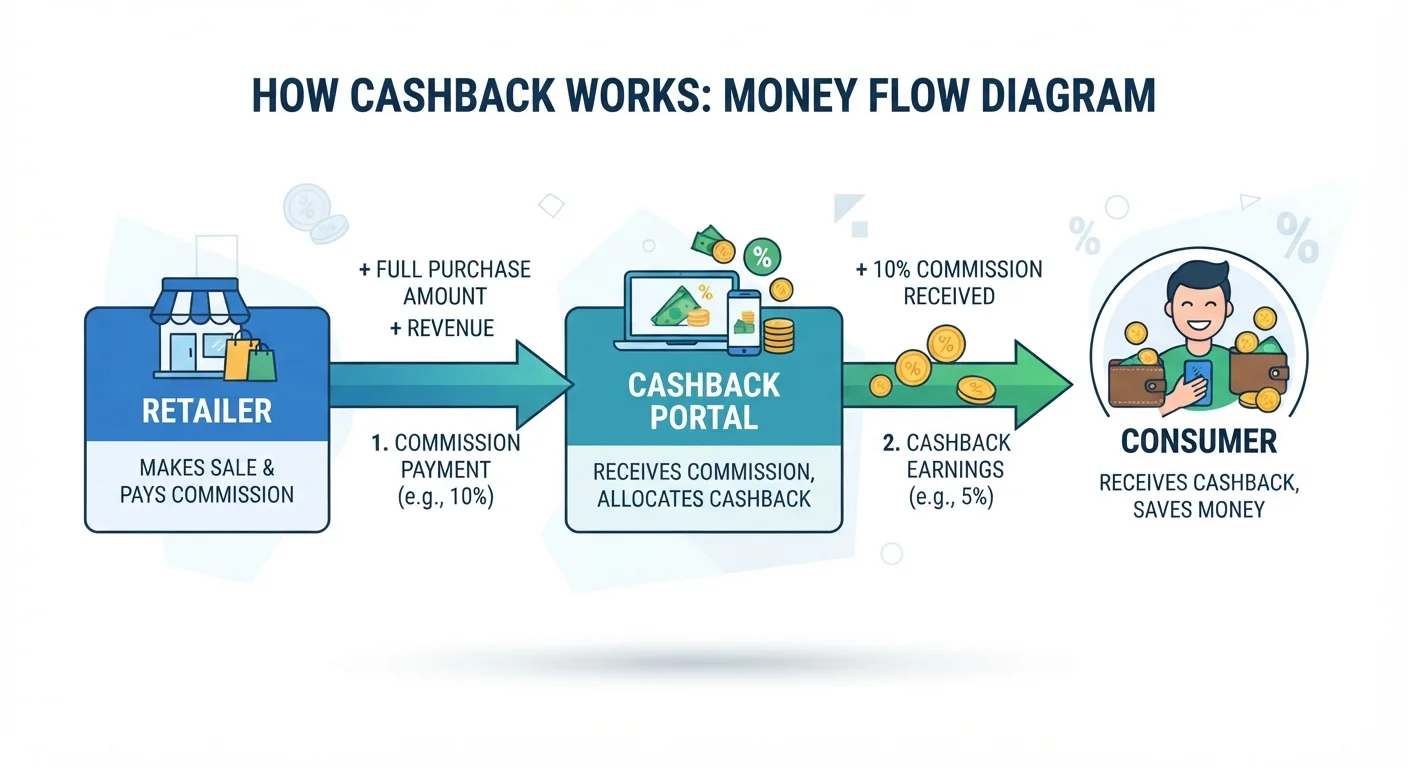
A cashback portal is a website (or browser extension) that acts as a referral middleman between you and an online retailer. When you click through the portal before shopping, it earns a commission from the retailer for sending you there - and it shares a portion of that commission with you as cashback. The retailer pays; you pocket the difference. You pay the same price either way.
Portals track referrals using browser cookies and affiliate tracking links embedded in click-through URLs. The commission split between portal and shopper is governed by each portal's individual affiliate agreement with the retailer.
The Mechanics: How Money Actually Flows
Most shoppers assume there's a catch - that cashback portals must inflate prices to fund their rebates, or that they harvest personal data to sell. Neither is true. The money trail is surprisingly straightforward once you map it out.
Every major online retailer runs an affiliate program. Under this arrangement, the retailer agrees to pay a commission to any website that successfully refers a paying customer. That commission is baked into the retailer's customer acquisition budget, the same budget that funds banner ads and influencer sponsorships. When a cashback portal sends a verified buyer, the retailer pays the portal a percentage of that sale - usually somewhere between 1% and 15%, depending on the product category and the retailer's margins.
Here's where your rebate comes from: the portal keeps a portion of that commission as its operating revenue and returns the rest to you. The exact split varies by platform. Portals like TopCashback advertise that they pass back the majority of the commission. Others, like Rakuten, retain more but invest it in a polished user experience and bonus promotions.
The tracking mechanism is a cookie. When you click a portal's link to a retailer, your browser receives a small tracking file that identifies the portal as the referring source. As long as that cookie persists through checkout - typically 24 hours to 30 days - the portal gets credited for your purchase. This is why competing browser extensions can be a problem: a coupon tool that auto-applies at checkout may overwrite your portal cookie, redirecting the commission away from the portal (and away from you).
How Long Do Tracking Cookies Last?
Cookie duration varies by retailer affiliate agreement, not by portal. Most retail affiliate programs use a 24-hour to 30-day cookie window. If you click through a portal but don't complete your purchase until the cookie expires, the commission won't be credited. For large purchases you're not ready to finalize immediately, note the cookie duration and click through again when you're ready to buy.
Portal Cashback and Taxes
The IRS generally treats cashback rebates as purchase price reductions rather than taxable income - the same treatment as a store discount. However, signup bonuses or referral bonuses paid without a qualifying purchase may be treated differently. If you're earning four figures annually from portal cashback, it's worth a quick check with a tax professional.
Portal Rates Are Not Equal - and the Gaps Are Significant
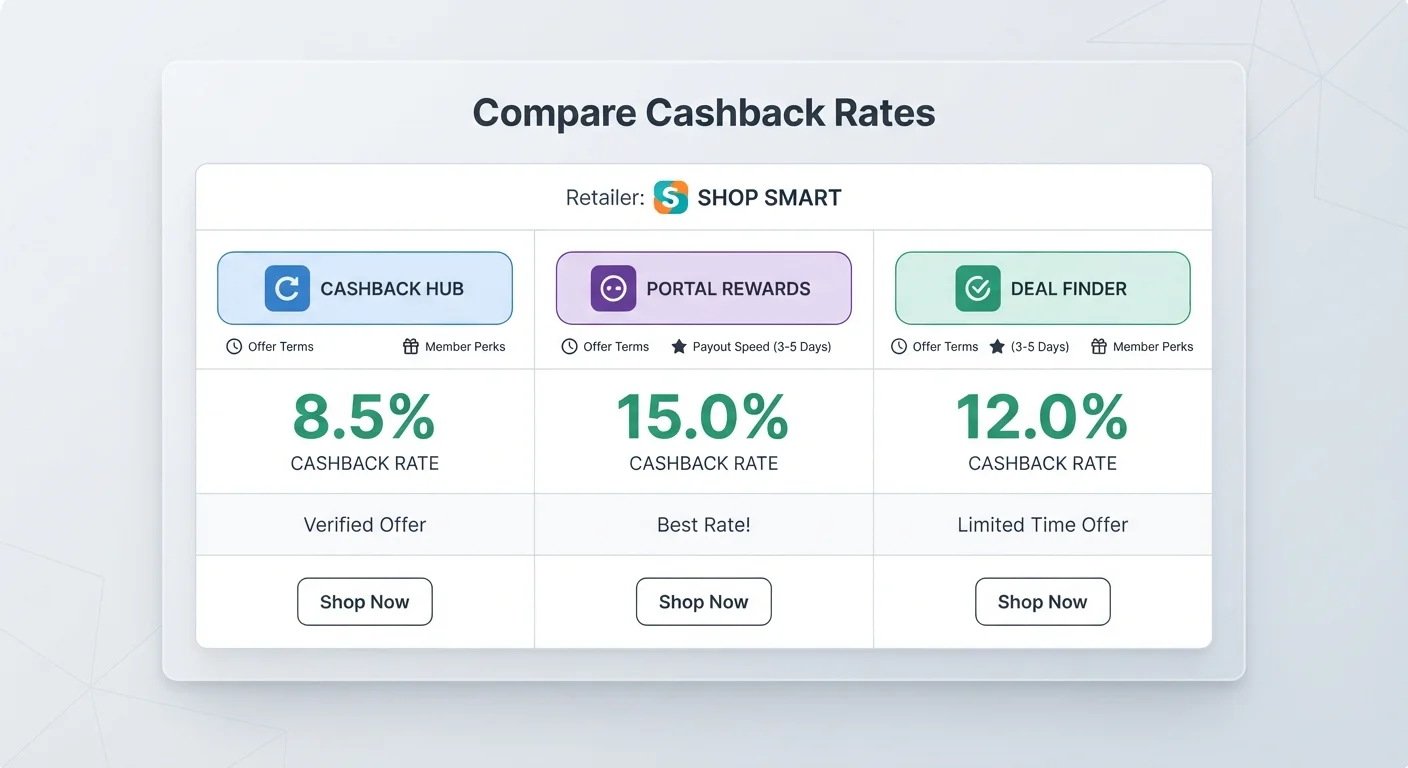
One of the biggest mistakes shoppers make is assuming all portals offer the same rate for a given store. They don't, and the differences can be dramatic. A retailer like Nike might offer 3% through Rakuten, 5% through BeFrugal, and a temporary 8% bonus through Swagbucks during a promotional period - all at the same time.
1%-15%
Typical cashback portal commission range by category
Rates vary widely by retailer and product type; travel and financial products tend to command the highest commissions in affiliate programs.
$300+
Average annual cashback for consistent portal users
Based on aggregate user data reported by Rakuten, moderate shoppers who activate portal cashback on every eligible purchase regularly accumulate three-figure annual rebates.
30-90 days
Typical pending period before cashback confirms
Portals hold earnings until the retailer's return window closes to allow for commission reversals on returned purchases.
12+
Major portals tracked by CashbackMonitor simultaneously
The aggregator site CashbackMonitor compares rates across more than a dozen portals for thousands of retailers in real time, making rate arbitrage practical for everyday shoppers.
8-12%
Achievable effective return when stacking portal + card rewards
Shoppers who combine portal cashback, a rewards credit card, and an approved retailer promotion routinely achieve total returns in this range on qualifying purchases.
The practical implication: always compare portal rates before clicking through. The free aggregator site CashbackMonitor pulls current rates from over a dozen major portals for thousands of retailers. A 30-second check before a significant purchase is one of the highest-ROI habits in deal-finding.
Rates also fluctuate. Retailers temporarily boost commissions to drive volume during slow periods or ahead of major shopping events. Portals that let you set rate-change alerts - like some features within TopCashback - can capture these spikes automatically.
Beyond base rates, watch for portal-specific bonuses: new member offers (often $10-$30 for your first qualifying purchase), double cashback events tied to retailer promotions, and category-specific boosts that can triple the standard rate for electronics or travel bookings for a limited window.
Set a Rate Alert Before Big Purchases
For purchases over $100, don't just check today's portal rates - check whether a promotional boost is likely soon. Major shopping events (Black Friday, Cyber Monday, back-to-school) routinely trigger double- or triple-cashback periods at major portals. If your purchase can wait two weeks, that patience can multiply your return significantly.
Use a Dedicated Browser Profile for Portal Shopping
Create a separate Chrome or Firefox profile that has only your preferred cashback portal extension installed - no coupon auto-appliers, no competing rewards tools. Switch to this profile whenever you're making a purchase through a portal. It eliminates cookie-overwriting conflicts without requiring you to manage extension settings every time.
The Major Portals: A Functional Comparison
You don't need to register with every portal. But maintaining accounts at two or three that cover different strengths is a practical baseline.
Rakuten (formerly Ebates)
The most mainstream option, with the widest retailer coverage and a clean interface. Rakuten pays out quarterly via PayPal or check, which some find inconvenient. Its browser extension is polished and triggers automatically when you land on a participating retailer's site. Rates tend to be mid-tier - not the highest, but reliable and with frequent triple-cashback promotions.
TopCashback
Consistently offers some of the highest base rates because it passes back more of the affiliate commission. Its interface is less intuitive than Rakuten's, but the payout flexibility is better - PayPal, ACH transfer, gift cards, or even cryptocurrency. Strong for travel, insurance, and financial product categories where commissions are large.
BeFrugal
A strong performer for retail categories, with a clean rate-comparison tool built into the site. Offers a $10 signup bonus and pays out at lower thresholds than some competitors.
Swagbucks
Doubles as a survey and rewards platform, which dilutes its focus for pure cashback shoppers, but its promotional cashback rates are frequently the highest available for specific retailers. Worth having an account if you're willing to act on bonus events.
Credit Card-Tied Portals
Many major banks operate their own shopping portals - Chase Ultimate Rewards Shopping, Amex Offers, Citi Bonus Cash Center, and Bank of America's Cashback Marketplace. These pay rewards in points or statement credits rather than cash, but can stack on top of your card's base rewards rate. If you're a heavy user of a specific bank's ecosystem, these portals deserve a regular check before purchasing.
Stacking: Combining Portals with Other Savings Layers
Portal cashback becomes significantly more powerful when combined with other savings mechanisms. The general rule is that portal cashback and credit card rewards are almost always stackable - the retailer pays the portal commission; your card issuer pays your rewards points separately. These two revenue streams don't know about each other.
The layered approach looks like this:
- Check portal rates via CashbackMonitor and select the highest-paying option for your retailer.
- Click through the portal to the retailer's site.
- Apply a retailer-issued coupon code - but verify it's affiliate-program-approved (codes from the retailer's own email list are usually safe; codes scraped from coupon aggregators may void your cashback).
- Pay with a rewards credit card that earns bonus points in the shopping category.
Done correctly, it's routine to earn 8-12% total back on a single purchase - 5% from the portal, 2% from your credit card's base rate, and 1-2% from a stackable retailer promotion.
For a deeper look at how portals and credit cards compare head-to-head, see our cashback portal vs. credit card rewards breakdown.
“Affiliate marketing has made businesses millions and ordinary people millionaires. The cashback portal is just the consumer's cut of that same pie.”
— Bo Bennett, Entrepreneur and author who built an affiliate marketing business valued at over $20 million
What Can Go Wrong - and How to Prevent It
Cashback portals are straightforward in theory, but real-world friction points exist. Understanding them upfront saves frustration later.
Cookie Overwriting
Browser extensions that auto-apply coupons at checkout - Honey, Capital One Shopping, and similar tools - often overwrite your portal's tracking cookie when they activate. The commission gets attributed to them instead, and your cashback disappears. The fix: disable competing extensions while portal shopping, or use a dedicated browser profile for portal-linked purchases.
Unauthorized Coupon Codes
Affiliate programs specify which promotional codes are permitted. Using a code not on the approved list - even if the discount successfully applies at checkout - can trigger a commission reversal, voiding your cashback. Stick to codes from the retailer's own email newsletters or the portal itself.
Account Issues
Purchases made while not logged into your portal account obviously won't track. Develop the habit of confirming your login status before clicking through. Most browser extensions display a logged-in indicator.
Return Window Delays
Cashback remains pending until the retailer's return period closes, because the retailer can claw back commissions on returned purchases. For high-value electronics or furniture, this can mean waiting 90 days or more. Plan accordingly if you need that cash for a specific purpose.
A full rundown of these pitfalls - including less obvious ones - is covered in our article on cashback portal mistakes that leave money on the table.
Also worth understanding: the broader pattern of habits that quietly erode your overall cashback earnings across apps and cards - see Leaving Cashback on the Table for a candid look at what most people miss.
Set a Rate Alert Before Big Purchases
For purchases over $100, don't just check today's portal rates - check whether a promotional boost is likely soon. Major shopping events (Black Friday, Cyber Monday, back-to-school) routinely trigger double- or triple-cashback periods at major portals. If your purchase can wait two weeks, that patience can multiply your return significantly.
Use a Dedicated Browser Profile for Portal Shopping
Create a separate Chrome or Firefox profile that has only your preferred cashback portal extension installed - no coupon auto-appliers, no competing rewards tools. Switch to this profile whenever you're making a purchase through a portal. It eliminates cookie-overwriting conflicts without requiring you to manage extension settings every time.
Building Portal Cashback Into Your Routine
The biggest barrier to using portals consistently isn't complexity - it's habit formation. Shoppers who save the most treat portal activation as a non-negotiable step in their buying process, the same way they'd comparison-shop prices before committing to a purchase.
A practical system:
- Install the browser extensions for your top two portals. Set them to auto-notify when you're on a participating retailer's site.
- Bookmark CashbackMonitor as your first stop before any purchase over $30.
- Keep a simple note (or spreadsheet) of which portal is currently offering the best rate for stores you shop at regularly. Update it monthly.
- Set a calendar reminder to check portal balances quarterly. Uncashed earnings sitting in a portal account earn you nothing.
Over a year of moderate online shopping, consistent portal use typically generates $100-$400 in cashback with no change to what you buy or where you buy it. For heavy online shoppers, four-figure annual returns are achievable. The top cashback apps hub is a good place to explore additional platforms worth adding to your stack, and the cashback programs hub covers the full landscape of rebate options including credit card reward structures.
If you want to understand why your cashback figures sometimes fall short of expectations despite doing everything right, Why Your Cashback Never Seems to Add Up walks through the structural reasons behind the gap.
Portal cashback is not a windfall. It's a yield - small per transaction, meaningful over time, and available to anyone willing to click one extra link before checkout.