

Key Takeaways
Our Verdict
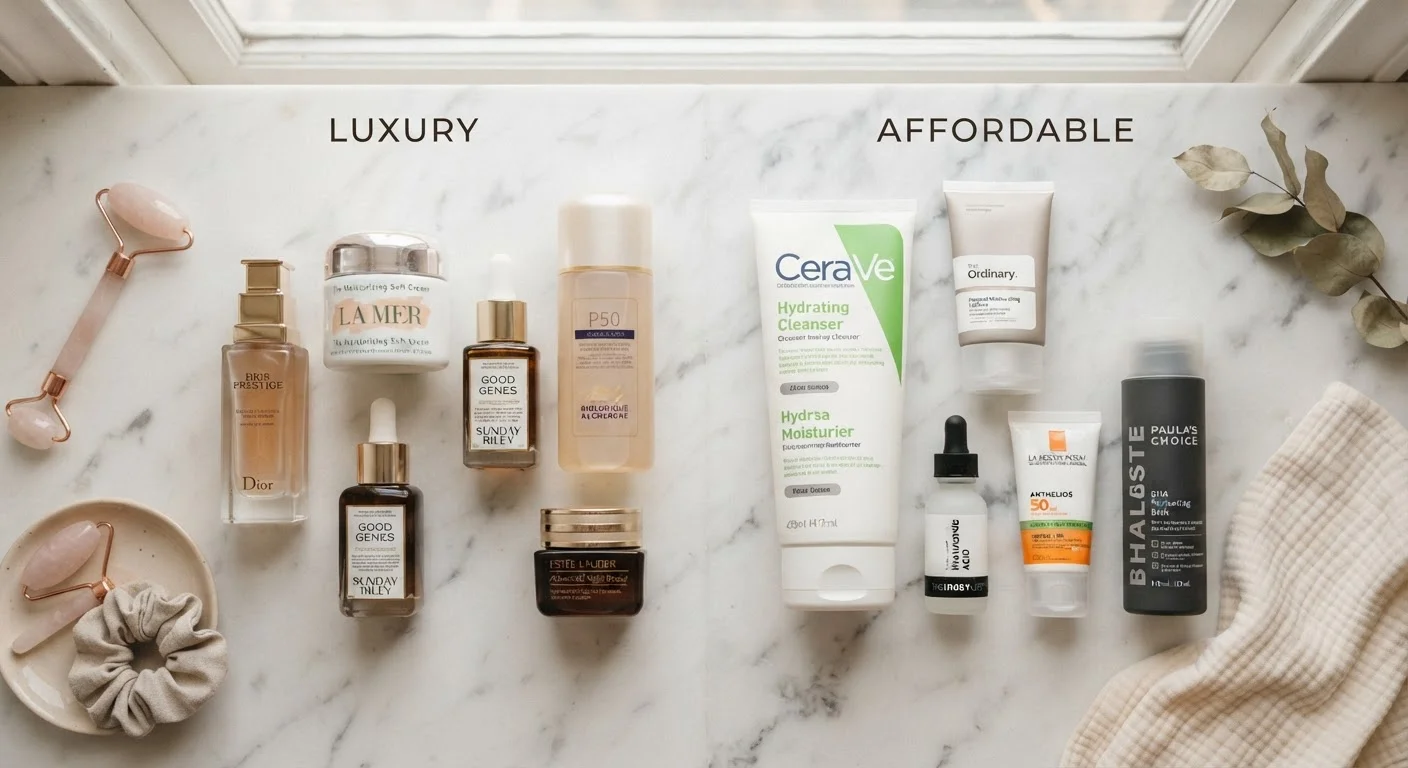
Your skincare routine doesn't need to be uniformly luxurious or uniformly bargain-bin. The savviest approach is to invest in the steps where formulation quality and ingredient stability genuinely matter - SPF and targeted actives - then save confidently on cleansers, basic toners, and eye creams. This balanced strategy protects your skin and your wallet simultaneously.
| Best for | Recommended |
|---|---|
| Budget-conscious beginners building a first routine | Save on most steps, splurge only on SPF |
| Those targeting anti-aging or hyperpigmentation | Splurge on retinoids and vitamin C serums |
| Sensitive or reactive skin types | Splurge on fragrance-free moisturizer and SPF |
| Skincare enthusiasts maximizing results on a budget | Save on cleansers and toners, invest in well-formulated actives |
Why the Splurge vs. Save Framework Matters
Walk into any Sephora and you could easily drop $300 on a skincare haul without blinking. Walk into a drugstore and spend $40 on a routine that, science-wise, does almost exactly the same thing. So which is it? The honest answer - and I say this as someone who has tested both ends of the spectrum obsessively - is that it completely depends on the step.
Skincare marketing is masterful at making every product feel essential and irreplaceable. But when you strip away the frosted glass, the French words on the label, and the celebrity endorsements, what actually matters is the concentration and stability of active ingredients, the delivery system getting them into your skin, and how well the product holds up over time. Sometimes a $12 drugstore option nails all three. Sometimes it genuinely can't.
The framework I use - and the one we're digging into today - is simple: ask yourself how much contact time the product has with your skin, whether the active ingredients degrade easily, and whether the formulation complexity justifies the cost. That lens cuts through the noise fast.
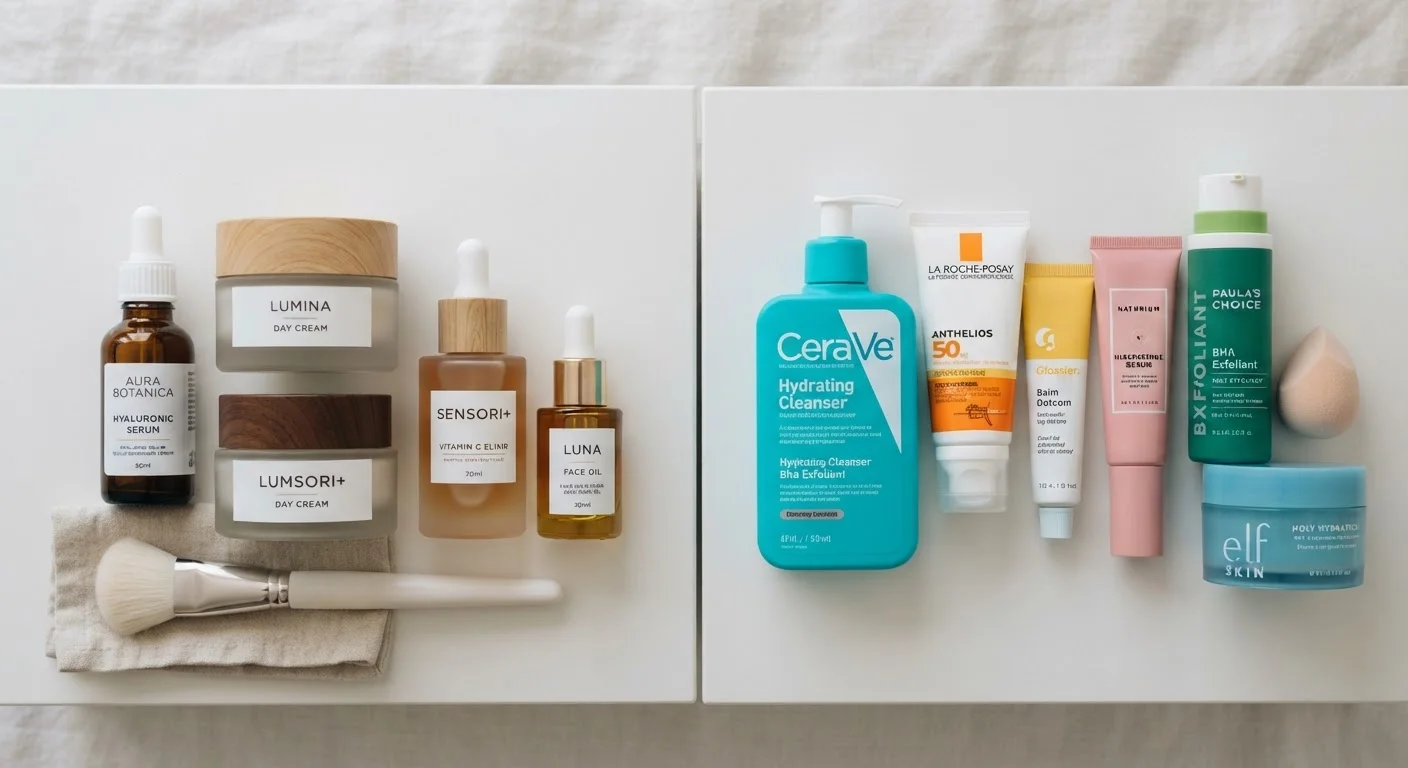
Think of it like the kitchen tools spending guide principle: a cheap wooden spoon works just as well as an expensive one, but a cheap nonstick pan can leach chemicals and warp in a month. Context is everything. Same logic, different aisle.
Where You Should Absolutely Save
Cleansers: The Rinse-Off Rule
Here's the thing about cleansers - they're on your face for, what, thirty seconds? A minute tops? Then they go straight down the drain. This means that any exotic botanical extracts, luxury peptides, or rare fermented ingredients in that $55 foaming wash are also going straight down the drain. The science simply doesn't support spending big here.
What your cleanser actually needs to do: remove makeup, sunscreen, and daily grime without stripping your moisture barrier. A gentle, sulfate-free formula from the drugstore does this flawlessly. CeraVe Hydrating Cleanser ($15), Neutrogena Ultra Gentle Daily Cleanser ($10), and La Roche-Posay Toleriane Hydrating Gentle Cleanser ($18) are perennial dermatologist favorites precisely because they perform at the level of products costing three times as much.
Save here: confidently and without guilt.
Basic Toners and Essences
Traditional toners - astringent, alcohol-heavy formulas - are essentially obsolete. Modern "hydrating toners" and essences can be genuinely nice, but unless they're delivering a meaningful dose of an active ingredient (like a niacinamide toner or an exfoliating toner with glycolic acid), you're mostly paying for water with a few humectants. The Good Molecules Hyaluronic Acid Toner at $10 and the COSRX AHA/BHA Clarifying Treatment Toner at $22 punch way above their price points.
Save here: especially if your toner is just adding a hydration layer before serum.
Eye Creams: The Great Skincare Myth
I know, I know - this one feels controversial. But board-certified dermatologists have been saying it for years: eye creams are largely a marketing category, not a scientific one. The skin around your eyes is thinner and more sensitive, yes, but it responds to the same ingredients as the rest of your face. A fragrance-free moisturizer with peptides, ceramides, or hyaluronic acid applied gently to the orbital bone does the same job as a $90 eye cream in a tiny jar.
The Gentle Pat Test for Eye Area
When applying any product near your eyes, use your ring finger and the lightest possible tapping motion - this minimizes tugging on the delicate orbital skin. Any fragrance-free moisturizer with peptides or ceramides can double as your eye cream, saving you from spending on a dedicated (and often overpriced) product. Just make sure it's completely fragrance-free to avoid irritation.
Patch-Test Your Actives First
Before committing to a full bottle of any active-ingredient serum - especially retinoids and vitamin C - patch test on your inner arm for 48 hours. This is especially important for budget formulas where pH and concentration may not be disclosed. Reactions to actives can set your routine back weeks, so one small test saves a lot of frustration and wasted product.
If you're concerned about dark circles or puffiness specifically, look for caffeine or vitamin K in any product - drugstore options like e.l.f. Holy Hydration! Eye Cream ($10) and The INKEY List Caffeine Eye Cream ($15) deliver these actives at a fraction of luxury prices.
Save here: and redirect that budget somewhere it actually moves the needle.
Where the Splurge Actually Pays Off
Sunscreen: Non-Negotiable Quality
If there is one single place to spend more, it is sunscreen. Full stop. Here's why: SPF is your number-one anti-aging, anti-hyperpigmentation, anti-skin-cancer tool, and its effectiveness hinges entirely on formulation. A sunscreen that feels greasy, leaves a white cast, or breaks you out is a sunscreen you won't wear consistently - and inconsistent SPF use is basically no SPF use at all.
Premium mineral and chemical-hybrid SPFs from brands like EltaMD, Supergoop, Isntree, and La Roche-Posay Anthelios have invested heavily in elegant formulations that feel like skincare, not sunblock. Many budget SPFs still leave that dreaded white cast or pill under makeup. Spending $30-$45 on a sunscreen you'll actually use every day is an investment in your skin's long-term health - nothing else in your routine even comes close to its impact.
90%
Of visible skin aging caused by UV exposure
According to research published by the Skin Cancer Foundation, up to 90% of visible skin aging is attributed to sun exposure, making daily SPF the most impactful anti-aging step.
$200+
Average annual overspend on skincare
Consumer surveys from NielsenIQ suggest the average skincare buyer spends over $200 annually on products that duplicate or underdeliver on the actives already present in budget alternatives.
40%
Potential routine cost reduction
Dermatology-informed budgeting frameworks suggest shoppers can cut skincare spend by 40% or more by saving on low-contact steps like cleansers and switching only key actives to premium formulas.
2x
Higher oxidation rate in clear-jar packaging
Cosmetic chemistry research indicates that vitamin C and retinol products stored in clear or open-top packaging degrade significantly faster, often losing efficacy within weeks of opening.
Retinoids: Stability and Tolerability Are Everything
Retinoids (vitamin A derivatives) are the most evidence-backed anti-aging ingredient in existence, full stop - and they're also notoriously tricky to formulate. Retinol oxidizes when exposed to light and air, which means the packaging, preservative system, and concentration all have to be just right. Poorly formulated or improperly stored retinol simply won't work.
Premium brands like Paula's Choice, SkinCeuticals, and RoC have invested in encapsulated retinol technology and rigorous stability testing. That said, mid-range options like Differin Adapalene Gel ($30) and The Ordinary's Granactive Retinoid serum ($15) are legitimate exceptions - they genuinely perform. The key is avoiding ultra-cheap retinols in clear packaging with no encapsulation tech, which degrade before they even reach your skin.
Splurge here: or at minimum, choose a mid-range option with solid formulation credentials.
Vitamin C Serums: Oxidation Is the Enemy
L-ascorbic acid (the most effective form of vitamin C for skin) is notoriously unstable. It oxidizes on contact with air and light, turning orange-brown and losing its efficacy. A budget vitamin C serum that turns orange within two weeks of opening is worthless - literally. High-quality formulations use specific pH levels, airless packaging, and sometimes vitamin C derivatives like ascorbyl glucoside that are more stable though slightly less potent.
Splurge-worthy options: SkinCeuticals C E Ferulic (yes, it's $180, but it's the gold standard and a little goes a long way), Paula's Choice C15 Super Booster, or Timeless 20% Vitamin C + E Ferulic Acid Serum ($25 - genuinely the best budget exception in this category due to its airless pump and solid formulation). If you can't stretch to premium, at least choose a stable-packaged mid-range option.
Splurge here: or at minimum, choose packaging that protects the formula. Learning to decode skincare ingredient labels helps you spot the stable formulations at any price point.
The Middle Ground: Moisturizers and Serums
Moisturizers occupy a genuinely nuanced space in the splurge-vs-save conversation. For most skin types, a well-formulated budget moisturizer is completely sufficient. CeraVe Moisturizing Cream contains ceramides, hyaluronic acid, and niacinamide - the same ingredients you'd pay $80 for in a department store brand. For normal to oily skin especially, save here without hesitation.
However, for sensitive, rosacea-prone, or eczema-prone skin, the difference between a budget moisturizer loaded with fragrance and a premium fragrance-free, barrier-repair formula can be the difference between a calm face and a flare-up. Brands like La Roche-Posay Cicaplast B5, Vanicream, and Avène Cicalfate are worth the small premium if your skin is reactive.
| Cleanser | Vitamin C Serum | Moisturizer | Retinoid | Eye Cream | SPF | |
|---|---|---|---|---|---|---|
| Verdict | Save | Splurge / Mid-range | Save / Mid-range | Mid-range to Splurge | Save | Splurge |
| Why it matters | Rinses off quickly | Oxidizes easily - formula stability critical | Barrier support for most types | Stability and encapsulation vary widely | Moisturizer works just as well | Formulation affects daily wearability |
| Budget pick range | $8-$18 | $15-$25 (stable formula) | $10-$20 | $15-$30 (mid-range) | $8-$15 | $15-$22 (budget often has white cast) |
| Premium pick range | $30-$55 | $80-$180 | $40-$90 | $45-$120 | $60-$120 | $28-$45 |
| Key ingredient to check | No harsh sulfates or fragrance | L-ascorbic acid % and pH | Ceramides, hyaluronic acid | Encapsulated retinol or adapalene | Caffeine, peptides | Broad-spectrum UVA/UVB filters |
| Packaging matters? | No | Yes - airless pump or opaque bottle | Moderately | Yes - opaque, airtight | No | Moderately |
Treatment Serums: Ingredient First, Brand Second
For targeted serums - niacinamide, hyaluronic acid, peptides - the active ingredient concentration matters far more than the brand. The INKEY List and The Ordinary have essentially democratized high-concentration actives, offering niacinamide serums, hyaluronic acid boosters, and peptide complexes at $10-$15 that match or exceed the performance of serums ten times the price.
The caveat: some complex peptide formulations (think Matrixyl 3000 or Argireline) require very specific formulation chemistry to remain stable and bioavailable. Here, a mid-range investment - Olay Regenerist Micro-Sculpting Serum, RoC Retinol Correxion, or COSRX Advanced Snail 96 Mucin Power Essence - tends to outperform ultra-budget options. Think of it as spending $25-$45 rather than $90-$200.
For more on evaluating whether a budget formula is a true match, the dupe evaluation breakdown applies directly to skincare too - the same logic of comparing active ingredients and delivery systems works across the beauty aisle.
How to Build a Balanced Routine That Does Both
Here's the practical framework I use when building a routine - and it's one I've recommended to literally dozens of friends who came to me overwhelmed by the options:
- Start with your non-negotiables: Sunscreen is your splurge anchor. Budget everything else first, then allocate remaining funds to SPF quality.
- Identify your skin concern: Hyperpigmentation? Invest in vitamin C and retinoids. Dryness and barrier damage? Invest in a premium moisturizer. Acne? A well-formulated benzoyl peroxide or salicylic acid treatment (often affordable) plus a gentle SPF.
- Read the label before the price tag: The guide to decoding skincare ingredient labels is your best friend here. Look at where the active appears in the ingredient list - if it's near the bottom, behind a dozen fillers, it barely counts.
- Check the packaging: Airless pumps and opaque bottles protect actives from light and air. Jars and clear bottles are red flags for any oxidation-sensitive ingredient.
- Test before committing to full size: Many brands offer travel sizes or samples. A $10 travel-size test before buying a $60 serum is always smart shopping.
Don't Layer Actives Without a Plan
Mixing retinoids, vitamin C, and AHA/BHA exfoliants in the same routine without spacing them out can cause serious irritation, redness, and barrier damage. This is especially risky when you're experimenting with new budget products that may have higher-than-expected concentrations. A good rule: use vitamin C in the morning and retinoids at night, and limit exfoliants to 2-3 times per week maximum.
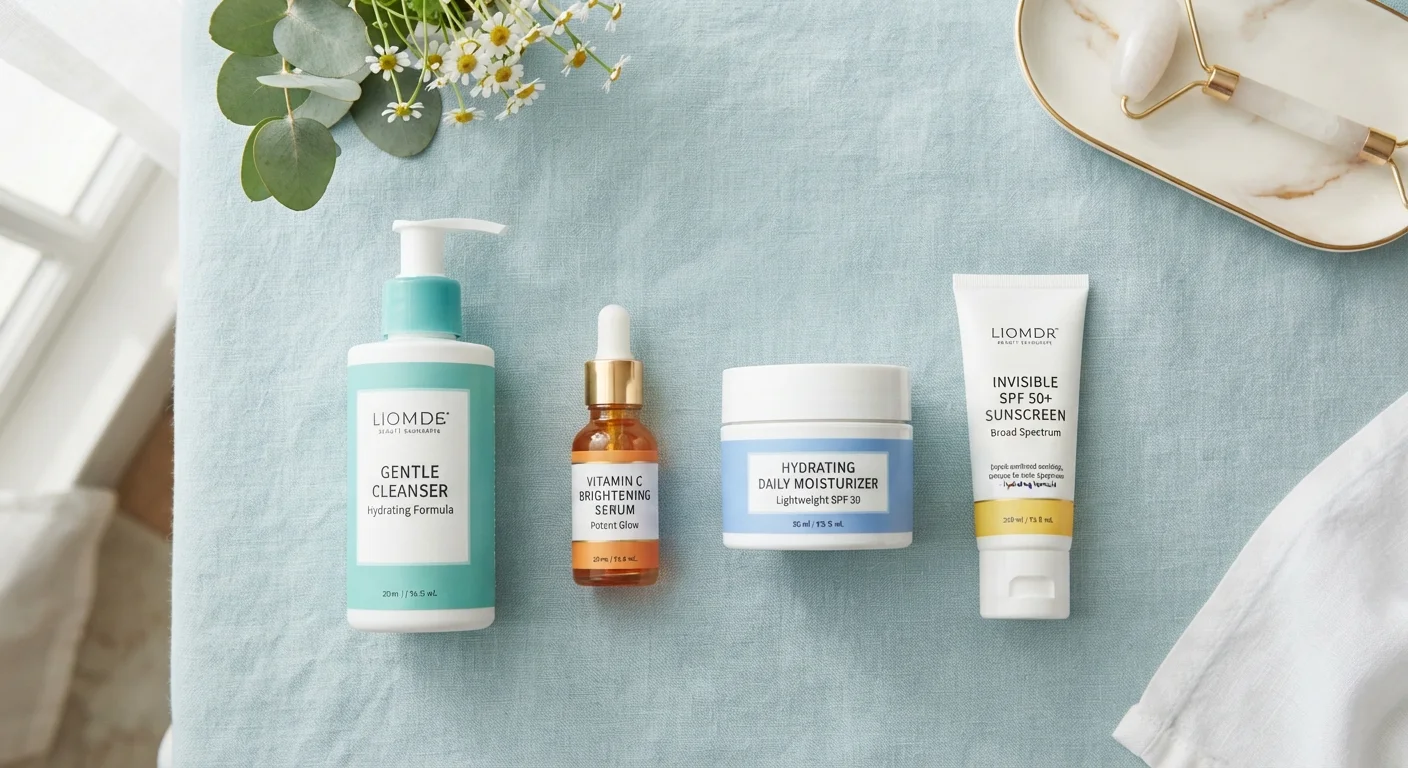
Applied consistently, this approach means your morning routine might look like: $12 cleanser → $15 vitamin C serum (stable formula, mid-range) → $18 moisturizer → $35 SPF. That's an $80 morning routine that performs like one costing $250+. And you're free to put the difference toward something that actually brings you joy.
This is the same principle behind knowing what makes a makeup dupe actually worth it - strategic, informed swaps rather than blanket budget cuts. Some things earn their price; others are just pretty packaging.
Quick Reference: Step-by-Step Splurge or Save
Use this as your cheat sheet next time you're standing in the beauty aisle or scrolling an online haul at midnight (we've all been there):
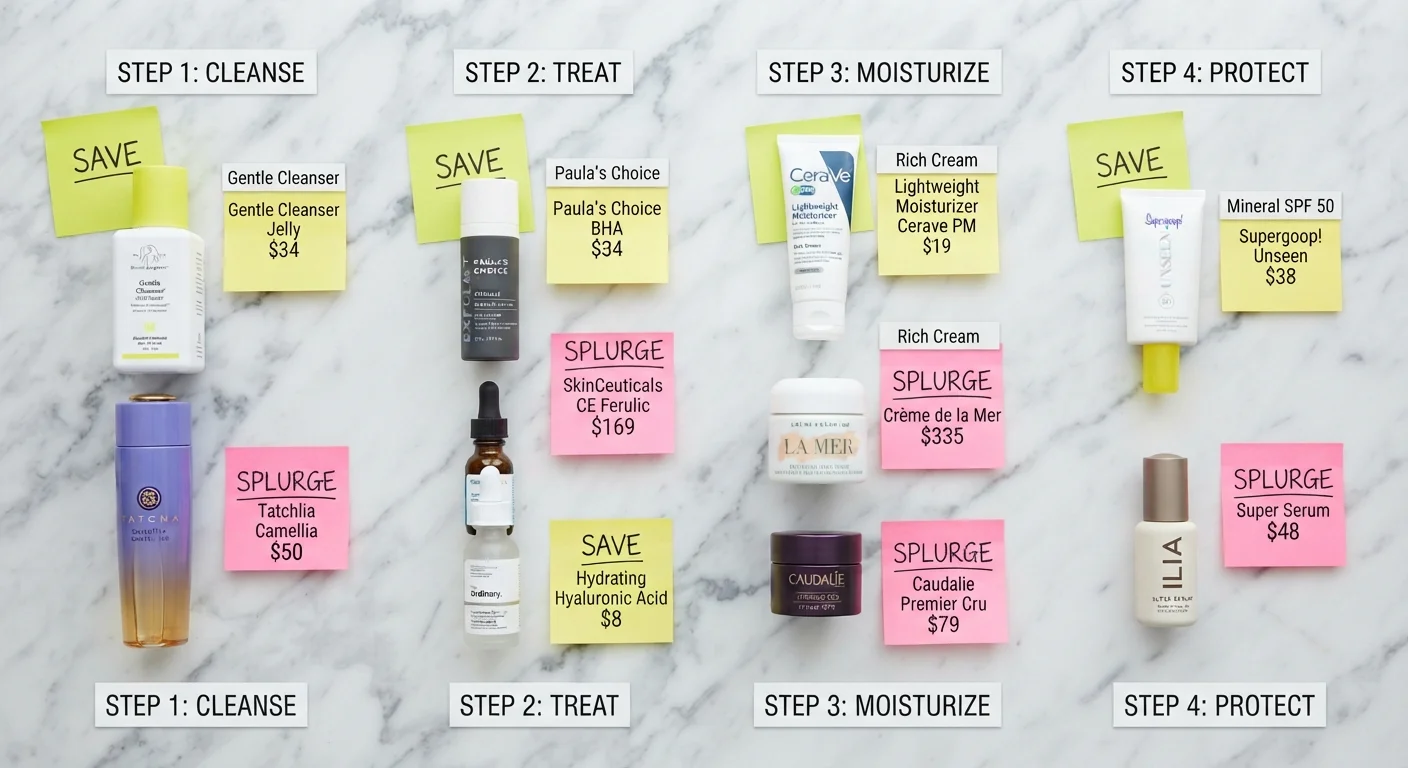
- Cleanser: Save. Rinse-off formula means expensive ingredients go down the drain.
- Exfoliant (AHA/BHA): Mid-range. Concentration and pH matter - The Ordinary and Paula's Choice both hit this well under $35.
- Vitamin C Serum: Splurge or carefully chosen mid-range. Packaging and stability are critical.
- Hydrating Toner / Essence: Save. Unless it contains a meaningful active, it's mostly a hydration step.
- Niacinamide / Hyaluronic Acid Serum: Save. These are stable, simple actives widely available at low cost.
- Retinoid: Mid-range to splurge. Stability and encapsulation matter; avoid ultra-cheap unencapsulated options in clear jars.
- Moisturizer: Save (most skin types), mid-range (sensitive/reactive skin).
- Eye Cream: Save. Use your moisturizer or a budget caffeine formula instead.
- SPF: Splurge. You'll actually wear a formula you love, and SPF is your most effective anti-aging tool.
See a pattern? The steps that stay on your skin longest and deliver active ingredients deepest are where quality pays dividends. Everything else is fair game for smart saving - and for those swaps, the makeup dupes hub is packed with tested alternatives across every category.