
Foundation at Every Price Point: What Changes and What Doesn't
From under £5 to over £50, foundation formulas vary in real ways — but not always where you'd expect. A balanced look at the differences.
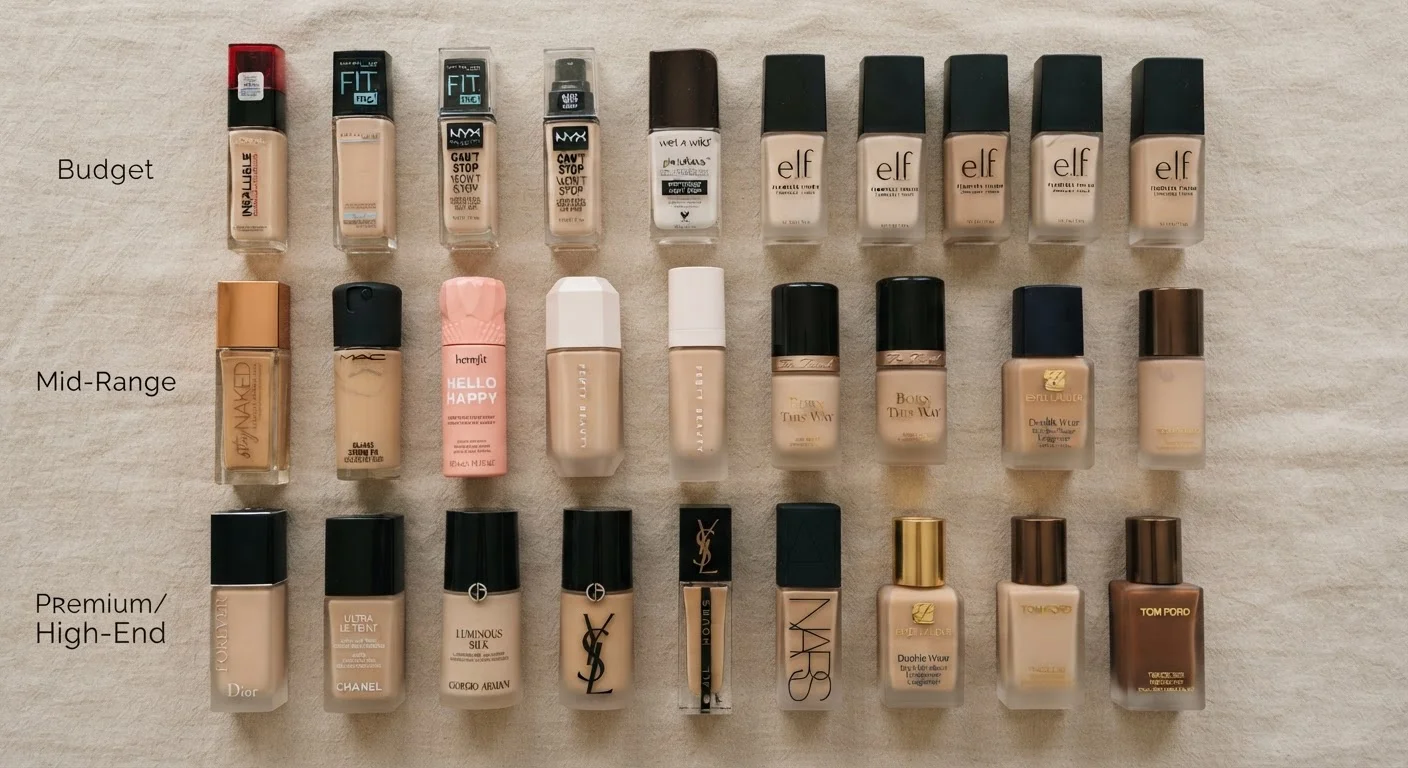
Photo: SaverSteals.com | Explore More. Shop Smarter. editorial
—— In This Article
Key Takeaways
- Pigment quality and longevity tend to show the most meaningful differences between price tiers.
- Packaging, marketing spend, and brand prestige account for a significant portion of premium pricing.
- Shade range and undertone accuracy have improved noticeably across drugstore lines in recent years.
- Skin type compatibility matters more than price - a $10 formula can outperform a $60 one for your skin.
- Ingredients lists often overlap more than packaging suggests, especially for core film-forming agents.
What Price Actually Buys You in Foundation
Foundation sits at the center of most makeup routines, which makes it one of the most scrutinized purchases a beauty shopper faces. The price gap between a drugstore option and a department store formula can be $50 or more - but that gap doesn't map neatly onto performance. As explored in our breakdown of how beauty products are priced, brand prestige, packaging, and marketing investment all inflate the retail number before any formulation cost is factored in.
That said, price isn't meaningless. Real differences do exist - they just tend to cluster around specific attributes rather than overall quality. Understanding which attributes those are helps you decide where to allocate your budget more deliberately.
| Drugstore (under $15) | Mid-Range ($15-$35) | Premium ($35+) | |
|---|---|---|---|
| Longevity | Variable; often moderate | Generally solid; 8-12 hrs common | Frequently all-day with fewer touch-ups |
| Finish sophistication | Decent; can appear heavier | Refined; broad finish options | Skin-like; fine pigment milling |
| Shade range | Improving; gaps in deep tones | Broad; better undertone variety | Generally most extensive |
| Ingredient overlap | High overlap with mid-range | Shares core agents with premium | Premium additives; similar base |
| SPF accuracy | Regulated; reliable rating | Regulated; reliable rating | Regulated; reliable rating |
| Packaging quality | Functional; less precise pump | Improved dispensing controls | Precision applicators common |
| Return/exchange ease | Easy in-store returns | Varies by retailer | Often counter or online only |
Where Higher Price Points Show Real Gains
Longevity is one area where premium formulas tend to justify their cost. Higher-end foundations more frequently incorporate advanced film-forming polymers and oil-control technologies that hold up through sweat, humidity, and long wear. For anyone who needs foundation to last through a full workday without touch-ups, this can be a meaningful difference.
Finish sophistication is another factor. Premium formulas often achieve a more skin-like texture - neither obviously matte nor reflectively dewy, but something closer to the natural variation of actual skin. This is partly about pigment milling: finer particle sizes disperse more evenly, reducing the "painted on" effect some budget foundations can produce under certain lighting.
Shade range has historically been a premium advantage as well, though this is shifting. Deeper skin tones and complex undertones - warm, neutral, and cool within the same depth level - are still more reliably represented in higher-tier lines, though several drugstore brands have invested in expanding their ranges significantly.
Test Before You Commit
Shade matching in artificial lighting is one of the most common reasons foundations get returned or abandoned. Whenever possible, swatch along your jawline in natural daylight before purchasing - this applies at every price tier. Many drugstore retailers now offer generous return windows even on opened makeup, which reduces the financial risk of experimenting with new formulas.
Where Drugstore Foundations Hold Their Own
Coverage and color payoff are areas where drugstore foundations consistently compete. Many affordable formulas deliver full, buildable coverage from inexpensive pigment bases that perform comparably to premium counterparts. For shoppers whose primary goal is evening skin tone, price tier matters less here than formula type (liquid vs. powder, for example).
Ingredient overlap is also more substantial than packaging implies. As detailed in our look at where drugstore and high-end formulas converge, many foundations across price tiers share the same core emollients, SPF actives, and skin-conditioning agents. The drugstore version may use a slightly lower concentration or a less refined variant, but the functional chemistry is often similar.
Accessibility also works in drugstore foundations' favor: buying in-store allows you to test shades in natural light, return easily if the match is wrong, and replace a formula quickly when it runs out - advantages that premium online-first or counter-only brands can't always match.
What Stays Consistent Across the Price Spectrum
Certain foundation fundamentals don't change with price. SPF ratings are regulated regardless of cost, so a drugstore formula with SPF 30 provides the same sun protection as a $60 one with the same rating. Similarly, the basic chemistry of foundation - water-in-oil or oil-in-water emulsions, silicone-based formulas - operates on principles that aren't proprietary to luxury brands.
Skin type compatibility is another constant. A foundation's suitability for oily, dry, or combination skin is determined by its formulation, not its price tag. A $12 formula built for dry skin will serve a dry-skin shopper better than a $55 formula designed for oily skin. This is one reason matching a formula to your skin type is consistently more important than price when evaluating foundations.
For a broader framework on navigating these trade-offs across all beauty categories, understanding where premiums genuinely pay off puts foundation in useful context alongside other product types.

Beauty Editorial Team
Beauty Editorial Team is the collective byline for our editorial team and contributor network. Articles published under this byline or an editorial pen name are researched, written, and reviewed according to our editorial standards for clarity, consistency, and independence before publication.
View author profile