
Price Tracking Tools for Toys: How They Work and What to Watch Out For
Automated price trackers can alert you to genuine drops, but they have blind spots. Here's what they capture well and where they fall short.
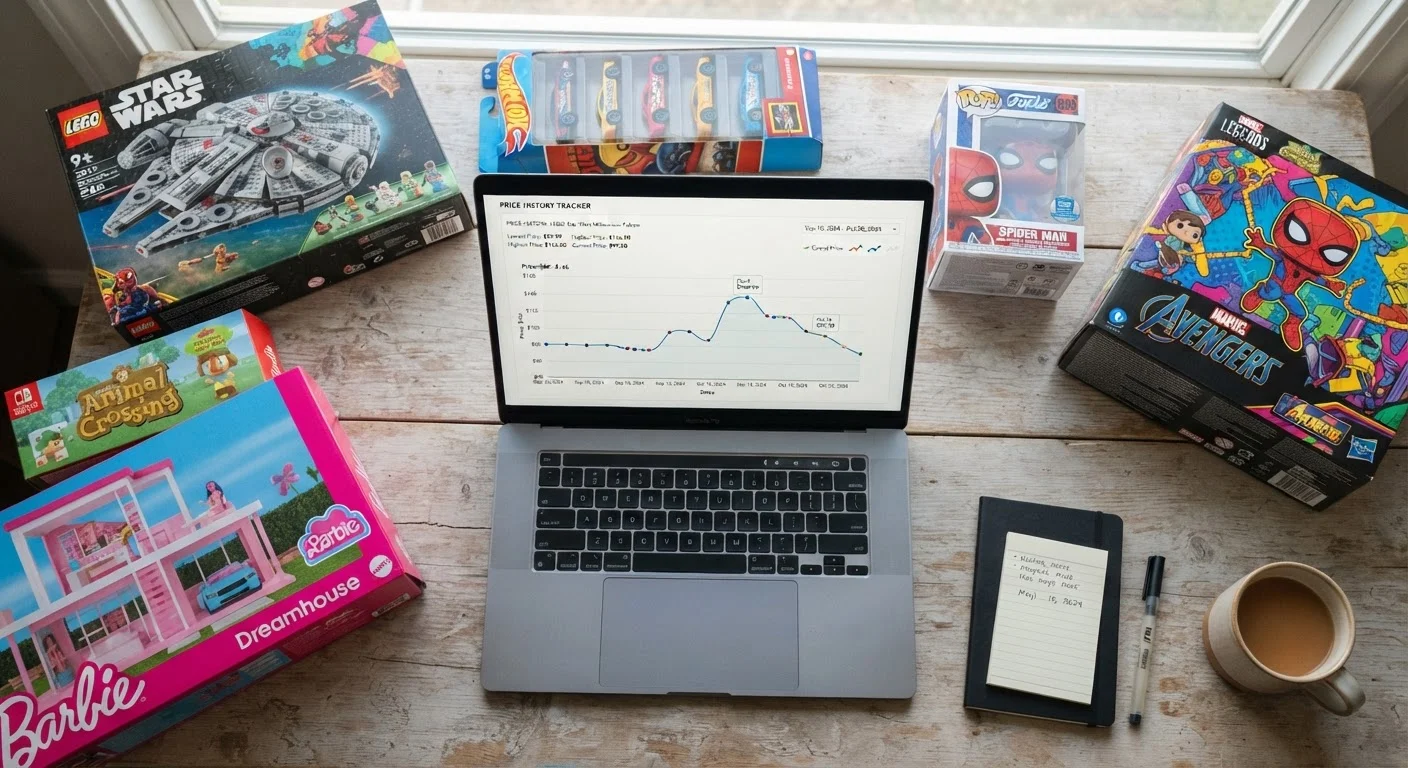
Photo: SaverSteals.com | Explore More. Shop Smarter. editorial
—— In This Article
Key Takeaways
- Price trackers log historical data that helps you distinguish real drops from inflated markdowns.
- Most tools only monitor a small set of major retailers, missing many legitimate discount channels.
- Alerts fire on list price changes and may not capture bundled offers, coupon codes, or clearance.
- Toy pricing is especially volatile around the holidays, making historical context more valuable than current price alone.
- Combining tracker data with seasonal knowledge produces more reliable purchasing decisions.
Historical charts expose manufactured 'original' price claims
A tracker that shows a toy has never sold above $38 makes a retailer's '$60 original price' claim immediately verifiable. This is one of the most practical defenses against reference price inflation.
Automated alerts eliminate repetitive manual checking
Instead of revisiting product pages daily, you set a threshold and wait. This reduces both the time cost and the psychological pressure that comes from repeated exposure to promotional messaging.
Identifies the realistic price floor over time
Seeing the lowest recorded price for a specific toy — and how often it has hit that level — gives you a benchmark that a single retailer page never provides.
Useful for planning around known sales windows
When combined with seasonal retail cycle knowledge, tracker data helps you anticipate when a price is likely to drop rather than simply react when one appears.
Limited retailer coverage misses many legitimate sources
Most tracking tools index only major national online retailers. Warehouse clubs, regional specialty stores, and third-party marketplace listings are routinely absent, leaving significant portions of the market unmonitored.
Invisible to coupon codes and loyalty pricing
Promotional structures that don't alter the listed price — stackable discount codes, member-only rates, or gift-card-based incentives — generate no alert and leave no trace in price history charts.
In-store clearance never appears in tracker data
Physical clearance events, which frequently represent the deepest toy discounts of the year, are not captured by any automated online tracking system.
Data reflects polling snapshots, not continuous availability
A tracker records the price at the moment it checks the page, which may have been a brief flash sale or limited-quantity pricing that was never realistically available to most shoppers.
Bundle and gift-with-purchase offers go undetected
When a retailer adds bonus items or gift cards to a purchase without reducing the list price, the tracker sees no change — even though the effective value of the purchase has increased.
How Price Tracking Tools Actually Work
Price tracking services work by periodically polling a product's listing page on supported retailers — typically every few hours — and recording the price they find. Over time, this builds a historical chart you can review before deciding whether a current price represents a real discount or a routine fluctuation.
Most tools let you set a target price threshold. When the tracked price drops to or below that threshold, you receive an email or push notification. Some services also display the product's price history graph directly in your browser via an extension, so you can check historical context without visiting a separate site.
For toys specifically, this history data is particularly telling. Retail prices on popular items can swing significantly in the weeks before and after major holidays. A tracker chart that shows a $45 price holding steady for six months is more informative than a retailer's claim that the item was originally $65. See our article on spotting inflated 'original' prices for context on why that reference price matters.
Tracker Polling Frequency Varies
Different tracking services check prices at different intervals — some poll every hour, others only once or twice daily. During volatile periods like Black Friday week, a price can drop and sell out between polling cycles, meaning the tracker may record a low price that was never practically available. Check the service's stated polling frequency before relying on its data for time-sensitive decisions.
What Price Trackers Do Well
Historical charts expose manufactured 'original' price claims
A tracker that shows a toy has never sold above $38 makes a retailer's '$60 original price' claim immediately verifiable. This is one of the most practical defenses against reference price inflation.
Automated alerts eliminate repetitive manual checking
Instead of revisiting product pages daily, you set a threshold and wait. This reduces both the time cost and the psychological pressure that comes from repeated exposure to promotional messaging.
Identifies the realistic price floor over time
Seeing the lowest recorded price for a specific toy — and how often it has hit that level — gives you a benchmark that a single retailer page never provides.
Useful for planning around known sales windows
When combined with seasonal retail cycle knowledge, tracker data helps you anticipate when a price is likely to drop rather than simply react when one appears.
Beyond individual alerts, the aggregate view of price history is arguably more valuable than any single notification. Knowing that a toy's recorded low is $28 — and that it has hit that price twice in the past year — gives you a defensible benchmark. Without that data, you're effectively guessing.
Trackers also remove the need to manually revisit product pages repeatedly, which reduces the kind of impulsive, emotionally driven purchasing that tends to follow repeated exposure to promotional language. That passive, automated quality is explored in more depth in our piece on how passive tracking changes buying habits.
Where These Tools Fall Short
Limited retailer coverage misses many legitimate sources
Most tracking tools index only major national online retailers. Warehouse clubs, regional specialty stores, and third-party marketplace listings are routinely absent, leaving significant portions of the market unmonitored.
Invisible to coupon codes and loyalty pricing
Promotional structures that don't alter the listed price — stackable discount codes, member-only rates, or gift-card-based incentives — generate no alert and leave no trace in price history charts.
In-store clearance never appears in tracker data
Physical clearance events, which frequently represent the deepest toy discounts of the year, are not captured by any automated online tracking system.
Data reflects polling snapshots, not continuous availability
A tracker records the price at the moment it checks the page, which may have been a brief flash sale or limited-quantity pricing that was never realistically available to most shoppers.
Bundle and gift-with-purchase offers go undetected
When a retailer adds bonus items or gift cards to a purchase without reducing the list price, the tracker sees no change — even though the effective value of the purchase has increased.
Coverage is the most significant limitation. Most widely used tracking services index only a handful of major online retailers. Warehouse club pricing, regional toy specialty stores, and third-party marketplace sellers are frequently absent from tracking databases entirely.
Trackers also tend to ignore promotional structures that don't appear as a list price change: stackable coupon codes, loyalty member pricing, gift-card promotions, and bundle offers all escape detection. A tracker might show no price movement on a toy while the retailer is simultaneously offering $10 off via a code that appears only at checkout.
In-store clearance is another blind spot. Physical clearance markdowns — often the deepest discounts available on end-of-season toys — don't appear in any automated tracking system. If you're open to secondhand and pre-owned toy options, those channels are similarly invisible to price trackers.
Reading Tracker Data Without Overinterpreting It
6–8 weeks
Typical pre-holiday toy price observation window
Consumer research consistently shows toy prices begin shifting meaningfully in the six to eight weeks before peak holiday shopping periods, making multi-week historical data most useful during that window.
3–5
Major retailers indexed by most free tracking tools
Industry reviews of commonly used browser-based price tracking extensions suggest most free tools actively index only a small number of major national retailers by default.
A price chart only shows you what a retailer charged at the moment the tracker polled the page. It doesn't indicate whether that price was available for five minutes or five weeks, whether stock was limited, or whether the retailer subsequently raised the price to create an artificial 'before' figure.
Cross-reference tracker data with an understanding of seasonal retail patterns. Toy prices tend to follow predictable cycles tied to back-to-school periods, pre-holiday inventory builds, and post-holiday clearance. Our article on seasonal patterns that signal genuine price drops outlines those cycles in detail. Using both sources together gives you a more complete picture than either provides alone.
If you track non-toy categories, the mechanics work similarly — our walkthrough on price-tracking tools for electronics covers the same underlying logic with category-specific nuances worth understanding.

Toys Editorial Team
Toys Editorial Team is the collective byline for our editorial team and contributor network. Articles published under this byline or an editorial pen name are researched, written, and reviewed according to our editorial standards for clarity, consistency, and independence before publication.
View author profile