
Reading a Sports Gear Price Tag: What Markdown Labels Actually Mean
Terms like 'was/now', 'compare at', and 'final sale' signal very different things. Here's what each label means and how to interpret it accurately.
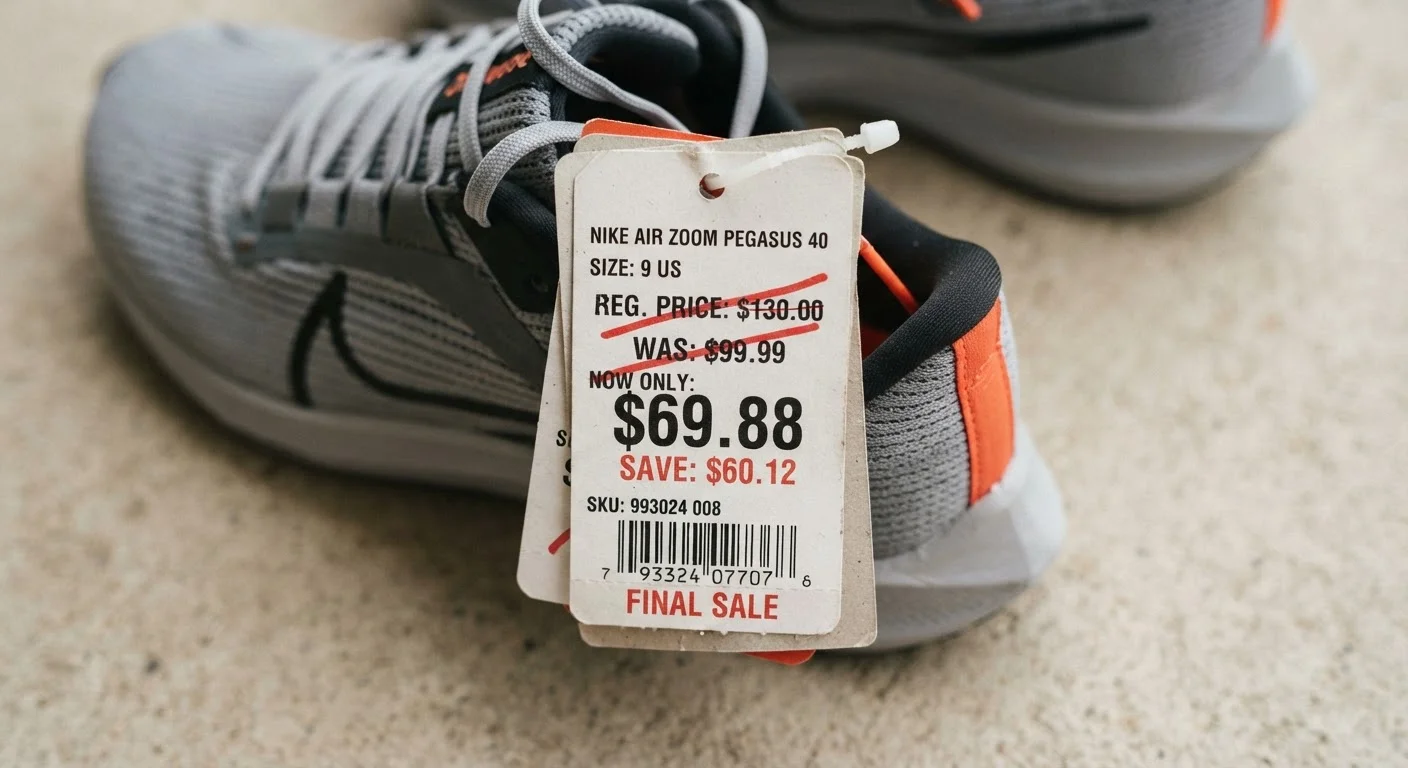
Photo: SaverSteals.com | Explore More. Shop Smarter. editorial
—— In This Article
Key Takeaways
- 'Was/now' labels should reflect a real prior selling price, not an inflated reference point.
- 'Compare at' often references a manufacturer's suggested retail price, which may never have been the actual selling price.
- 'Clearance' typically signals the retailer wants to move remaining inventory, not necessarily that a deep discount applies.
- 'Final sale' means no returns — factor in the risk before purchasing, especially for fit-dependent sports gear.
- Off-season timing is when sports gear markdown labels are most likely to reflect genuine price reductions.
- Checking a product's price history helps verify whether a markdown is real or manufactured.
Was/Now: The Most Common Label and Its Limits
The 'was/now' format is the most familiar markdown structure in retail sports gear pricing. It presents a crossed-out 'was' price alongside the current 'now' price to imply a clear saving. In principle, the 'was' price should represent the price at which the item was genuinely sold — not a hypothetical or inflated anchor.
In practice, the 'was' price can reflect a very short selling window at the higher price before the markdown was applied. U.S. Federal Trade Commission guidelines state that former price comparisons should reflect a price at which the item was offered in good faith for a reasonably substantial period, but what counts as 'substantial' is not rigidly defined. Some retailers interpret this loosely.
For sports gear specifically, 'was/now' labels appear most frequently during end-of-season transitions — after ski season, post-summer, or following a major sporting event cycle. These are also the moments when 'was' prices are more likely to reflect sustained prior selling prices, because the markdown is driven by inventory pressure rather than promotional strategy. The same logic applies across other retail categories; how clothing retailers structure markdowns follows comparable patterns.
Check Price History Before Trusting a 'Was' Price
Free browser extensions and price-tracking tools log historical selling prices for many major retailers. Before accepting a 'was/now' label at face value, check whether the item was consistently sold at the 'was' price for at least several weeks. If the price only briefly touched that level before the markdown, the stated saving is overstated.
Compare At, MSRP, and Reference Pricing
'Compare at' is a reference price label, not a claim that the retailer ever sold the item at that price. It typically cites the manufacturer's suggested retail price (MSRP) or a price observed at another retailer. This distinction matters: if a product's MSRP is $120 but it commonly sells for $85 everywhere, a 'compare at $120 / now $79' tag is not the deal it appears to be on the surface.
MSRP is set by manufacturers as a pricing guideline, not a market-determined figure. Some product categories — particularly performance footwear and technical outerwear — are rarely sold at MSRP outside of launch windows. Treating MSRP as a reliable baseline overstates the actual discount.
'Reference pricing' is a broader term covering any comparison to an outside price point. When evaluating these labels, the relevant question is: what did this specific item actually sell for, at this retailer, over the past two to three months? Price-history tools can answer that question more reliably than any label. For a comparable look at how this plays out in another category, see how furniture retailers use MSRP and 'was' prices.
~90 days
Typical prior-price window retailers reference
FTC guidance generally points to a good-faith offering period; many retail compliance programs use a 90-day window as an internal benchmark for 'was' price validity.
15–40%
Typical off-season markdown range for sports gear
Industry analysts and consumer reporting organizations generally observe that genuine end-of-season sports gear markdowns fall within this range, though it varies significantly by category and retailer.
MSRP
Most common 'compare at' reference point
Manufacturer's suggested retail prices are the most frequently cited reference figure in 'compare at' labels, despite often differing substantially from actual market selling prices.
Clearance vs. Final Sale: Different Terms, Different Implications
'Clearance' is an inventory status label. It signals that the retailer is discontinuing or reducing stock of that item — typically because a new model is arriving, the season is ending, or the product is being phased out. Clearance pricing can represent genuine reductions, but the discount depth varies widely. A 10% clearance markdown on a treadmill is very different from a 40% markdown on last year's running shoes.
The practical value of clearance for sports gear shoppers is that it often surfaces equipment that remains fully functional despite being discontinued. A kayak paddle marked clearance because a newer version exists performs the same as it did at full price.
'Final sale' is entirely separate — it is a return-policy designation, not a pricing category. It means the transaction is non-refundable and non-exchangeable. For sports gear, where fit and sizing matter significantly, final sale purchases carry real risk. Helmets, wetsuits, and climbing harnesses all depend on precise fit for both comfort and safety. Purchasing these as final sale without an opportunity to return them is worth weighing carefully.
Some items carry both labels simultaneously — clearance and final sale. That combination means a reduced price and no recourse if the item doesn't work for you. Understanding the distinction prevents confusion about what each label is actually communicating. The same clearance-vs.-sale dynamic exists in other retail sectors; what clearance means for furniture shoppers covers analogous ground.
How Off-Season Timing Affects Label Reliability
Not all markdown moments are equal. Promotional sale events — holiday weekends, single-day sale campaigns — frequently use 'was/now' and 'compare at' labels against inflated or rarely-charged reference prices. Off-season inventory clearance tends to produce more straightforward markdowns because the driver is operational: the retailer needs the shelf space or warehouse capacity.
For winter sports equipment, meaningful price reductions typically appear in late winter and early spring. For warm-weather gear — paddleboards, cycling equipment, outdoor fitness items — late summer into early fall is when inventory pressure builds. These windows are when markdown labels are most likely to reflect genuine reductions from sustained prior prices rather than manufactured discount theater.
Verifying the baseline remains important regardless of timing. A 'was/now' label during an off-season clearance is still only as reliable as the accuracy of the 'was' figure. Cross-referencing with price-history data or checking the item's pricing at multiple retailers gives a more complete picture. For additional context on verifying genuine markdowns, how to spot real tool discounts applies the same verification logic across a parallel category. If you're also evaluating secondhand options, understanding condition labels on used sports gear is a useful complement to reading new-gear price tags accurately.
This article is for informational purposes only. Pricing practices vary by retailer and are subject to change. Always verify current prices and policies directly with the seller before making a purchase decision.
Frequently Asked Questions

Sports Editorial Team
Sports Editorial Team is the collective byline for our editorial team and contributor network. Articles published under this byline or an editorial pen name are researched, written, and reviewed according to our editorial standards for clarity, consistency, and independence before publication.
View author profile