

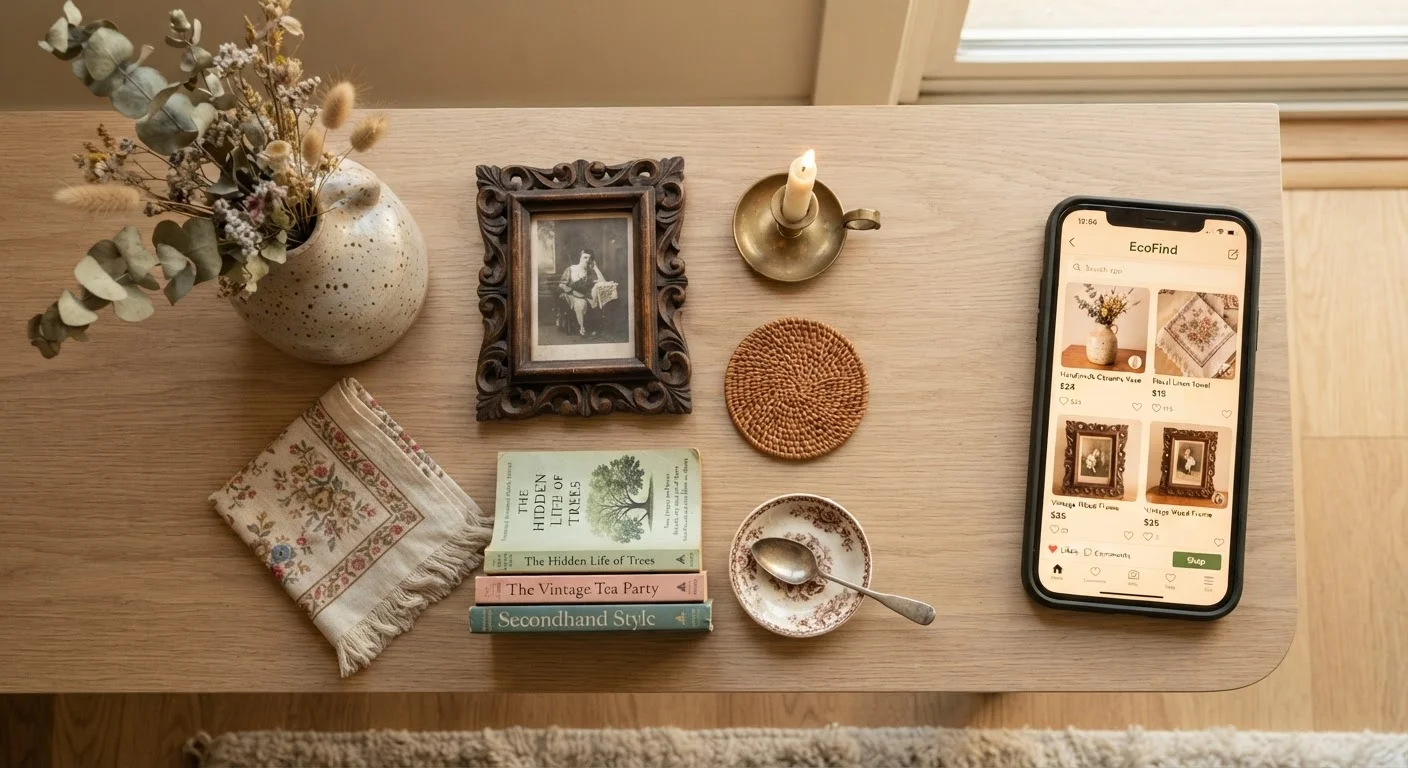
Key Takeaways
Option A
Resale Apps
The curated, convenient digital marketplace for secondhand finds.
Best for: Shoppers who want filtered searches, specific items, and the ability to shop from their couch at any hour.
Option B
Thrift Stores
The tactile, treasure-hunt experience with rock-bottom prices.
Best for: Budget maximizers who enjoy browsing in person, discovering surprises, and paying as little as possible per piece.
If you need a specific item fast and hate uncertainty
Resale Apps
Search filters let you find exactly what you need by category, color, or brand. You can message sellers and arrange pickup within days rather than waiting for a lucky thrift store visit.
If you're furnishing a space on the tightest possible budget
Thrift Stores
Thrift store pricing is consistently the lowest you'll find on secondhand goods. With frequent visits you can furnish an entire room for a fraction of what you'd spend even on resale apps.
If you're hunting for a specific brand or vintage style
Resale Apps
Platforms like eBay, Poshmark, and Chairish let you search by brand, era, and style - so you're not leaving your Le Creuset pot or mid-century lamp to chance.
If you want to discover décor you didn't know you needed
Thrift Stores
The serendipity of in-person thrift shopping leads to unexpected finds that transform a room. No algorithm can replicate the surprise of stumbling onto the perfect ceramic lamp for $4.
If you're sourcing large furniture and want to inspect before buying
Resale Apps
Facebook Marketplace and OfferUp enable local pickup with the ability to message sellers for detailed photos - combining the convenience of apps with the inspection advantage of in-person shopping.
The Real Cost Difference: Prices, Fees, and Hidden Extras
Let's talk money first, because that's why we're here. Thrift stores - your Goodwills, Salvation Armys, and local charity shops - price goods based on donation volume and category, not market value. That means a solid brass candlestick might be tagged at $1.99 while a comparable piece sells for $35 on Etsy. The pricing logic is almost delightfully arbitrary, and when it works in your favor, it really works. Thrift store pricing actually reveals a lot about an item's perceived condition and category - understanding that system helps you spot genuine bargains versus overpriced cast-offs.
Resale apps operate on a different logic entirely. Sellers on Poshmark, eBay, Chairish, or Facebook Marketplace are individuals or small resellers who've already done their market research. They've Googled the item, checked completed listings, and priced accordingly. That's not a bad thing - it means you're less likely to overpay for junk - but it does mean you'll rarely find the $2 miracle that thrift stores occasionally deliver.
| Criterion | Resale Apps | Thrift Stores |
|---|---|---|
| Average price level | Moderate - market-informed pricing | Low - donation-based, often arbitrary |
| Buyer fees | Indirect (baked into seller pricing) | None - sticker price only |
| Shipping costs | Significant for large/heavy items | None - take home immediately |
| Search & filtering | Excellent - by keyword, brand, price | None - browse only |
| Inventory consistency | High - listings stay until sold | Low - rotates daily, unpredictable |
| Condition verification | Photos + seller Q&A + platform protection | In-person inspection - touch and test |
| Buyer protection | Strong on most platforms (eBay, Poshmark) | Minimal - usually no returns |
| Best item categories | Furniture, lighting, branded goods | Ceramics, textiles, kitchenware, frames |
| Time to find an item | Minutes to days with saved searches | Days to weeks with regular visits |
| Negotiation flexibility | High - direct seller messaging | Low - fixed tag prices mostly |
The fee structure is another crucial variable. Poshmark charges sellers a flat $2.95 on sales under $15 and 20% on anything above. eBay's fees hover around 12-15% depending on category. Those fees get baked into asking prices, which means buyers absorb them indirectly. Thrift stores have no such overhead passed to you - you pay the sticker price and walk out.
Shipping costs are the sleeper issue nobody talks about enough. A $40 sideboard on eBay with $80 freight shipping is a $120 sideboard. For home goods specifically - heavy, awkward, breakable - shipping can completely wipe out the savings. Local pickup options on Facebook Marketplace and OfferUp sidestep this entirely, which is why those two platforms tend to be the sweet spot for sourcing furniture and larger décor pieces online.
$15B+
U.S. secondhand home goods market size
According to ThredUp's 2023 Resale Report, the overall secondhand market - including home goods - is projected to nearly double by 2027.
40-70%
Typical savings vs. retail on resale apps
Internal analysis of Facebook Marketplace and OfferUp listings for furniture shows average savings of 40-70% compared to equivalent new retail prices.
85-95%
Typical savings vs. retail at thrift stores
Goodwill and similar charity thrift stores routinely price donated home goods at 5-15% of their original retail value, per consumer shopping studies.
2-4x
More visits needed for consistent thrift finds
Experienced thrift shoppers report visiting two to four times weekly to reliably source quality home goods before they're picked over by other shoppers.
Selection and Searchability: Hunting vs. Filtering
Here's where resale apps pull dramatically ahead: search. Type "sage green ceramic lamp" into Facebook Marketplace and you'll get a curated list of relevant results within miles of your zip code. Refine by price, condition, and distance. Save the search. Get notified when new listings match. That kind of precision is something no thrift store rack can replicate.
Thrift store inventory is gloriously, maddeningly random. You might walk into a Goodwill and find three Le Creuset Dutch ovens in one week, then go six months without seeing a single piece of quality cookware. The stock rotates constantly - most stores process new donations daily - which means the selection is always fresh but never predictable. The shoppers who consistently score the best finds aren't luckier than you; they visit more often and know when new stock hits the floor.
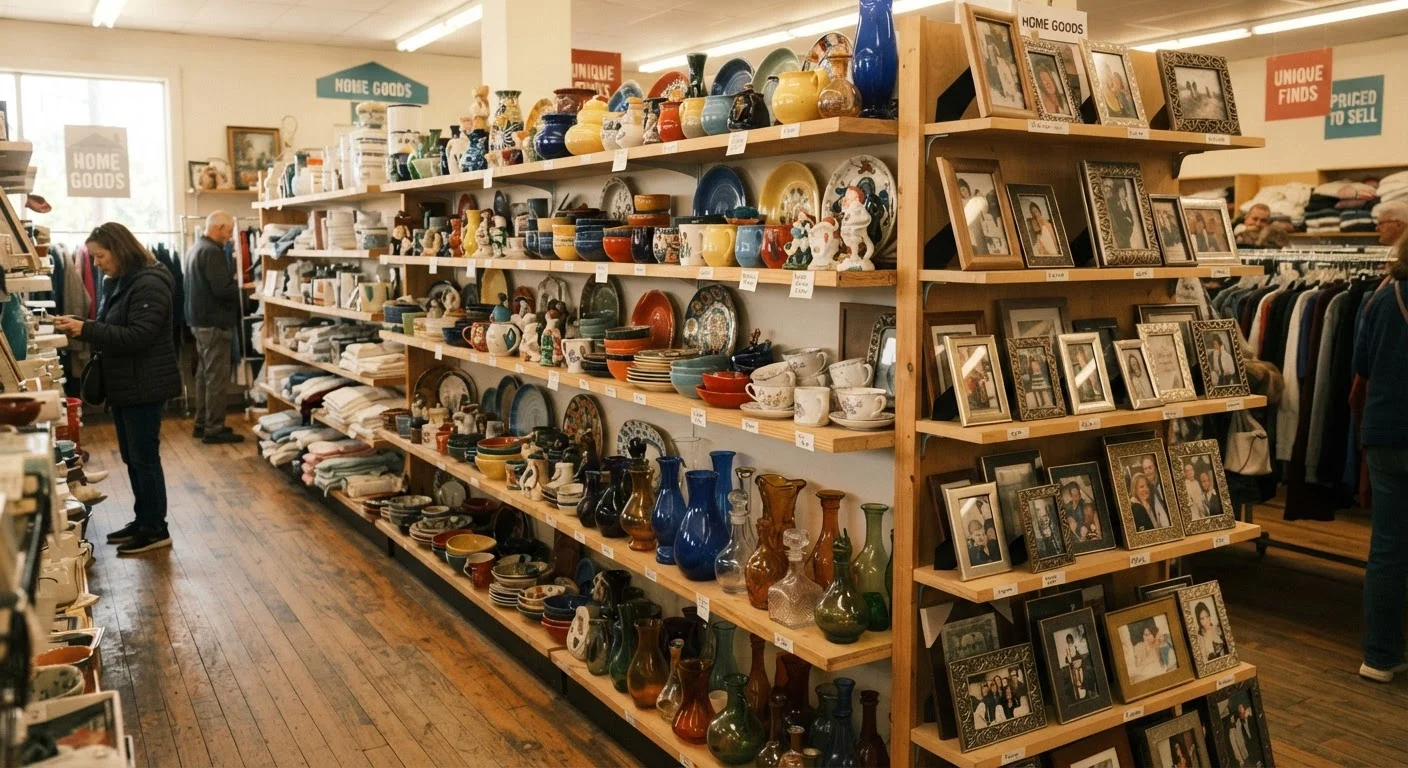
For home goods specifically, the category matters a lot. Thrift stores tend to be well-stocked with:
- Glassware, mugs, and ceramics
- Picture frames and mirrors
- Small decorative objects and vases
- Linens, curtains, and throw pillows
- Small appliances and kitchen tools
Resale apps shine for:
- Furniture (especially larger pieces)
- Lighting fixtures and lamps
- Specific brand-name items (KitchenAid, Le Creuset, Crate & Barrel)
- Vintage or antique pieces with identifiable provenance
- Sets - matching dinnerware, coordinating décor collections
If you're building a cohesive aesthetic room by room, resale apps give you far more control over what lands in your home. For broader, volume-based shopping - filling a kitchen with functional tools, layering in textiles, adding personality with small objects - thrift stores deliver more per dollar spent. See also our broader guide to where affordable décor actually hides for a look at how thrift stores stack up against estate sales and clearance channels.
Condition, Trust, and the Risk of Getting Burned
Buying secondhand always carries some risk, but the nature of that risk differs sharply between channels. In a thrift store, you physically hold the item. You can check for chips, smell for mustiness, test zippers, plug in the lamp. Your senses are your quality-control system, and with practice they get remarkably good. The downside is that thrift stores rarely accept returns - once you've paid and walked out, that chipped bowl is yours.
Resale apps rely on photos, descriptions, and seller reputation. Reputable platforms have buyer protections: Poshmark holds payment until you confirm the item's condition; eBay's Money Back Guarantee covers items that don't match their description. Facebook Marketplace has no built-in buyer protection for cash transactions, which is why local pickup with cash-on-inspection remains the safest approach. OfferUp has in-app payment with some buyer protection, splitting the difference.
Local Pickup: The Best of Both Worlds
Many resale app listings - particularly on Facebook Marketplace and OfferUp - offer local pickup rather than shipping. This option combines the searchability and convenience of apps with the in-person inspection advantage of thrift stores. Always prioritize local pickup listings for furniture, upholstered pieces, and anything where size or condition is difficult to assess from photos alone. Meeting in a public place for smaller items is a standard safety practice.
When to Walk Away: Red Flags in Both Channels
On resale apps, be wary of listings with only one low-resolution photo, sellers who refuse to answer condition questions, prices significantly below comparable listings (potential scam), and requests to pay via wire transfer or gift card. At thrift stores, develop a nose - literally - for mildew and smoke damage in upholstered goods and textiles. Check electrical items for frayed cords or cracked housings. A bargain that needs $50 of repair is often not a bargain at all.
Seller ratings matter enormously on resale apps. A seller with 200 five-star reviews and detailed photos of every angle is a significantly safer bet than an anonymous new account with one blurry listing photo. Always check completed reviews, ask for additional photos if anything looks off, and never send payment before you've confirmed the listing details match reality.
For items where condition is mission-critical - upholstered furniture (check for odors and staining), mattresses (avoid entirely in both channels), electrical items (test before you buy), and anything with intricate mechanisms like clocks or cameras - resale apps let you ask precise questions before committing. That conversational layer of due diligence is something a thrift store floor simply can't provide.
Time Investment: Browsing Marathons vs. Couch Scrolling
Let's be honest about the time cost of thrift shopping. A productive thrift run - driving to the store, parking, working systematically through the sections, waiting in line - easily runs 90 minutes to two hours. To find genuinely great home goods consistently, experienced thrifters visit two to four times per week. That's a significant time commitment that doesn't suit every schedule or personality.
Resale apps compress the browsing into your phone. You can scroll Facebook Marketplace during a lunch break, save listings, message sellers after dinner, and arrange pickup for the weekend - all without leaving your current location. For people who are time-poor but budget-conscious, that convenience is genuinely transformative.

The flip side is that resale app browsing has its own time sinks. Messaging back-and-forth with sellers who ghost you, driving across town only to find the piece is worse in person than in photos, waiting for listings to update - these frustrations are real. The right marketplace strategy makes a big difference in how efficiently you source across platforms.
A practical hybrid approach that many seasoned secondhand shoppers use:
- Set up saved searches on Facebook Marketplace and OfferUp for specific items you actively need. Let the notifications do the hunting.
- Make thrift store visits a weekly ritual rather than a mission - go with low expectations and treat it as a browse, not a search. The mindset shift reduces frustration dramatically.
- Use eBay and Chairish for specific, high-value pieces where brand or era matters and you're willing to pay a bit more for certainty.
- Reserve Poshmark for home goods with strong resale brand identity - think Anthropologie candles, Williams-Sonoma cookware, or West Elm throw blankets.
Platform Deep-Dive: Which App Does What Best
Not all resale apps are created equal, and for home goods specifically, the platform choice matters as much as the channel itself. Here's how the major players break down:
Facebook Marketplace
The undisputed king for local furniture and large home goods. Zero fees for local sales, massive inventory in most metros, and the ability to negotiate directly with sellers. The lack of buyer protection on cash deals is the main drawback - always inspect before paying.
OfferUp
Similar to Facebook Marketplace but with in-app payment options and seller ratings baked in from the start. Tends to skew toward electronics and furniture. Good for buyers who want slightly more structure than Facebook's wild west.
eBay
Best for specific, searchable items where brand and model number matter - KitchenAid mixers, specific Pyrex patterns, vintage Fiesta dinnerware. The buyer protection is strong and the inventory is enormous, but shipping costs on home goods can be brutal. Stick to local pickup listings when possible.
Poshmark (Home category)
Poshmark launched a home goods category that's grown steadily. It's most useful for decorative objects, textiles, and smaller brand-name pieces. The flat-rate shipping ($7.97 for most items under 5 lbs) makes it practical for small goods but expensive for anything heavier.
Chairish
The premium tier of secondhand home goods - think curated vintage furniture, designer lighting, and antique décor. Prices are higher than Goodwill by orders of magnitude, but you're getting vetted sellers and pieces that are genuinely investment-grade. Worth bookmarking for statement pieces.
Local Pickup: The Best of Both Worlds
Many resale app listings - particularly on Facebook Marketplace and OfferUp - offer local pickup rather than shipping. This option combines the searchability and convenience of apps with the in-person inspection advantage of thrift stores. Always prioritize local pickup listings for furniture, upholstered pieces, and anything where size or condition is difficult to assess from photos alone. Meeting in a public place for smaller items is a standard safety practice.
When to Walk Away: Red Flags in Both Channels
On resale apps, be wary of listings with only one low-resolution photo, sellers who refuse to answer condition questions, prices significantly below comparable listings (potential scam), and requests to pay via wire transfer or gift card. At thrift stores, develop a nose - literally - for mildew and smoke damage in upholstered goods and textiles. Check electrical items for frayed cords or cracked housings. A bargain that needs $50 of repair is often not a bargain at all.
For a broader look at how these platforms compare across all product categories - not just home goods - our analysis of which marketplace wins by product category breaks down the full competitive landscape.
Building Your Secondhand Home Strategy
The smartest secondhand shoppers don't choose between resale apps and thrift stores - they deploy each channel strategically based on what they're sourcing. Think of it like a toolkit: you wouldn't use a hammer for every job.
Use thrift stores for: High-volume, low-stakes items where price matters most and you have flexibility on timing. Glassware, frames, textiles, small ceramics, kitchen tools, and décor accents. These categories are consistently well-stocked at thrift prices, and the in-person inspection removes condition risk.
Use Facebook Marketplace and OfferUp for: Furniture, lamps, rugs, and larger pieces where local pickup allows inspection and shipping costs would otherwise be prohibitive. Set saved searches and check notifications daily - good pieces move fast.
Use eBay for: Specific, brand-identifiable items where you know exactly what you want. Search completed listings first to understand fair market value before bidding or buying.
Use Poshmark and Chairish for: Designer or vintage pieces where curation matters and you're willing to pay a modest premium for seller vetting and platform protections.

One underrated move: use thrift stores as a price anchor. Before you buy anything on a resale app, ask yourself whether you've recently seen comparable pieces in local thrift stores and at what price. This mental baseline keeps you from overpaying on platforms where sellers set their own prices. If you're patient and visiting thrift stores regularly, you'll develop an accurate sense of what secondhand goods are actually worth - which makes you a far sharper buyer on resale apps too.
If your goal extends beyond home goods into fashion and wardrobe building, the same channel logic applies - building a cohesive wardrobe entirely from secondhand pieces follows identical principles of channel pairing and intentional sourcing. And if you want to go deeper on the thrift side specifically, our thrift style tips hub has everything you need to shop smarter in store.
The bottom line? Both channels are genuinely powerful. Thrift stores win on price and serendipity. Resale apps win on specificity and convenience. Together, they give you everything you need to build a beautiful home on a budget that would make any retailer's marketing team nervous.