
Single-Use Beauty Products and the Cost They Add Up To
Makeup wipes, sheet masks, and disposable tools are convenient — but the cumulative cost and waste are worth understanding before you stock up.
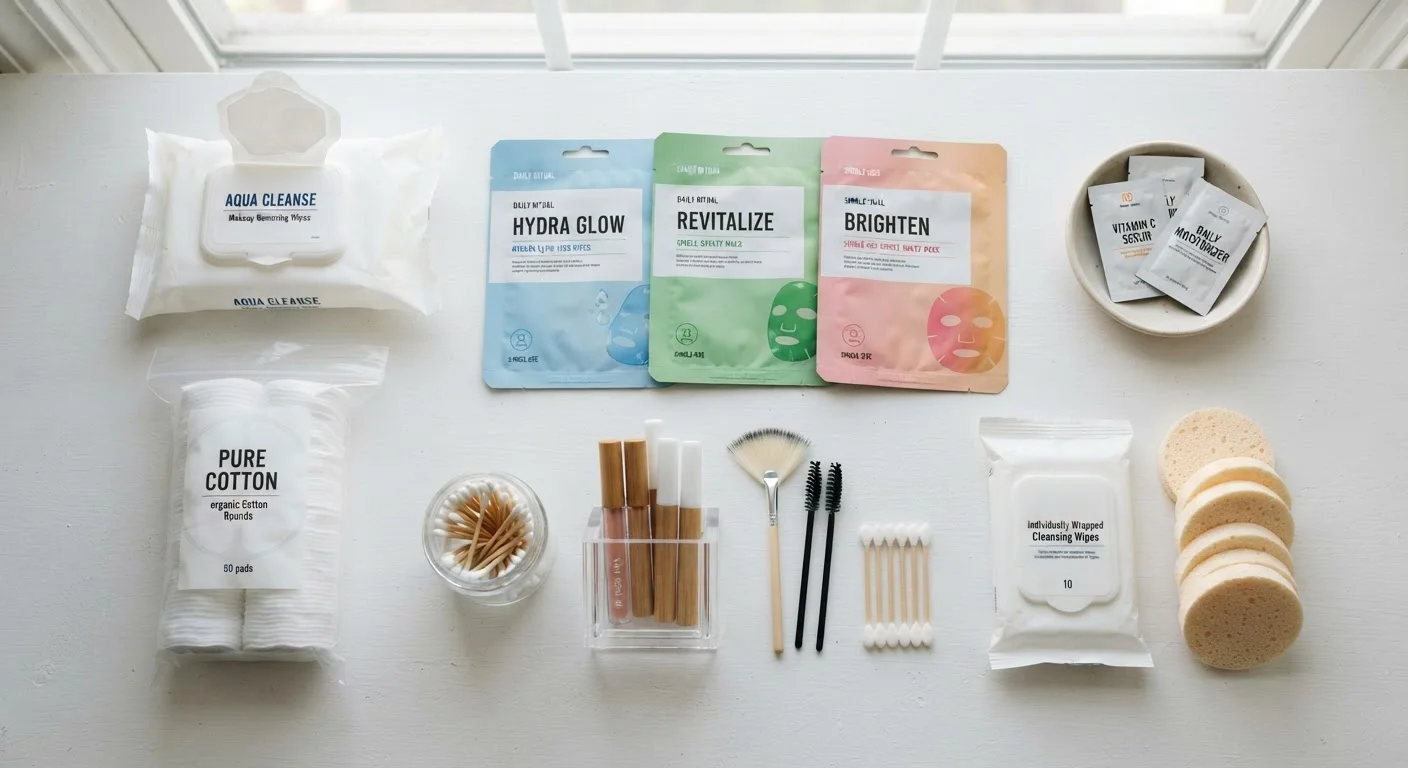
Photo: SaverSteals.com | Explore More. Shop Smarter. editorial
—— In This Article
Key Takeaways
- Single-use beauty products feel affordable per unit but accumulate significant cost over months.
- Many disposable items have reusable alternatives that perform comparably at a fraction of the ongoing expense.
- Convenience and hygiene are genuine advantages, but they rarely justify unlimited use for most routines.
- Environmental impact is a real factor - biodegradability and packaging waste vary widely by product type.
- Understanding your actual usage rate helps identify where disposables are worth it and where they aren't.
Genuinely hygienic for travel and gym use
Disposable wipes and single-serve sachets eliminate the contamination risk of open jars in shared or high-contact environments. For on-the-go cleansing, they fill a practical gap that reusables often can't.
No cross-contamination between applications
Disposable applicators for eye products or lip treatments reduce the risk of transferring bacteria between sessions - a genuine hygiene consideration, particularly for eye area products.
Low barrier to trying new formats
Single-serve sachets and individual sheet masks let you evaluate a product before committing to a full-size purchase, reducing the risk of a costly mistake with an incompatible formula.
Consistent dosing without measuring
Pre-measured disposable formats remove guesswork, which can actually prevent overuse of potent actives - a practical advantage for serums or exfoliating treatments packaged this way.
Cumulative cost significantly exceeds reusable alternatives
The per-unit price of disposables appears modest, but annualized spending on makeup wipes, cotton rounds, and sheet masks routinely reaches well over $100 for many shoppers - costs that reusable swaps would largely eliminate after an initial investment.
Substantial environmental footprint from packaging and waste
Most single-use beauty products are not recyclable, and many contain synthetic fibers that don't biodegrade. The packaging-to-product ratio is also high, adding to household waste at a faster rate than refillable or bulk alternatives.
Wipes can cause mechanical skin irritation
Makeup wipes used with rubbing motion - as required to fully remove makeup - can disrupt the skin barrier over time. Dermatology literature generally recommends wipes as a supplement to, not a replacement for, proper cleansing.
Encourages passive overconsumption without tracking
Because each disposable unit feels inexpensive, it's easy to use more than necessary - extra wipes, multiple cotton rounds - without recognizing how usage habits inflate monthly spend.
Reusable alternatives exist for most categories
For the majority of routine applications - toner application, makeup removal, cleansing, shaving - reusable tools now perform comparably and reduce ongoing spend after an initial purchase.
What Counts as a Single-Use Beauty Product?
Single-use beauty products are items designed - or commonly used - for one application before disposal. The category is broader than most shoppers realize: makeup remover wipes, sheet masks, cotton rounds, disposable razors, individual eye patches, nail polish remover pads, and single-serve skincare sachets all qualify. So do disposable applicators bundled with foundations or concealers.
The appeal is straightforward. These products remove friction from a routine - no rinsing, no cleaning, no measuring. But that convenience is priced into every unit, and the math shifts considerably once you calculate monthly or annual spend. Someone using one makeup wipe per night, for example, goes through roughly 30 units a month on that single step alone. At common drugstore price points, that can translate to $80-$150 per year on wipes exclusively - comparable to several bottles of a well-formulated micellar cleanser.
If you're evaluating where your beauty budget actually goes, common overspending traps in the beauty aisle are worth reviewing alongside disposable habits, since both categories operate on the same low-per-unit, high-frequency spending pattern.
The Real Advantages of Disposable Beauty
It would be inaccurate to dismiss single-use products as pure waste. There are contexts where they offer genuine, hard-to-replicate value.
Genuinely hygienic for travel and gym use
Disposable wipes and single-serve sachets eliminate the contamination risk of open jars in shared or high-contact environments. For on-the-go cleansing, they fill a practical gap that reusables often can't.
No cross-contamination between applications
Disposable applicators for eye products or lip treatments reduce the risk of transferring bacteria between sessions - a genuine hygiene consideration, particularly for eye area products.
Low barrier to trying new formats
Single-serve sachets and individual sheet masks let you evaluate a product before committing to a full-size purchase, reducing the risk of a costly mistake with an incompatible formula.
Consistent dosing without measuring
Pre-measured disposable formats remove guesswork, which can actually prevent overuse of potent actives - a practical advantage for serums or exfoliating treatments packaged this way.
Sheet masks, for instance, deliver a concentrated dose of actives in a format that maximizes skin contact - something a standard moisturizer can't replicate. Used occasionally rather than daily, the cost-per-use becomes much more defensible. Similarly, disposable razors designed for single use genuinely reduce the bacterial buildup risk associated with keeping a blade too long.
Where the Costs and Drawbacks Stack Up
The disadvantages of routine reliance on disposables are financial, environmental, and - in some cases - dermatological.
Cumulative cost significantly exceeds reusable alternatives
The per-unit price of disposables appears modest, but annualized spending on makeup wipes, cotton rounds, and sheet masks routinely reaches well over $100 for many shoppers - costs that reusable swaps would largely eliminate after an initial investment.
Substantial environmental footprint from packaging and waste
Most single-use beauty products are not recyclable, and many contain synthetic fibers that don't biodegrade. The packaging-to-product ratio is also high, adding to household waste at a faster rate than refillable or bulk alternatives.
Wipes can cause mechanical skin irritation
Makeup wipes used with rubbing motion - as required to fully remove makeup - can disrupt the skin barrier over time. Dermatology literature generally recommends wipes as a supplement to, not a replacement for, proper cleansing.
Encourages passive overconsumption without tracking
Because each disposable unit feels inexpensive, it's easy to use more than necessary - extra wipes, multiple cotton rounds - without recognizing how usage habits inflate monthly spend.
Reusable alternatives exist for most categories
For the majority of routine applications - toner application, makeup removal, cleansing, shaving - reusable tools now perform comparably and reduce ongoing spend after an initial purchase.
From a skin-health standpoint, makeup wipes deserve particular scrutiny. Many formulations require rubbing to dissolve makeup effectively, which can cause mechanical irritation over time. Dermatologists frequently note that wipes are better understood as a supplementary step than a replacement for proper cleansing - a distinction that matters for both skin outcomes and spending efficiency. The skincare myths that keep you spending more often include the idea that more products automatically means better skin, which disposable marketing tends to reinforce.
~30 units
Monthly wipes used at nightly frequency
A one-wipe-per-night habit consumes approximately 360 units annually, making wipes one of the highest-volume disposable categories in a typical skincare routine.
2-3 years
Typical payback period for reusable cotton rounds
Reusable rounds cost more upfront but typically offset the purchase price within several months of regular use compared to equivalent single-use pad spending.
Identifying Where Reusable Alternatives Work
Not every disposable category has an equally practical reusable swap, but many do. Reusable cotton rounds made from bamboo or microfiber are washable and perform the same mechanical function as single-use pads for toner application or gentle cleansing. Silicone cleansing tools replace disposable scrubbing pads. A well-maintained safety razor replaces an ongoing stream of disposable cartridges.
The upfront cost of reusables is higher, and that can feel like a barrier - especially for shoppers already working within a tight beauty budget. The approach of buying affordable products that actually last applies here: evaluating cost-per-use rather than sticker price tends to favor reusables in most routine applications.
Reusables and Coupon Savings: A Trade-Off to Know
Shoppers who actively use loyalty points or manufacturer coupons on disposables may offset some of the cost gap between single-use and reusable products. However, this advantage diminishes if coupon availability is inconsistent or if the products are purchased impulsively in larger quantities than actually used. Factoring realistic coupon frequency into your cost comparison gives a more accurate picture than assuming maximum savings every cycle.
For shoppers who use beauty coupons and loyalty programs, it's worth noting that reusable products purchased once rarely generate repeat coupon savings - whereas disposables repurchased monthly do. Factor this into any direct cost comparison rather than assuming reusables always win on pure spend.
A Practical Framework for Auditing Your Disposable Habit
Rather than eliminating single-use products wholesale, a structured audit tends to yield better results. Start by listing every disposable product currently in your routine and calculating a rough monthly cost for each. Then ask two questions: Does a reusable alternative exist that performs the same function? And is this product used in a context - travel, post-gym, sensitive-skin flares - where the convenience genuinely offsets the cost?
Products that fail both tests are strong candidates for replacement. Those that pass either one are worth keeping with usage limits in mind. Understanding ingredient overlaps across your products can also reveal where disposable treatments duplicate actives already in your routine - an often-overlooked source of redundant spending.
The goal isn't an austerity routine. It's a routine where every product - disposable or not - earns its place.

Beauty Editorial Team
Beauty Editorial Team is the collective byline for our editorial team and contributor network. Articles published under this byline or an editorial pen name are researched, written, and reviewed according to our editorial standards for clarity, consistency, and independence before publication.
View author profile