
Online vs. In-Store Toy Sales: Where Discounts Run Deeper
A balanced look at how online and brick-and-mortar retailers approach toy pricing, and what each channel does better for deal seekers.
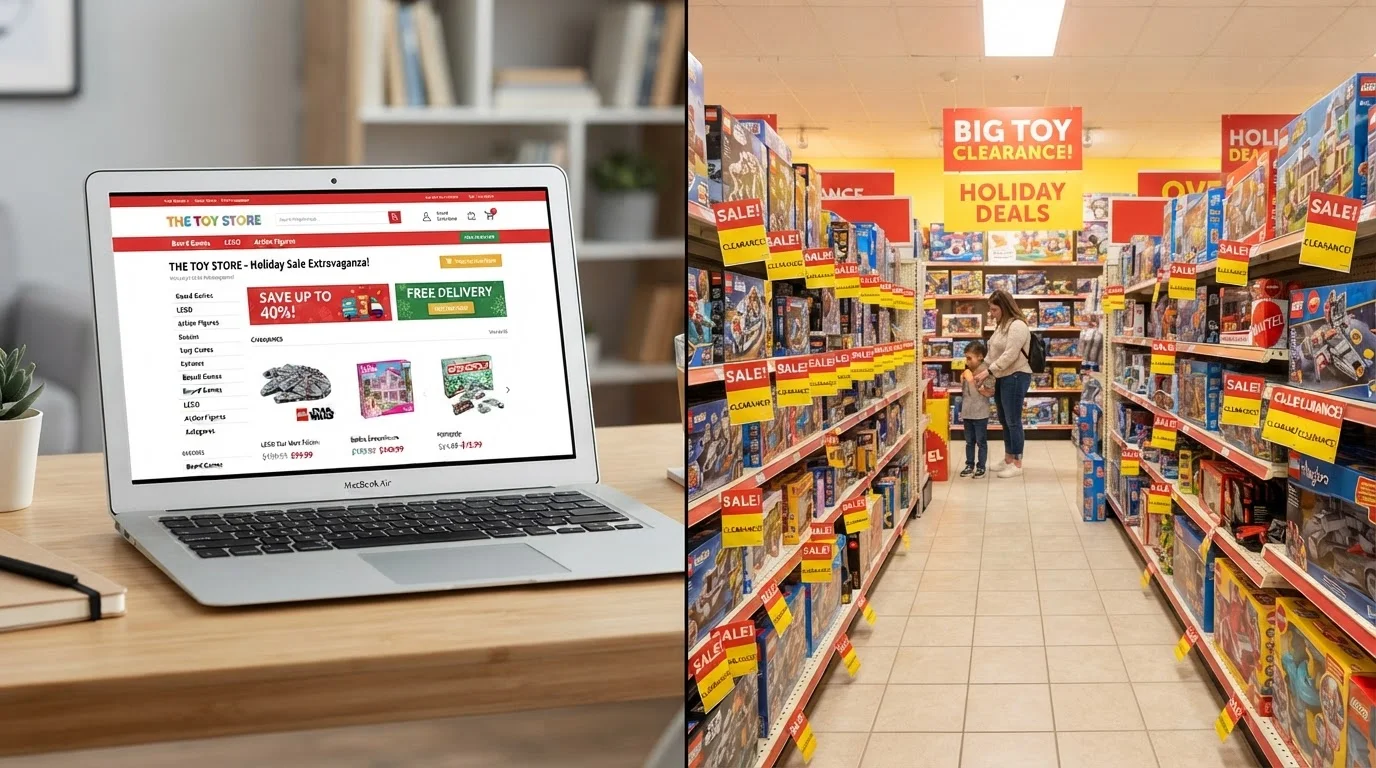
Photo: SaverSteals.com | Explore More. Shop Smarter. editorial
—— In This Article
Key Takeaways
- Online channels tend to offer more consistent price tracking tools and broader inventory.
- In-store clearance often produces steeper markdowns on physical stock nearing discontinuation.
- Timing matters more than channel — neither setting wins across every season or toy category.
- Layering strategies (price alerts, store visits near cycle end) delivers better results than picking one channel exclusively.
How Each Channel Sets Toy Prices
Online and brick-and-mortar retailers operate under different cost structures, and those differences show up directly in how they discount toys. Physical stores carry overhead — rent, staff, shelf space — that limits how aggressively they can reduce prices across a wide range of items at once. Online retailers, by contrast, can adjust prices algorithmically, sometimes dozens of times per day, responding to competitor pricing, inventory levels, and demand signals in near real time.
That doesn't automatically mean online prices are lower. Shipping costs, handling fees, and marketplace seller markups can erode apparent savings. Understanding these mechanics helps you evaluate whether a marked-down price actually represents a genuine reduction. For a deeper look at how retailers construct pricing in the first place, see retail pricing cycles for toys.
Where Online Shopping Has a Structural Edge
The clearest advantage of shopping for toys online is access to price history. Browser-based tools and retailer apps allow shoppers to view how a price has moved over time, making it easier to recognize when a listed discount reflects a genuine reduction versus an inflated reference price. Without that context, a "30% off" label is nearly meaningless. This problem is common enough that it warrants its own attention — spotting inflated original prices before committing to a purchase.
Online channels also give access to a broader inventory across more categories simultaneously. Price alert features let shoppers set a target price and wait, rather than checking repeatedly. During major promotional windows — late October through December — online competition between retailers tends to drive prices down on high-demand items more visibly than in-store competition does.
~35%
Share of US toy sales made online
E-commerce's share of total US toy retail has grown substantially over the past decade, according to industry analysts tracking the category.
January–February
Peak period for in-store toy clearance
Post-holiday inventory resets consistently produce the deepest in-store markdowns as retailers clear shelf space for new product lines.
Where In-Store Shopping Delivers Real Advantages
Physical stores hold one distinct advantage that online channels rarely match: end-of-season and end-of-line clearance. When a retailer needs to move floor inventory to make room for new stock, in-store markdowns can reach levels that online pricing seldom touches for the same item. These clearance cycles are predictable — they typically follow the post-holiday period (January through February) and mid-year resets (July through August) — which means shoppers who visit stores during these windows can find genuine depth of discount.
In-store shopping also allows physical inspection before purchase. For toys with complex assembly requirements, specific size constraints, or safety considerations for younger children, being able to read the actual packaging and assess build quality matters. This is especially relevant when buying for infants or toddlers, where age-appropriateness and small-parts warnings are critical.
Check Store Clearance Sections Consistently
In-store clearance racks and end-caps are restocked irregularly, so a single visit rarely tells the full story. Checking the clearance section during routine shopping trips — rather than special trips — is a low-effort way to catch markdowns as they happen. Staff in most large toy departments can also point you toward recently reduced items if you ask directly.
Comparing Key Factors Side by Side
The table below summarizes how the two channels compare across criteria most relevant to families looking for toy savings. Note that individual retailer behavior varies — these reflect general patterns rather than guarantees.
| Online Retail | In-Store Retail | |
|---|---|---|
| Price transparency | High — history tools available | Low — reference prices harder to verify |
| Depth of clearance discounts | Moderate — varies by platform | High — especially post-holiday and mid-year |
| Inventory breadth | Wide — across many categories | Limited to floor stock |
| Ability to inspect before buying | None — relies on photos/reviews | Yes — packaging and size visible |
| Price fluctuation frequency | High — algorithmic adjustments | Lower — manual markdown cycles |
| Ease of price comparison | Easy — multiple tabs or tools | Requires visiting multiple stores |
| Immediate availability | Delayed — shipping time applies | Immediate — take home same day |
For a broader framework on how clearance and promotional discounts differ in structure, understanding clearance vs. promotional pricing can sharpen your evaluation of any sale you encounter in either channel.
Using Both Channels Together
The most effective approach isn't choosing a single channel — it's recognizing what each does well and sequencing your shopping accordingly. Use online tools to research prices, track history, and identify when a toy is at a cyclical low. Then check whether an in-store clearance event might close the gap further, particularly for items that have been on shelves for several months.
Shoppers already familiar with discount strategies often fall into the trap of loyalty to one channel out of habit. habits that make toy deal hunting pay off explores the practices that separate consistent savings from hit-or-miss results. Combining price awareness with an understanding of retail timing — outlined in the complete guide to toy discounts — gives you a workable system rather than a one-off win.

Toys Editorial Team
Toys Editorial Team is the collective byline for our editorial team and contributor network. Articles published under this byline or an editorial pen name are researched, written, and reviewed according to our editorial standards for clarity, consistency, and independence before publication.
View author profile