
Toy Age Labels and Secondhand Safety: Reading the Markings That Matter
Age ratings, safety symbols, and country-of-origin marks all carry meaning. A quick-reference guide to the markings found on used toy packaging.
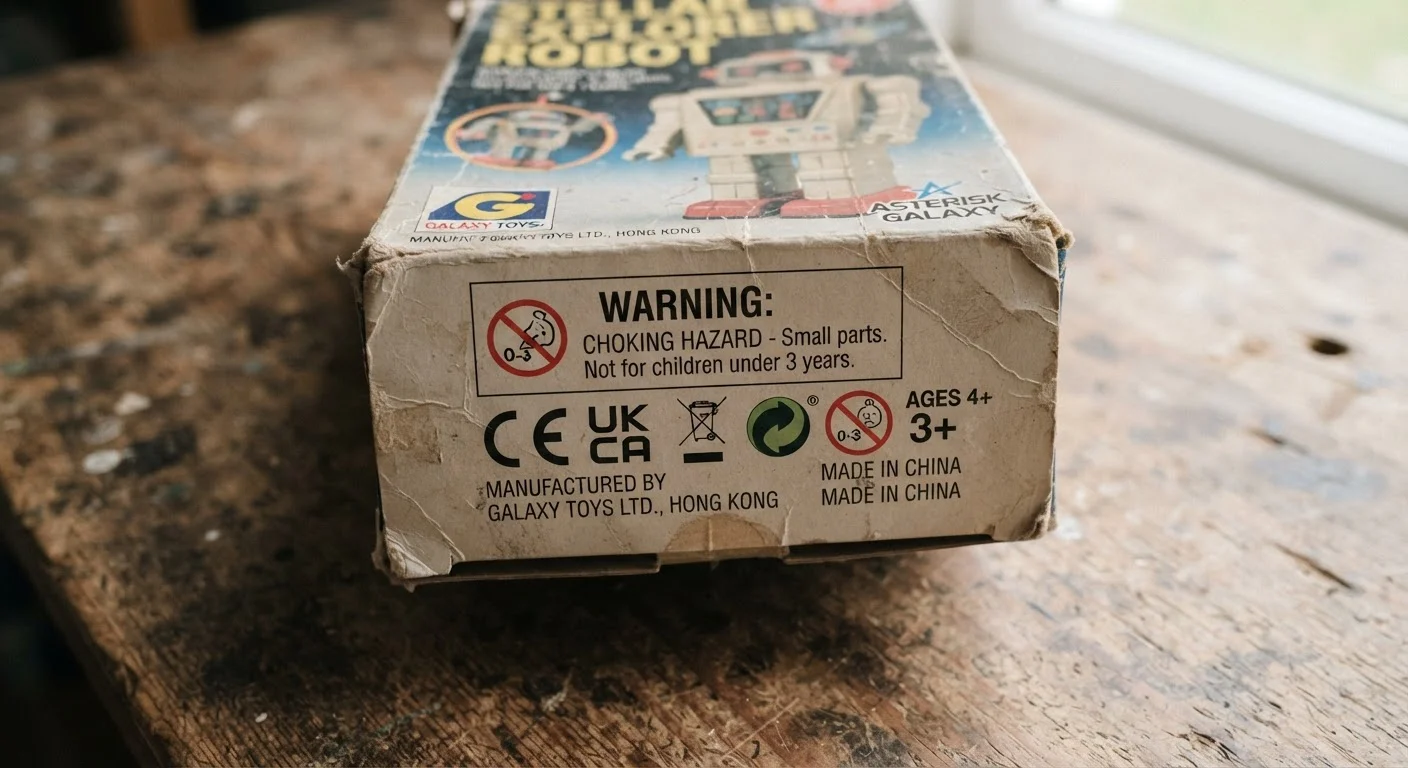
Photo: SaverSteals.com | Explore More. Shop Smarter. editorial
—— In This Article
Why Toy Markings Matter More on Secondhand Purchases
When you buy a new toy, the retailer, manufacturer, and regulatory system have all filtered out the most obvious hazards. In a secondhand transaction, that safety net is largely gone. The markings on the original packaging — or the toy itself — become your primary tool for assessing whether a toy is appropriate for the child who will use it.
Age labels are not marketing suggestions. Under U.S. Consumer Product Safety Commission (CPSC) guidelines, age-grading on toys is tied directly to specific hazard categories: choking risks for children under three, electrical hazards, and developmental appropriateness. A toy labeled 3+ typically contains small parts that present a documented choking risk to younger children. Ignoring that label because a two-year-old seems "mature" is a risk no savings are worth.
For a full picture of what to look for across a toy's entire secondhand life, see The Complete Lifecycle of a Secondhand Toy.
| U.S. toy safety standard | ASTM F963 (CPSC mandatory standard for most toy categories) |
| Age below which small-parts warnings are required | Under 36 months (3 years) (U.S. Consumer Product Safety Commission) |
| Key U.S. law tightening toy safety | Consumer Product Safety Improvement Act (CPSIA), 2008 (U.S. Congress, effective 2009) |
| EU toy safety mark | CE mark (European Union toy safety directive) |
| Where to verify U.S. recalls | CPSC recall database (cpsc.gov/recalls) (U.S. Consumer Product Safety Commission) |
| Electrical component certification mark | UL Listed (Underwriters Laboratories) |
Decoding the Symbols: A Practical Reference
Most toys sold in the U.S. carry a recognizable set of marks. Here is what each one signals:
- Age advisory triangles (e.g., "Not suitable for children under 36 months") — These are federally mandated warnings tied to small-part hazard testing, not arbitrary age cutoffs. The CPSC defines a small part using a standardized test cylinder that approximates a young child's airway.
- ASTM F963 — This mark indicates the toy has been tested against the American Society for Testing and Materials' toy safety standard. It is the primary voluntary (and in many cases mandatory) standard for toys sold in the U.S. Look for it on the original box or a sticker on the product.
- CE mark — Required for toys sold in the European Union. On a secondhand toy imported from Europe, a CE mark means it met EU safety directives at the time of manufacture, though standards differ from ASTM F963 in some areas.
- Country of origin — Required by U.S. Customs law. Helps you date a toy roughly and cross-reference against recall databases, since recall notices often list the country of manufacture.
- UL Listed / UL mark — Appears on toys with electrical components. UL (Underwriters Laboratories) certification means the electrical parts met specific safety requirements at the time of testing.
ASTM F963
The standard published by ASTM International covering safety requirements for toys sold in the United States. It addresses hazards including small parts, sharp edges, flammability, and toxic materials. Compliance is mandatory for many toy categories under the CPSIA.
Small Parts Warning
A federally mandated label indicating a toy contains components small enough to be swallowed or aspirated by children under three. Determined using a standardized CPSC test cylinder that approximates a young child's upper airway diameter.
CE Mark
A conformity mark required for toys sold within the European Union, indicating the product meets EU health, safety, and environmental requirements. It is not equivalent to U.S. ASTM certification, as the underlying standards differ in scope.
CPSIA
The Consumer Product Safety Improvement Act, enacted in 2008, which set stricter U.S. limits on lead content and phthalates in children's products and required third-party testing for many toy categories. Toys made before 2009 were not subject to these requirements.
UL Listed
A mark from Underwriters Laboratories indicating that a product's electrical components were independently tested and met defined safety requirements at the time of certification. Relevant for battery-powered and plug-in toys.
Date Code
A manufacturer-stamped alphanumeric code on a toy or its packaging indicating when the product was made. Useful for cross-referencing recall databases that specify affected production date ranges.
When packaging is missing entirely — common with secondhand toys — look for molded-in markings on the toy's underside or battery compartment. Many manufacturers stamp age warnings and material codes directly onto the product itself.
Once you have identified the relevant markings, pair that information with a hands-on inspection. Safety checks every family should run on a used toy walks through the physical inspection steps in detail.
Using Markings to Spot Recall Risk and Date a Toy
Country-of-origin marks, date codes, and batch numbers printed on toys can help you narrow down whether a specific unit falls within a recall window. The CPSC's recall database is searchable by product type, manufacturer, and date range — a batch number from the toy's underside can sometimes confirm or rule out a recalled unit.
Toys manufactured before 2009 in the U.S. may predate the Consumer Product Safety Improvement Act (CPSIA), which significantly tightened lead content and phthalate limits. Painted wooden toys and soft vinyl products from that era deserve extra scrutiny. This is especially relevant for toys passed down through multiple generations.
For more on how recalls interact with the secondhand market specifically, Toy Recalls and Secondhand Markets explains how to search databases and what to do if you find a match.
If you are selling a used toy, clearly photographing and disclosing all visible markings — including age labels and any warnings — is both an ethical practice and, in some contexts, a legal one. Pricing a used toy fairly covers how condition and completeness affect fair pricing. Material condition also plays into safety: how different toy materials hold up secondhand explains which surfaces and components degrade in ways that can introduce new hazards over time.

Toys Editorial Team
Toys Editorial Team is the collective byline for our editorial team and contributor network. Articles published under this byline or an editorial pen name are researched, written, and reviewed according to our editorial standards for clarity, consistency, and independence before publication.
View author profile