
Solid Wood vs. Engineered Wood: Why It Matters More the Second Time Around
Learn how to tell solid wood from MDF or particleboard in used pieces, and why the distinction affects durability and repairability.
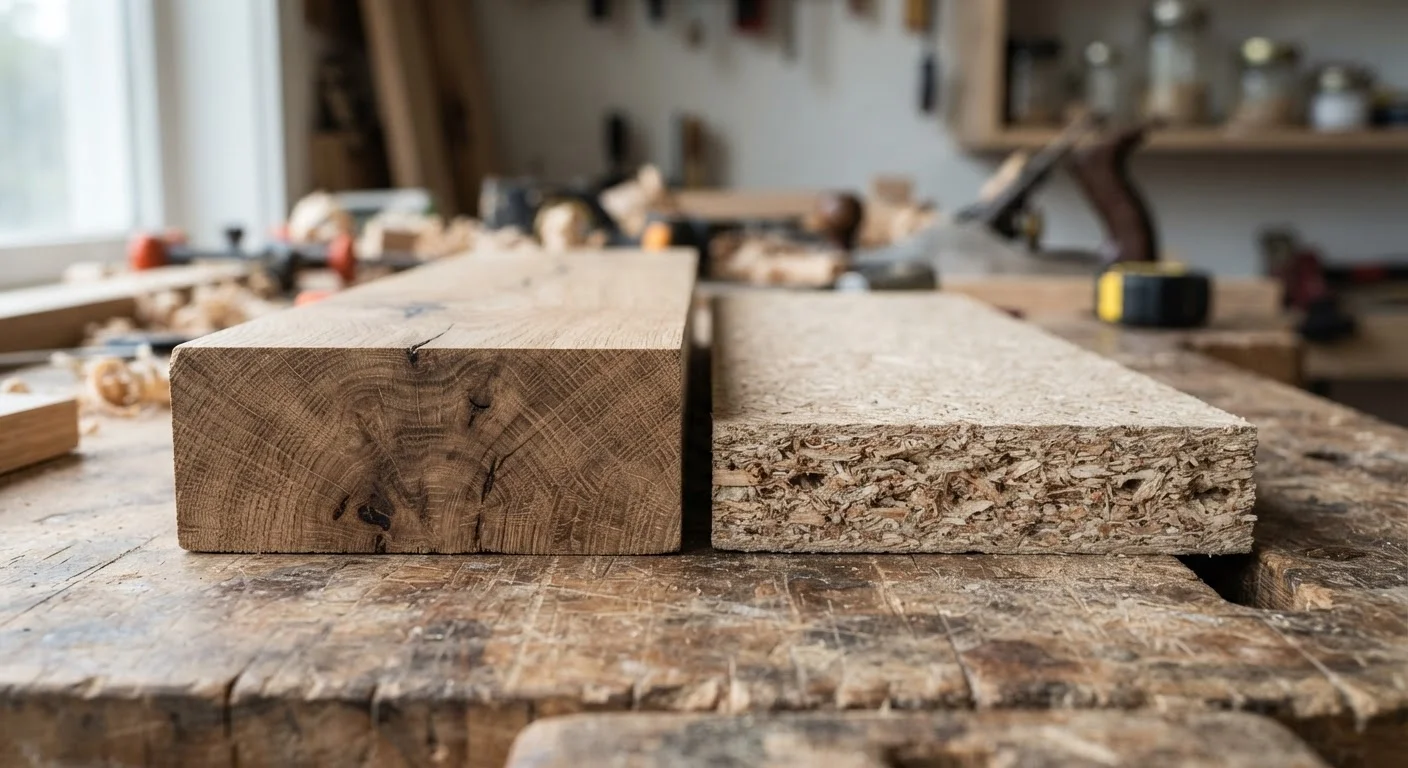
Photo: SaverSteals.com | Explore More. Shop Smarter. editorial
—— In This Article
Key Takeaways
- Solid wood can be sanded, refinished, and structurally repaired; engineered wood generally cannot.
- Water exposure is the fastest way to spot failing particleboard - look for swelling at corners and edges.
- Listings using 'wood' or 'wood finish' without the word 'solid' almost always mean engineered materials.
- Solid wood pieces gain value with age and use; engineered wood typically degrades and cannot recover.
- A simple scratch or chip test on an inconspicuous edge can confirm material type before you buy.
Why the Distinction Hits Harder the Second Time Around
When furniture is new, the difference between solid wood and engineered wood is mostly about price. The second time around - meaning when you're buying or selling a used piece - it becomes a question of durability, repairability, and whether you're getting real value or inheriting someone else's problem.
Solid wood is exactly what it sounds like: lumber cut from a single tree, with continuous grain running through the piece. Engineered wood is a catch-all term covering materials like MDF (medium-density fiberboard) and particleboard, which are made from wood fibers or chips compressed with adhesive. Both categories also include plywood, which sits somewhere in between - it's made from layered wood veneers and behaves differently from MDF or particleboard.
On the used market, this distinction matters because the two materials age in fundamentally different ways. Solid wood can absorb decades of use and still be restored. Engineered wood has a ceiling, and once moisture, heavy use, or structural stress breaks through it, there's no recovery. Understanding which you're looking at before you commit is the single most practical skill a secondhand furniture shopper can develop.
How to Identify the Material Before You Buy
Listings rarely volunteer this information accurately. Terms like "wood," "wood-look," or "wood finish" almost never mean solid wood. Even "hardwood" can appear in listings for pieces with only a thin hardwood veneer over particleboard. Decoding these listing terms before committing can save you from a bad purchase.
In person, use these quick tests:
- Check the edges and underside. Solid wood shows continuous grain. Engineered wood reveals layers, a speckled interior (particleboard), or a uniform gray-brown density (MDF).
- Look at corners and drawer bottoms. Peeling veneer, swelling edges, or white chalky residue at corners signals particleboard that has absorbed moisture - a condition that cannot be reversed.
- Try the fingernail test on an inconspicuous spot. Solid wood resists scratching; MDF dents cleanly and reveals a smooth, dense gray material underneath rather than wood grain.
- Assess the weight. Solid wood pieces are noticeably heavy. Particleboard is dense but tends to feel heavier than its size suggests; MDF is extremely heavy relative to its apparent size. Plywood is lighter and more rigid.
For a deeper understanding of how these structural differences affect joints and overall construction integrity, see our plain-language construction reference for secondhand shoppers.
| Criterion | Solid Wood | Engineered Wood (MDF/Particleboard) |
|---|---|---|
| Surface repair | Sand, fill, refinish - fully restorable | Veneer damage is largely permanent |
| Moisture damage | Can warp but may dry and stabilize | Swells permanently; cannot be reversed |
| Joint repair | Re-gluing or re-doweling is reliable | Stripped screw holes rarely hold again |
| Refinishing / painting | Handles multiple rounds | Limited; surface degrades with sanding |
| Identification on inspection | Continuous grain on all faces | Layered or speckled interior at edges |
| Longevity under heavy use | Decades with basic maintenance | Typically 5-10 years under normal use |
| Secondhand value | Retains or gains value over time | Depreciates quickly; little residual value |
What Damage Is Repairable - and What Isn't
This is where the material type determines your real cost of ownership. Solid wood tolerates a wide range of damage that engineered wood simply cannot recover from.
5-10 yrs
Typical useful lifespan of particleboard furniture
Industry estimates generally place particleboard furniture lifespan at 5-10 years under normal household use, compared to decades for well-maintained solid wood.
3-5 mm
Typical veneer thickness on engineered pieces
Most factory-applied veneers on engineered wood furniture range from 0.5 mm to 5 mm, leaving very little material for sanding or refinishing.
Solid wood: Surface scratches, worn finishes, and minor dents can typically be sanded and refinished. Loose joints can be re-glued. Deep gouges can be filled with wood filler and refinished. Even significant structural damage - a cracked rail, a broken tenon - is often fixable by a competent woodworker.
Engineered wood: Surface veneer that has lifted, bubbled, or peeled cannot be re-adhered cleanly for a lasting result. Swollen edges from moisture exposure will not return to their original dimension. Screw holes that have stripped - common in high-use areas like drawer slides and hinges - cannot be reliably re-drilled in particleboard without reinforcement. Painting over MDF is possible, but repeated sanding between coats breaks down the surface binder.
The practical rule: if a solid wood piece has cosmetic damage, it's a project. If an engineered wood piece has structural or moisture damage, it's likely a pass.
For upholstered secondhand pieces, similar logic applies to the frame underneath the fabric - see which upholstered pieces tend to recover well secondhand.

Furniture Editorial Team
Furniture Editorial Team is the collective byline for our editorial team and contributor network. Articles published under this byline or an editorial pen name are researched, written, and reviewed according to our editorial standards for clarity, consistency, and independence before publication.
View author profile