
Why 'Original Price' Tags Are Often Misleading - and How to See Past Them
Inflated reference prices are a well-documented retail practice. Here's how to identify them and assess whether a discount is genuinely worthwhile.
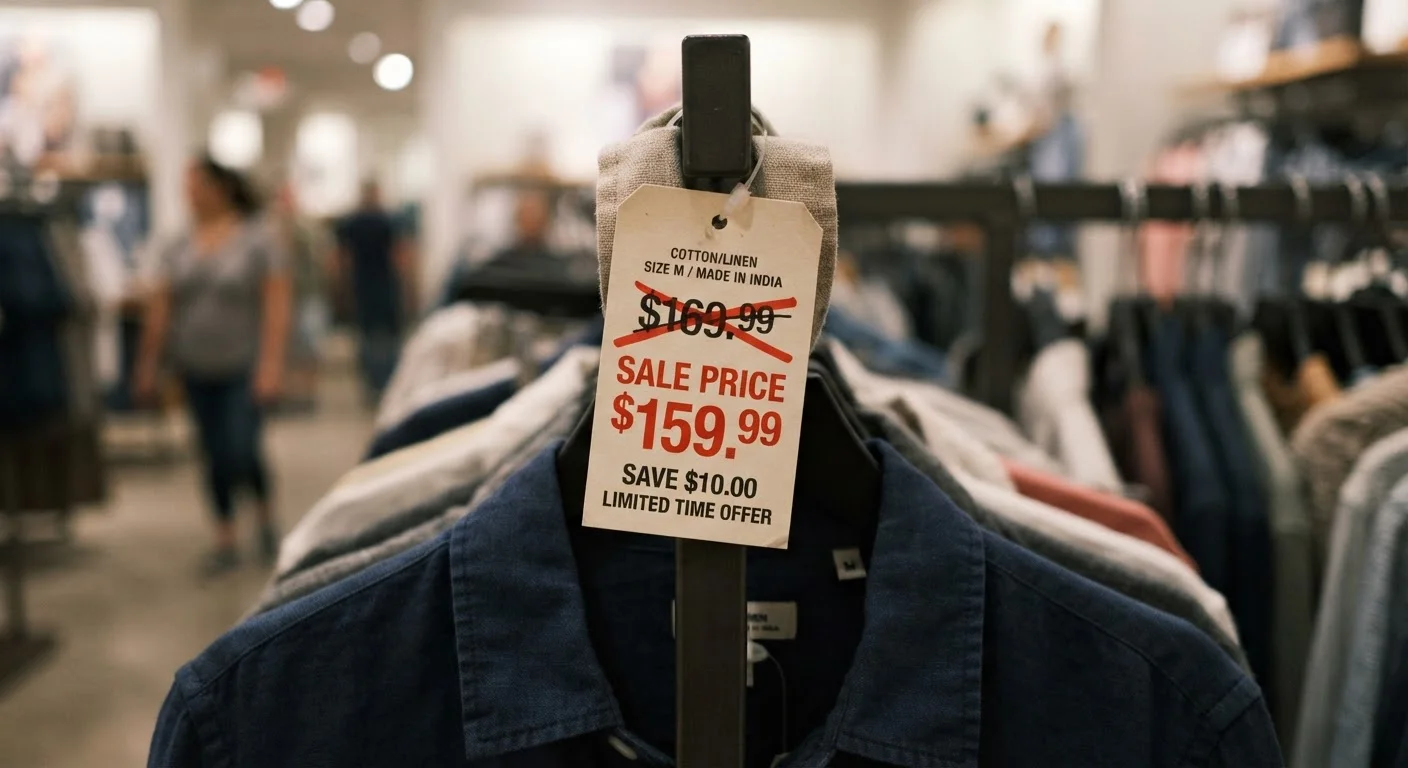
Photo: SaverSteals.com | Explore More. Shop Smarter. editorial
—— In This Article
Key Takeaways
- Retailers frequently set artificially high 'original' prices so markdowns appear more impressive than they are.
- Comparing across multiple retailers and tracking historical prices reveals whether a discount is genuine.
- Legal standards around reference pricing vary by state, leaving shoppers to do their own due diligence.
- Percentage-off figures alone are unreliable - the actual price paid is what determines real value.
How Reference Pricing Works - and Where It Breaks Down
Walk through almost any clothing section and you'll see them: tags showing a price crossed out, replaced by a number that looks like a significant savings. This practice is called reference pricing - presenting a higher 'original' or 'compare at' price alongside the current price to imply a discount. The problem is that the reference price may never have reflected what most shoppers actually paid.
Some garments are introduced at an inflated price for a brief period - sometimes only days, sometimes only in select locations - before being 'marked down' permanently. Others carry a manufacturer's suggested retail price (MSRP) that no retailer ever charged. The Federal Trade Commission has issued guidelines stating that reference prices should reflect prices at which 'substantial' sales were made, but enforcement is inconsistent and definitions remain loose. The result is a landscape where a '40% off' tag can mean almost anything.
For a deeper look at how seasonal cycles and markup structures drive these practices, see our guide to clothing sale anatomy. The same inflated-reference dynamic appears across retail categories - spotting inflated original prices on electronics listings offers a useful parallel.
Myth
If a price is crossed out on the tag, that was the real price the item sold for.
Fact
Crossed-out prices may reflect a brief introductory price, an MSRP no retailer honored, or a comparison to another store's price - not necessarily this store's actual selling history.
Retailers are not universally required to prove that a crossed-out price reflects a genuine prior selling price at that specific store. Regulatory frameworks like the FTC's guidelines set a standard, but enforcement gaps mean consumers encounter reference prices that were never 'real' in any practical sense. Treat the crossed-out number as a data point to question, not a verified baseline.
Myth
A bigger percentage off always means a better deal.
Fact
Percentage discounts are only meaningful relative to an accurate baseline price. When that baseline is inflated, a large percentage off can still result in an above-market final price.
A garment marked '60% off $150' costs you $60. If the same garment retails for $55 at a competing store with no promotional framing, the discount figure is misleading. Always anchor your judgment to the actual dollars leaving your wallet, and cross-reference that figure against comparable items elsewhere.
Myth
'Compare at' and 'original price' mean the same thing.
Fact
'Compare at' typically signals a price comparison to another retailer, while 'original price' implies the store's own prior selling price - these are legally and practically different claims.
The distinction matters because 'compare at' prices can be drawn from any retailer the store chooses, including higher-priced competitors, without representing what this store ever charged. When you see 'compare at,' you're being told about someone else's price - which may or may not be a useful benchmark for your purchase decision.
Myth
Sale events like end-of-season clearances always offer the deepest discounts.
Fact
Clearance pricing can be genuine, but some retailers raise reference prices before sale events precisely so the 'discounted' price still meets their margin targets.
Price-tracking data across major retail events has repeatedly shown that some items are priced higher in the weeks before a major sale, only to be 'discounted' back to or near their previous everyday price during the event itself. If you haven't tracked an item's price in the weeks before a sale, you have no reliable way to know whether the clearance figure represents a true reduction. Common misconceptions about electronics discounts mirror this pattern closely.
Myth
High-quality clothing is always priced high at regular retail, so a discount proves value.
Fact
Price and quality have a weak correlation in clothing retail. A high original price does not confirm quality, and a discount from that price does not confirm savings.
Markup structures in clothing are highly variable. A garment with a $200 reference price may cost a retailer $18 to produce, while a well-made $60 item may have a narrower margin. The original price reflects brand positioning and retail strategy more reliably than it reflects material or construction quality. Evaluating garments on their own merits - construction, fabric content, intended use - is more informative than using price as a proxy for quality.
Practical Ways to Verify Whether a Discount Is Real
Once you understand that reference prices are often set strategically rather than historically, the next step is building habits that cut through the noise.
~40%
Clothing sold at a discount in the US
Industry analysts have estimated that a large share of clothing in the US is sold below the listed regular price, raising questions about what 'regular' actually represents.
90-180 days
Useful price-history window to check
Consumer advocates generally suggest reviewing at least 90 days of price history to assess whether a sale price reflects a genuine reduction from a stable baseline.
- Check multiple retailers simultaneously. If a jacket is listed at '$120, marked down from $200' at one store but retails for $115 elsewhere without any sale framing, the original price figure is doing little meaningful work.
- Use price-history tools. Several browser extensions and third-party sites track historical pricing across major retailers. A glance at a product's price chart over 90 to 180 days often reveals whether the 'original' price was ever the norm or just a brief ceiling.
- Focus on the absolute price, not the percentage. A 50% discount on an item that was inflated 80% above its standard market value still leaves you overpaying. Ask whether the final price is competitive on its own terms.
- Read the fine print on 'compare at' tags. This phrase often signals a comparison to a different retailer's price - not a markdown from the store's own previous price. That's a meaningful distinction.
These principles apply well beyond clothing. The home décor discount guide and tool discount verification guide both examine how to approach similar reference-pricing tactics in other categories.
Reference Prices Are Not a Reliable Anchor
No tag, crossed-out figure, or percentage claim should be taken at face value without independent verification. The final price you pay is the only number that matters - and it should be compared against actual market prices for equivalent items, not against a reference figure set by the seller. Building a habit of cross-checking before purchasing is the most reliable protection against manufactured discounts.

Clothing Editorial Team
Clothing Editorial Team is the collective byline for our editorial team and contributor network. Articles published under this byline or an editorial pen name are researched, written, and reviewed according to our editorial standards for clarity, consistency, and independence before publication.
View author profile