

| Average U.S. Household Electricity Bill | ~$130/month (U.S. Energy Information Administration, 2023) |
| Share of Bill from Phantom Loads | 5-10% (U.S. Department of Energy) |
| Potential Savings from Shifting to Off-Peak Use | 20-50% per kWh (Varies by utility and TOU plan structure) |
| Recommended Attic Insulation Level (Most U.S. Zones) | R-38 to R-60 (U.S. Department of Energy) |
| Heating/Cooling Savings from Proper Insulation | Up to 15% (ENERGY STAR Home Advisor) |
| Minimum SEER Rating (Current Federal Standard) | 14-15 SEER (U.S. DOE regional requirements, 2023) |
| Annual Phantom Load Cost (Average Home) | $78-$156/year (Based on DOE estimates and average billing data) |
Why Energy Jargon Is Worth Decoding
Your electricity bill is basically a monthly report card - and most of us are reading it without understanding the language. Terms like phantom load, peak hours, and demand charges aren't just utility-company filler. Each one represents a real mechanism that moves money out of your wallet. Once you understand what they actually mean, you can start making choices that chip away at your bill without turning your home into a cave.
This guide breaks down the most impactful energy terms in plain English, explains how each one affects your monthly cost, and gives you something actionable to do about each one. Think of it as the glossary your electric company never handed you - but absolutely should have.
If you've ever wondered why your bill stays stubbornly high even when you feel like you're being careful, this is the place to start. (We also have a deeper dive on that exact mystery: why your electricity bill stays high even when you try to cut back.)
| Average U.S. Household Electricity Bill | ~$130/month (U.S. Energy Information Administration, 2023) |
| Share of Bill from Phantom Loads | 5-10% (U.S. Department of Energy) |
| Potential Savings from Shifting to Off-Peak Use | 20-50% per kWh (Varies by utility and TOU plan structure) |
| Recommended Attic Insulation Level (Most U.S. Zones) | R-38 to R-60 (U.S. Department of Energy) |
| Heating/Cooling Savings from Proper Insulation | Up to 15% (ENERGY STAR Home Advisor) |
| Minimum SEER Rating (Current Federal Standard) | 14-15 SEER (U.S. DOE regional requirements, 2023) |
| Annual Phantom Load Cost (Average Home) | $78-$156/year (Based on DOE estimates and average billing data) |
Phantom Load: The Bill You Pay for Nothing
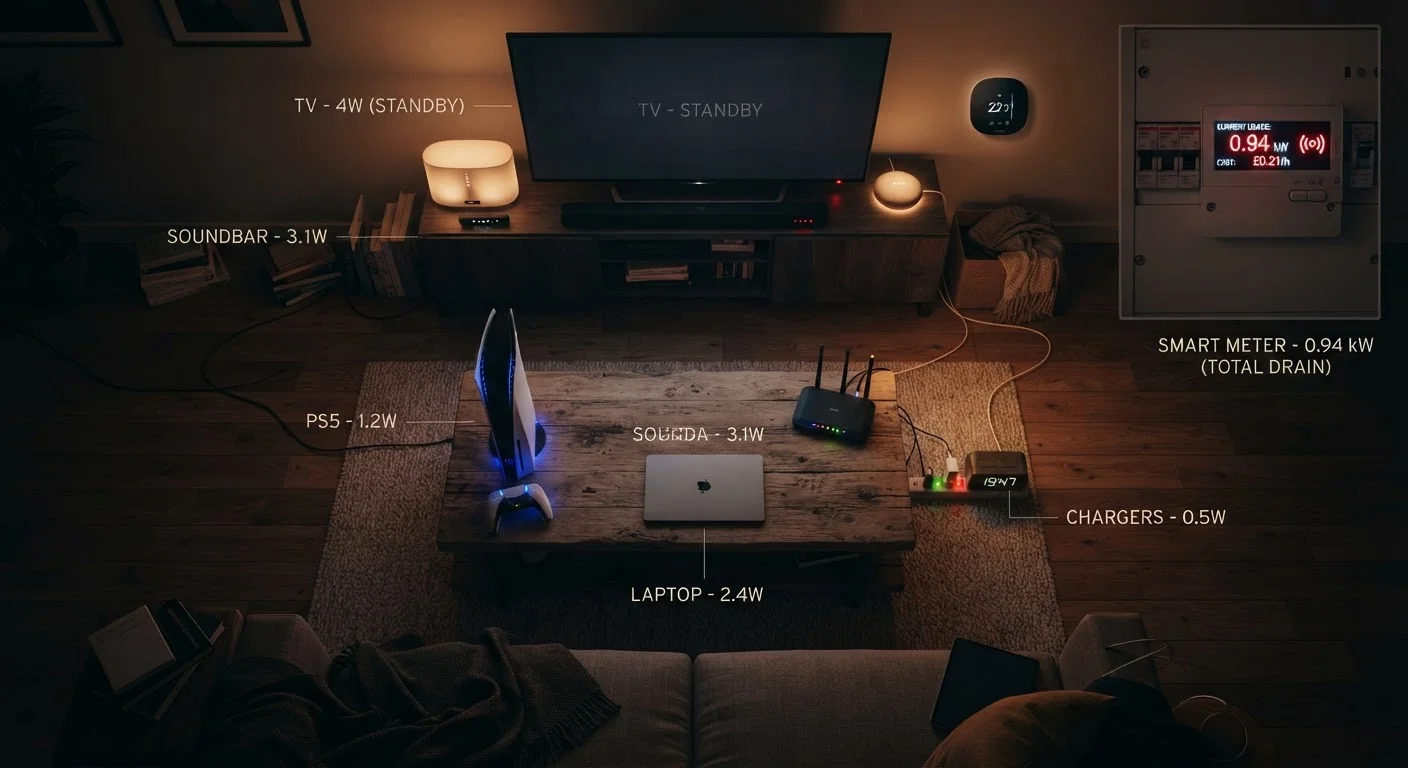
Let's start with the term that shocks people the most - and not in a good way. Phantom load (also called standby power or vampire energy) is the electricity your devices consume when they're plugged in but not actively being used. That TV on standby. The phone charger with no phone attached. The game console in sleep mode. All of them are quietly sipping electricity around the clock.
Here's why it adds up fast: the U.S. Department of Energy estimates that phantom loads account for 5-10% of residential electricity use. For the average American household paying around $130/month on electricity, that's $6.50 to $13 every single month - roughly $78 to $156 per year - for power you never consciously used.
5-10%
Of home electricity used by phantom loads
According to the U.S. Department of Energy, standby power from idle devices represents a significant and largely avoidable share of residential electricity consumption.
$156/year
Maximum annual phantom load cost for average household
Based on DOE standby power estimates applied to the average U.S. residential electricity bill of approximately $130/month.
50%
More efficient than non-certified models (Energy Star products)
The EPA's Energy Star program certifies products that use up to 50% less energy than standard alternatives, depending on the product category.
15%+
Potential HVAC savings from adequate attic insulation
ENERGY STAR estimates that properly insulating and air-sealing a home can reduce heating and cooling costs by 15% or more annually.
20-50%
Higher cost per kWh during peak vs. off-peak hours
Under time-of-use pricing plans offered by many U.S. utilities, electricity rates during peak demand windows can be significantly higher than off-peak rates.
The biggest phantom load offenders in most homes are:
- Entertainment systems - TVs, streaming boxes, soundbars, and gaming consoles
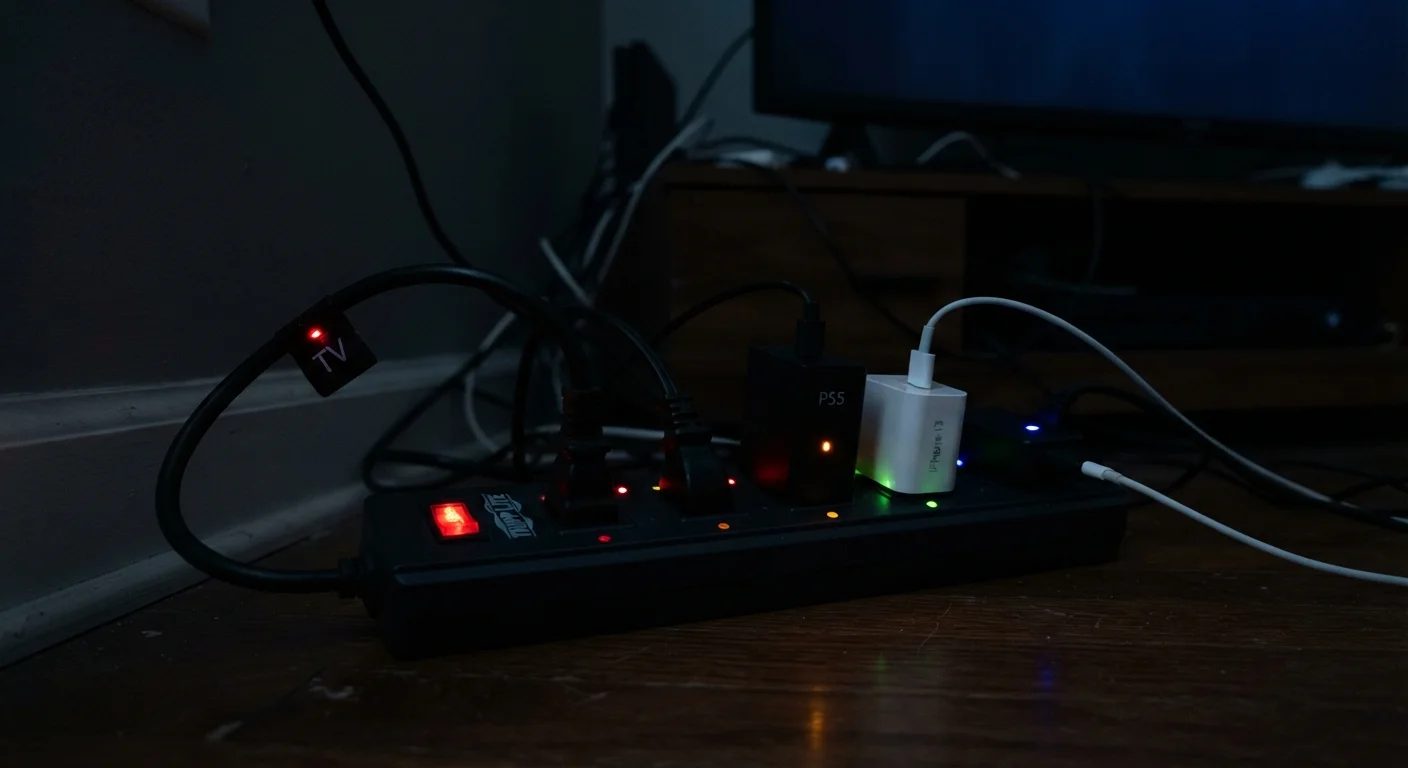
- Chargers and power adapters - even when nothing is plugged into them
- Microwaves and coffee makers - those digital clocks run 24/7
- Older desktop computers and monitors in sleep mode
- Cable or satellite boxes - notorious for almost never truly powering down
Your move: Smart power strips are the easiest fix. They cut power to peripheral devices the moment your primary device (like a TV) turns off. Plug-in outlet timers work well for chargers you only need running at certain hours. For anything you rarely use, just unplug it entirely - it costs literally nothing to do.
Smart Strips vs. Standard Power Strips
Standard power strips cut power when you manually flip a switch - which most people never do. Smart power strips automatically detect when a primary device (like your TV) powers off and cut electricity to peripheral outlets accordingly. They typically cost $20-$35 and can pay for themselves within a few months. Look for ones with a few always-on outlets for devices like DVRs that need continuous power.
Not All Utilities Offer TOU - Here's How to Check
Time-of-use pricing is more common in California, Arizona, Texas, New York, and Illinois, but it's expanding nationwide. The simplest way to find out: log into your utility's online portal and look for 'rate plans' or 'billing options.' If TOU is available, your utility may even offer a bill comparison tool that shows what you would have paid under a TOU plan based on your past usage. It takes about five minutes and could reveal significant savings potential.
Federal and State Rebates Can Offset Upgrade Costs
The Inflation Reduction Act (2022) extended and expanded federal tax credits for energy-efficient home improvements, including insulation, efficient HVAC systems, and heat pumps. Many state and local utilities also offer additional rebates. The DSIRE database (dsireusa.org) is the most comprehensive free resource to find incentives available at your specific address - it's worth checking before any home efficiency investment.
Peak Hours and Time-of-Use Rates: When You Use Power Matters as Much as How Much
Not all kilowatt-hours cost the same. Many utility companies use time-of-use (TOU) pricing, which means electricity costs more during peak hours - typically late afternoon through early evening on weekdays - when demand on the grid is highest. Off-peak hours (nights, weekends, early mornings) are significantly cheaper.
If your utility uses TOU rates and you're running your dishwasher, laundry, and oven during peak hours every evening, you could be paying 20-50% more per kilowatt-hour than you would running those same appliances a few hours later. That's not a small difference.
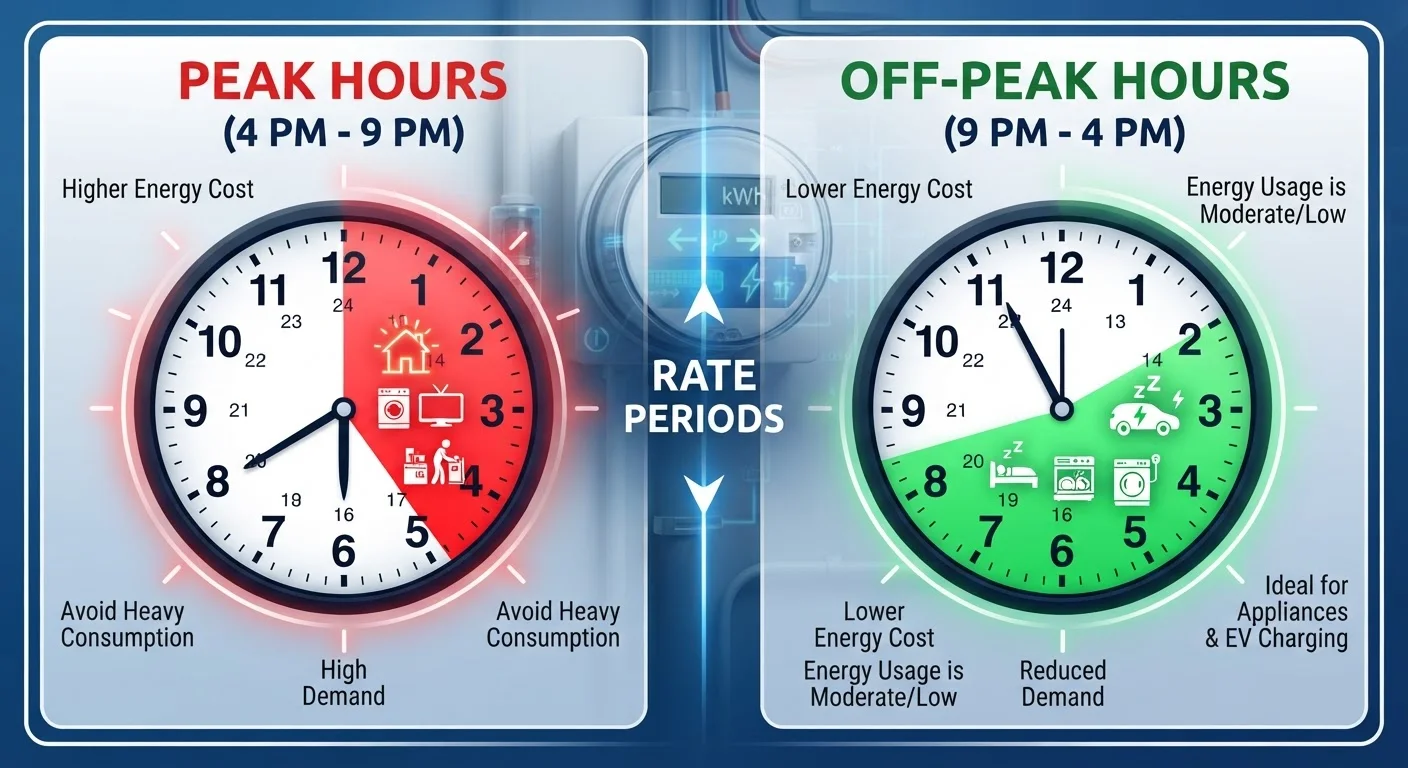
How to find out if TOU applies to you: Log into your utility account or call your provider and ask directly. Many utilities now offer TOU as an opt-in option even if it's not your default plan - and for households with flexibility, switching can produce meaningful savings.
Your move: Shift your big energy tasks - laundry, dishwashing, EV charging, oven cooking - to after 9 p.m. or before noon on weekdays. Most modern appliances have delay-start settings built in. Set them once and let the savings run on autopilot.
This same kind of timing logic applies to other household costs too. If you enjoy finding the right timing for better value, check out our hub on off-season deals - it's all about knowing when to buy for the best price.
Phantom Load
The electricity consumed by devices that are plugged in but not actively in use. Also called standby power or vampire energy, it can account for 5-10% of a home's total electricity use.
Peak Hours
The time windows - usually late afternoon to early evening on weekdays - when electricity demand on the grid is highest. Many utilities charge higher rates during these periods under time-of-use pricing.
Time-of-Use (TOU) Pricing
A billing structure where the cost per kilowatt-hour varies by time of day and sometimes day of week, with cheaper rates during off-peak periods and higher rates during peak demand windows.
Kilowatt-Hour (kWh)
The standard unit of electrical energy used in residential billing. It represents 1,000 watts of power consumed over one hour - for example, a 1,000-watt microwave running for 60 minutes.
Demand Charge
A billing fee based on the highest rate of electricity use (measured in kilowatts) during any short interval in a billing period, rather than total consumption. Running multiple high-draw appliances simultaneously can trigger this charge.
Energy Star
A U.S. EPA and DOE certification indicating that an appliance or product meets specific energy-efficiency standards. Certified products typically use 10-50% less energy than non-certified equivalents.
R-Value
A measurement of a material's resistance to heat flow. Higher R-values mean better insulation performance. The DOE recommends attic R-values of R-38 to R-60 for most U.S. climate zones.
SEER Rating
Seasonal Energy Efficiency Ratio - a metric for air conditioner and heat pump efficiency measuring cooling output divided by energy input over a typical cooling season. Higher SEER equals lower operating costs.
EnergyGuide Label
The yellow tag required on most major appliances that estimates annual energy consumption and operating cost, allowing consumers to compare the long-term expense of different models.
Power Factor
A measure of how efficiently a device converts electrical current into useful work. Devices with poor power factors draw more current than needed, contributing to inefficiency and higher energy use over time.
Kilowatt-Hours, Demand Charges, and the Metrics on Your Bill
Your bill is denominated in kilowatt-hours (kWh) - the standard unit for measuring electrical energy consumption. One kWh equals 1,000 watts used for one hour. A 100-watt light bulb burning for 10 hours uses 1 kWh. Easy enough. The confusion usually comes when people mix up watts (a rate of power use) with watt-hours (actual energy consumed over time).
Some utility customers - particularly those in areas with smart meters - also see demand charges on their bills. This is a fee based not on total consumption, but on your peak rate of use during any short window in the billing period. In other words, if you run your dryer, air conditioner, electric oven, and hot water heater all at once for even 15 minutes, that spike can trigger a higher demand charge for the whole month.
Demand charges are more common for businesses but are increasingly appearing on residential bills in some states. If you see a line item that isn't your flat kWh rate, call your utility and ask exactly what you're being charged for.
Your move: Stagger your high-draw appliances. Don't run the dryer while the oven is on. Let your dishwasher finish before you run the washing machine. These small sequencing habits can meaningfully reduce your peak demand footprint - and potentially your bill.
Power factor is a related term worth knowing: it describes how efficiently your devices convert electrical power into useful work. Most residential customers aren't billed for power factor directly, but inefficient older appliances with poor power factors draw more current from the grid than they technically need, which contributes to higher consumption over time.
Energy Star Ratings, Insulation R-Values, and the Long Game
Not every energy term shows up on your bill - some appear on the appliances and materials you buy, and they determine how much you'll spend for years to come.
Energy Star is a certification program backed by the EPA and Department of Energy. Products bearing the label meet strict efficiency standards - typically using 10-50% less energy than non-certified alternatives. When replacing any major appliance, an Energy Star rating is one of the most reliable signals that the product won't be quietly expensive to run.
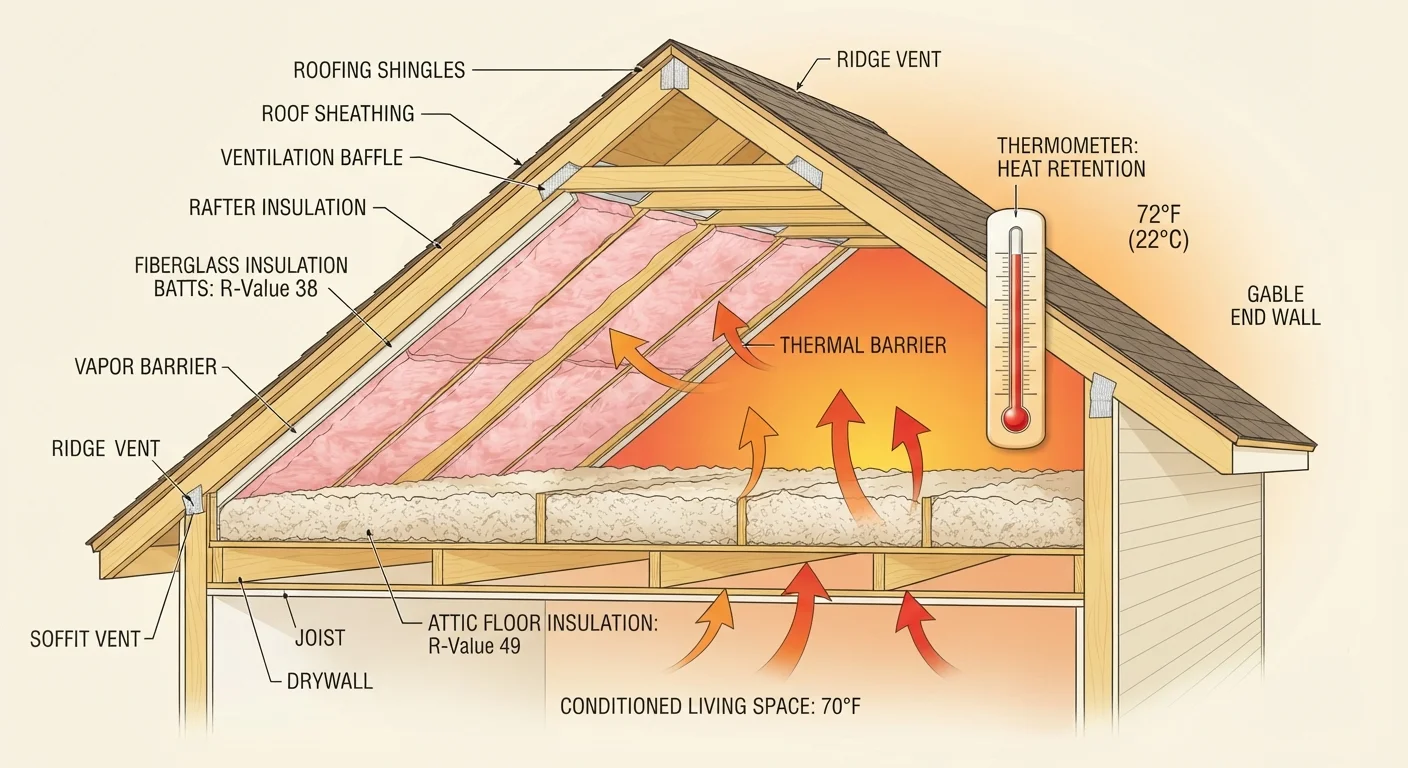
R-value is the insulation metric you'll encounter during any home improvement project involving walls, attics, or crawl spaces. It measures thermal resistance - how well a material slows heat transfer. Higher R-values mean better insulation. The Department of Energy recommends attic insulation of R-38 to R-60 for most U.S. climate zones. Underinsulated attics are one of the biggest sources of heating and cooling loss in American homes, and adding insulation typically has one of the shortest payback periods of any home upgrade.
SEER rating (Seasonal Energy Efficiency Ratio) applies to air conditioners and heat pumps. The higher the SEER, the more efficiently the unit cools per unit of energy consumed. Current federal minimums are 14-15 SEER depending on region; high-efficiency units can reach SEER 20-25. If your AC is 10+ years old and has a low SEER rating, it may be worth replacing - especially as summer temperatures intensify.
Your move: Before any appliance purchase, look up the EnergyGuide label - the yellow tag that estimates annual operating costs. Compare two models not by sticker price alone, but by total cost of ownership over five years. A $50 premium upfront for an efficient model often saves $200+ over its lifetime.
Curious about where other household utility costs quietly leak? Our piece on where most households quietly waste water and money covers the same hidden-cost logic applied to your water bill.
Putting It All Together: A Practical Action Plan
Understanding energy terms is only useful if it changes what you actually do. Here's how to translate this glossary into a real action plan you can start this week - no major investment required.
- Audit your phantom loads this weekend. Walk through every room and unplug anything that's charging nothing or sitting idle. Pick up a couple of smart power strips (under $20 each) for your entertainment center and home office.
- Check your utility's rate structure today. Log in or call. Find out if you're on a flat rate or TOU plan. If TOU is available and your schedule allows flexibility, consider switching - and set delay-start on your dishwasher tonight.
- Sequence your high-draw appliances. Make a mental rule: one major appliance at a time during evenings. Dryer first, then dishwasher. It costs nothing and takes two seconds of planning.
- Check your attic insulation level before next heating or cooling season. If you can see the floor joists, you almost certainly need more insulation. Many utilities offer rebates on insulation upgrades - check the Database of State Incentives for Renewables and Efficiency (DSIRE) at dsireusa.org.
- Use the EnergyGuide label on your next appliance purchase. Compare five-year operating costs, not just the price tag.
These aren't dramatic changes - but they compound. Eliminating phantom load saves $100+ per year. Shifting to off-peak laundry might save another $50-80. Better insulation can cut heating and cooling bills by 15% or more. Add it all up and you're looking at several hundred dollars annually from decisions that take minutes to implement.
And if you want to go even deeper on what's driving your bill up, our full guide on stubborn electricity bills walks through the hidden habits and overlooked appliances that most households miss. For a broader look at all your utility costs together, our Water Bill Hacks hub covers the water side of the equation with the same practical focus.
DSIRE: Database of State Incentives for Renewables & Efficiency
The most comprehensive database of federal, state, and utility-level incentives for energy efficiency upgrades. Search by your zip code to find rebates and tax credits applicable to your specific home improvements.
U.S. DOE Home Energy Saver
A free online tool from the Department of Energy that estimates your home's energy use by category and identifies your highest-impact opportunities for savings based on your location and home details.
Energy Star Product Finder
The EPA's official tool for finding Energy Star certified appliances, electronics, and building products. Useful when comparing models before any major appliance purchase to verify efficiency certifications.
Kill A Watt Electricity Usage Monitor
A $20-$30 plug-in meter that shows exactly how many watts any device draws - even on standby. It's the fastest way to identify your home's worst phantom load offenders before deciding which to prioritize.
EnergyGuide Label Explainer (FTC)
The Federal Trade Commission's official explainer on how to read and compare EnergyGuide labels - the yellow tags on appliances that estimate annual operating costs and help you calculate true long-term value.