
Why Cheap Home Décor Often Costs More in the Long Run
Low price tags on décor can be deceiving. Explore the durability, safety, and replacement-cost factors that determine true value.
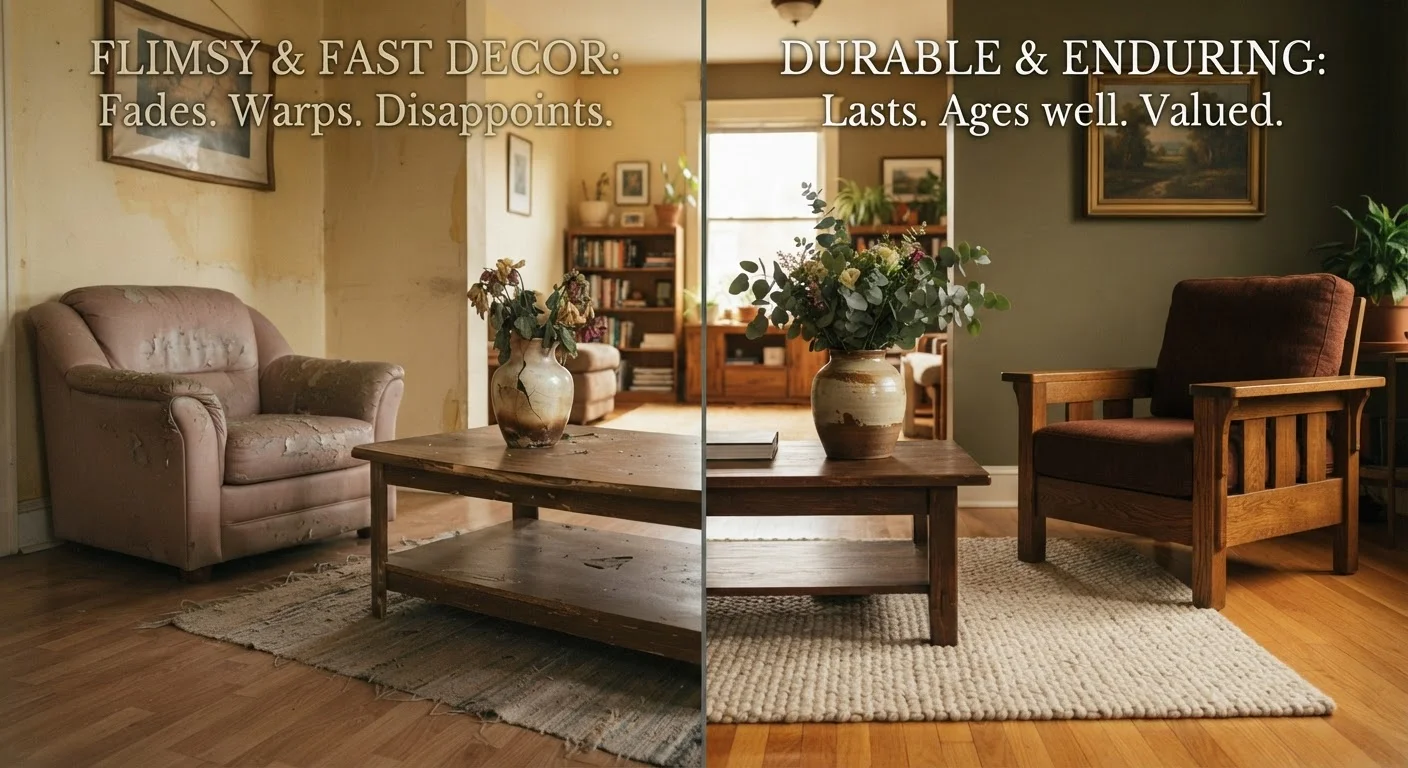
Photo: SaverSteals.com | Explore More. Shop Smarter. editorial
—— In This Article
Key Takeaways
- Cheaply made décor often requires replacement within one to two years, erasing initial savings.
- Material quality, construction methods, and finish durability are reliable predictors of longevity.
- Safety risks from low-quality finishes and unstable structures carry hidden financial and personal costs.
- Trend-driven pieces depreciate in satisfaction value faster than classic, neutral designs.
- Calculating cost-per-year of use reveals the true value of a décor purchase.
The True Price of a Décor Purchase
A $12 wall sconce or a $25 decorative vase feels like a responsible choice when budgets are tight. The problem is that the sticker price captures only one moment in a longer story. Home décor purchases have a lifespan, and when that lifespan is short, the money spent per year of actual use can easily surpass what a more durable item would have cost.
This pattern mirrors a broader principle that applies across product categories. As explored in our piece on the hidden cost of cheap used tools, the initial price and the real cost of ownership are rarely the same number. Home décor is no different — and in some cases, the gap is wider because replacement cycles are harder to notice when they happen gradually.
3–5×
Replacement frequency vs. durable alternatives
Consumer research broadly suggests that low-quality household goods may need replacing three to five times more often than mid-range or well-constructed counterparts over a decade.
~30%
Shoppers who report regretting cheap décor purchases
Surveys of home décor shoppers indicate roughly a third regret prioritizing price alone, citing poor durability or aesthetic dissatisfaction within the first year.
Common Mistakes That Turn Savings into Spending
Most overspending on home décor doesn't happen because shoppers are careless — it happens because the mistakes are subtle and easy to rationalize. The following patterns come up repeatedly, and understanding why they happen is the first step toward avoiding them.
Judging value by sticker price alone without estimating cost-per-year of use.
Why it happens: A low number at checkout feels like an immediate win, and it's easy to overlook how quickly a poorly made item deteriorates.
Ignoring material composition and construction details on product listings.
Why it happens: Shoppers often focus on appearance in product photos, which rarely reveal whether a piece is solid wood, engineered particleboard, or hollow-fill resin.
Buying trend-driven décor pieces expecting them to provide lasting satisfaction.
Why it happens: Trend pieces are heavily marketed and visually arresting at point of purchase, making them feel like essential updates rather than short-lived novelties.
Overlooking assembly and installation quality as part of total cost.
Why it happens: Flat-pack furniture and décor accessories appear affordable until hardware fails, shelves bow, or adhesive joints separate — costs that appear after purchase.
Treating every cheap item as equivalent regardless of category.
Why it happens: It's tempting to apply a blanket "cheap is fine" or "cheap is risky" rule rather than thinking category by category.
Safety Risks Are a Real Hidden Cost
Some very low-cost décor items — particularly candles, lighting fixtures, and painted accessories — may use finishes or materials that do not meet U.S. safety standards. Beyond financial replacement costs, these items can pose fire or toxicity hazards. Always check for recognized safety certifications on items like candles, lamps, and children's room accessories before purchasing.
Smarter Approaches to Stretching Your Décor Budget
Avoiding these mistakes doesn't mean spending more upfront across the board. It means being selective about where durability matters and where it doesn't.
For furniture, the stakes are higher and the value of quality construction is clearest. Whether you're browsing furniture savings events or considering secondhand options through used furniture sources, applying a cost-per-year lens helps filter out items that look affordable but aren't.
For soft furnishings and purely decorative accessories, consider whether a DIY approach makes sense for your time and skill level. The trade-offs there are real and worth examining — our DIY vs. buying guide covers this honestly, including cases where making your own décor costs more than buying it.
Discount Labels Don't Always Signal Real Value
A heavily discounted price tag may reflect a genuine markdown — or it may simply reflect a low-quality product priced to appear like a deal. Before assuming you're saving money, evaluate the item's construction, materials, and expected lifespan. Our article on spotting genuine discounts explains how reference pricing can mislead shoppers.
The core discipline is simple: before any décor purchase, ask what the item is made of, how long it is likely to last, and whether the cost-per-year of ownership actually represents savings or just defers spending to a later date.

Home & Garden Editorial Team
Home & Garden Editorial Team is the collective byline for our editorial team and contributor network. Articles published under this byline or an editorial pen name are researched, written, and reviewed according to our editorial standards for clarity, consistency, and independence before publication.
View author profile